

Betta fish ich is a parasite infection that causes tiny white spots, like grains of salt, on the body or fins. But not every white spot is ich. Look for several spots at once, rubbing on objects, clamped fins, and low energy. If you suspect ich, record the symptoms, test the water, and ask an aquatic vet or experienced fish professional to confirm it. Then use a treatment made for your setup and follow the label exactly.
This guide is for beginners. It explains what ich looks like, how it spreads, and what to do next. It also shows how to tell ich from other look-alike problems. Fishella can’t diagnose your fish, so use this as a starting point, not a final answer.
What Is Ich in Betta Fish?
Ich is also called white spot disease. A tiny freshwater parasite named Ichthyophthirius multifiliis causes it. It is a single-celled organism that needs a living fish to survive. UF/IFAS Extension says all freshwater fish are considered susceptible.
The parasite has three main stages. The feeding stage burrows into the skin, fins, and gills. When mature, it drops off and forms a sticky cyst on tank surfaces. Inside the cyst it divides into many young parasites, which swim out to find a new fish.
One parasite can multiply into hundreds in a single generation. That is why early action matters. Mortality can be rapid, especially when the gills are heavily affected.
What Does Ich Look Like on a Betta Fish?
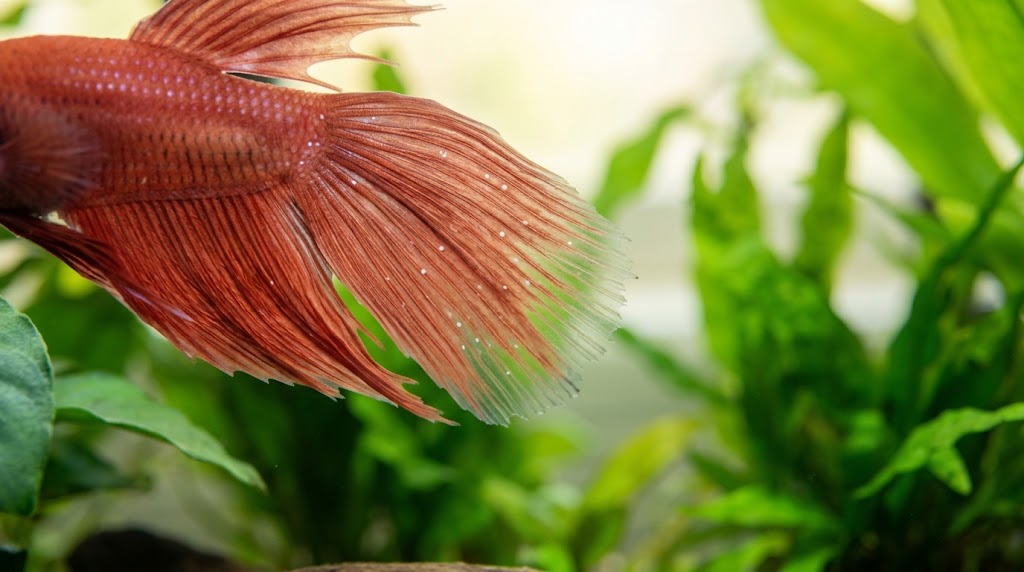
The classic sign is small white dots on the skin or fins. UF/IFAS describes them as looking like dots, tiny blisters, or salt grains. On a betta they may show up on the body, tail, or other fins.
Other signs can include:
- Scratching or rubbing: Your betta may rub against plants, decor, or gravel. Fish keepers call this flashing.
- Clamped fins: The fins stay folded close to the body. See our guide to betta fish clamped fins.
- Low activity: Your betta hides, rests more, or acts weak.
- Poor appetite: It ignores food it normally eats.
- Fast or labored breathing: This is more likely in serious cases. Our betta breathing heavily guide covers other causes.
Symptoms vary. No single sign confirms ich. White spots can be hard to see on pale or white bettas. If the parasites sit only on the gills, you may see no spots at all.
By the time spots are easy to see, the fish can already be very sick. Watch for earlier hints like rubbing, extra mucus, or a weak appetite.
What Causes Ich in Betta Fish?
Ich does not appear out of nowhere. The parasite has to be introduced to your tank. Common routes include a new fish, live plants, decorations, substrate, nets, and other gear moved from a tank that had fish.
An infected fish can look healthy at first. Some fish carry the parasite without showing signs. UF/IFAS notes that shipping and handling stress can trigger visible disease, often one to three weeks after arrival in warm water.
Stress and poor conditions do not create the parasite. But they can make an outbreak more likely or more severe. UF/IFAS lists crowding, fast temperature changes, and weaker immune function as factors.
That is why stable care matters. Our betta fish care guide covers the basics. Our betta fish water temperature guide explains how to keep the heat steady.
Betta Fish Ich vs. Other White Spot Problems
Several problems can look like ich at a glance. Some look alike even to experienced keepers. The table below gives general clues only.
| Possible cause | What it may look like | General clues |
|---|---|---|
| Ich | Many tiny, evenly sized white dots on the body or fins | Often comes with rubbing, clamped fins, or low energy. New spots may keep appearing. |
| Fungal growth (water mold) | Gray-white, cotton-like patches | Often starts on injured tissue. Fuzzy, not dot-like. Merck notes cold water can raise the risk. |
| Epistylis or similar ciliates | Whitish fuzz or tufts on the skin or fins | Linked to organic-rich, dirty water. Merck says they mainly affect pond fish, so confirmation matters. |
| Velvet | Very fine gold or rust-colored dust | Spots are finer and tinted. A light may help you see the color. |
| Minor injury or skin change | One patch, a scar, or a faded area | Does not multiply. May match an injury or a normal color pattern. |
See our guide on pearl betta blue spots if your spots are blue or pearly rather than white.
A photo or short description cannot confirm a diagnosis. UF/IFAS says white spots should never be the only basis for diagnosis. Vets confirm ich by looking at a skin or fin sample under a microscope, as the Merck Veterinary Manual explains. If you are unsure, get help before you medicate.
How to Treat Ich in Betta Fish Safely
Use this step-by-step plan. It avoids guessing at doses, because the right product depends on your fish and your tank.

1. Observe and record. Note where the spots are, how many you see, and any behavior changes. Take clear photos each day. This helps you and any vet track change.
2. Test the water. Check ammonia, nitrite, nitrate, and temperature. Ammonia and nitrite should read zero. Poor water can cause many of the same signs.

3. Confirm the diagnosis or get advice. An aquatic vet can check a sample. If that isn’t possible, ask an experienced fish professional. Don’t guess if the signs are unclear.
4. Choose a suitable treatment. Pick a product labeled for ich in freshwater tropical fish. Make sure it is safe for bettas and for any snails, shrimp, or live plants in the tank. Some active ingredients, such as copper, can be very toxic if misused.
5. Follow the label exactly. Use the stated dose, treatment length, and water-change steps. Don’t mix products unless the label or a vet says it is safe. Keep the water surface open so your betta can breathe air.
6. Monitor closely. Watch breathing, appetite, swimming, and water quality every day. Remove any dead fish right away. Stop treatment and call a vet if your betta gets worse.
7. Finish the full course. Don’t stop because the spots vanish.
Why finish the course? Only the free-swimming young parasites are easy to reach with treatment. The grown parasite under the skin and the cyst in the tank are protected. According to UF/IFAS, a single dose isn’t enough for this reason. Treatment has to be repeated or maintained so new parasites die as they hatch.
UF/IFAS also notes that vacuuming debris helps. Cysts stick to organic material, so removing it can lower the number of parasites in the tank. Match the replacement water to the tank temperature and treat it. Our tap water guide for bettas explains how.
Treatment results vary. Fish that are weak or heavily infected may not survive, even with good care. No product or timeline can promise a cure.
Is It Safe to Raise the Temperature to Treat Ich?
Temperature affects the parasite’s life cycle. UF/IFAS says the cycle can finish in about three to six days at 75–79°F. It slows down in cooler water. That is why treatment timing depends on temperature.
But raising the heat is not automatically safe, and it is not a cure on its own. Warmer water holds less oxygen. A sudden jump can stress an already sick fish. Medication labels may also set limits.
Bettas are tropical fish and normally live in warm water. If your tank is cold, correct it gradually into the normal betta range. Don’t push it high or change it fast. Beyond that, raise the heat only if your vet or the product label says it is safe for your setup.
Can Ich Spread to Other Fish?
Yes. Ich is highly contagious in freshwater tanks. It spreads by direct contact with infected fish. It can also travel on nets, siphon hoses, decorations, and plants. UF/IFAS also warns that water mist or spray can carry it.
If other fish share the tank, treat the whole system, not just the fish with spots. Fish that survive may still carry the parasite. Taking these steps can help:
- Use a net and tools only for the affected tank.
- Don’t pour debris or tank water down a path that reaches other tanks.
- Wash your hands and arms between tanks.
- Watch nearby tanks closely.
Don’t assume you must move the betta. Moving a sick fish adds stress. It also leaves cysts behind in the original tank. If your betta lives alone, treating its own tank is often simpler. If the medicine isn’t safe for tank mates, ask a vet whether to separate fish, and use separate equipment.
How to Prevent Ich in Betta Fish

Prevention is easier than treatment. These habits lower the risk:
- Quarantine new fish. UF/IFAS recommends a minimum 30-day quarantine for new fish. Use a separate tank with its own gear.
- Watch new fish before you buy or add them. Avoid fish from tanks with sick or spotted fish. Check them again during quarantine.
- Avoid sudden changes. Keep water temperature and chemistry steady. Our betta fish water temperature guide can help.
- Keep water quality good. Test regularly and do partial water changes. See the betta fish care guide.
- Use dedicated, clean equipment. Don’t share nets or hoses between tanks. Clean decorations before using them.
- Treat new plants with care. Plants from a tank with fish can carry cysts. UF/IFAS suggests holding plants without fish for the length of the parasite’s life cycle.
- Give your betta enough space. Crowding makes outbreaks worse. Our betta tank size guide covers what to choose.
When Should You Seek Veterinary Help?

Get help promptly if you see any of these:
- Severe breathing trouble or constant gasping
- Collapse, or being unable to swim normally
- Rapid decline over hours or a day or two
- Spots spreading fast, or signs in several fish
- No improvement after treatment
See our posts on a betta fish laying on its side and a betta staying at the top of the tank for related warning signs. An aquatic vet can confirm the cause and guide treatment. You can also browse our fish diseases section. Learn how to set up a hospital tank for sick fish to safely isolate sick fish and help prevent illness from spreading to healthy tank mates.
Frequently Asked Questions
Can betta fish recover from ich?
Many fish can recover when ich is caught early and treated correctly. But no one can promise a cure. Without treatment, ich can be deadly, and weak or heavily infected fish may not survive.
How long does ich treatment take?
There is no fixed number of days. Length depends on the product, water temperature, and the parasite’s life cycle. Follow the label for the full recommended period, even after the spots disappear.
Are all white spots on betta fish ich?
No. Fungus, other parasites, injuries, and normal color patterns can all look like spots. Ich usually shows as many tiny, similar dots. A vet can confirm the cause with a microscope.
Can ich spread to other fish?
Yes. It spreads through direct contact and through shared nets, plants, decor, and water. Treat the whole tank system. Don’t share gear between tanks.
Should I change the water during ich treatment?
It depends on the product. Some labels call for water changes, and some tell you when to redose. Vacuuming debris can help remove cysts. Always use treated water at the right temperature, and avoid changing all of it at once.
Can aquarium salt treat ich in betta fish?
Veterinary references describe higher salinity as an option for some freshwater fish. But tolerance varies by species. Live plants, snails, and shrimp may not tolerate salt. Don’t guess at amounts. Ask a vet or follow a product made for your setup.
Can ich return after treatment?
Yes. Survivors can carry the parasite, and it can come back with new fish, plants, or gear. Quarantine, stable care, and good tank hygiene lower the risk.
Should I remove my betta fish from the aquarium?
Not automatically. Moving adds stress, and the cysts stay in the original tank. If your betta lives alone, treating its tank is often simpler. If tank mates can’t handle the medicine, ask a vet about separating them.
Conclusion
Betta fish ich shows up as many tiny white spots, often with rubbing, clamped fins, and low energy. But white spots alone can’t confirm it. Fungus, velvet, and injuries can look similar, so confirm the cause when you can.
If it is ich, act early, follow the product label, and finish the full course. Keep the tank clean, avoid sudden changes, and quarantine new arrivals. For more help, explore Fishella’s other betta guides, starting with the betta fish care guide.
This article is for general education and isn’t a substitute for advice from an aquatic veterinarian.

Pingback: Betta Fish Staying at Top of Tank: 7 Causes and Fixes (2026)