Affiliate disclosure: This article contains affiliate links. Fishella may earn a commission when you buy through them, at no extra cost to you.
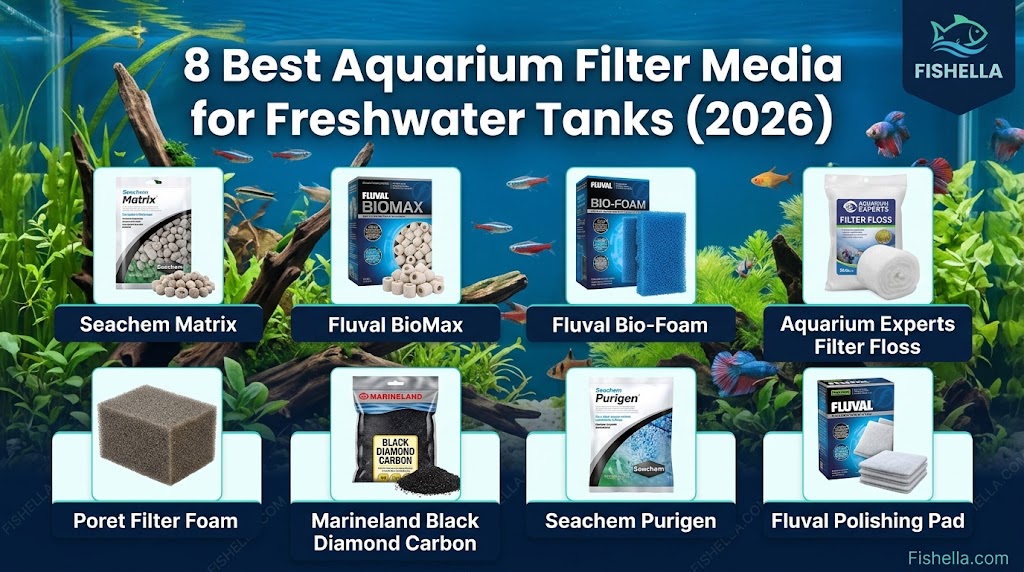
The best aquarium filter media depends on the job you need done. For biological filtration, Seachem Matrix and Fluval BioMax give beneficial bacteria room to grow. For debris, foam and filter floss do the work. For dissolved impurities, activated carbon and Seachem Purigen can help. Most freshwater tanks need mechanical and biological media; chemical media is optional.You don’t need all eight products. Your filter design, tank size, and stocking level should decide what you buy. Below, we explain what each option does, where it fits, and what to check before ordering.
How We Chose These Filter Media
We selected filter media that cover all three filtration types: biological, mechanical, and chemical. Our selection includes options for different aquarium filter designs and common freshwater tank needs.
We considered each product’s filtration purpose, reusability, maintenance requirements, manufacturer guidance, and potential long-term value. We also included different media materials so beginners can compare their options.
This guide is based on product research and manufacturer information. We do not claim personal testing or hands-on experience with every product.
Quick Comparison: Best Aquarium Filter Media
| Product | Type | Reusable? | Replace or maintain | Best for |
|---|---|---|---|---|
| Seachem Matrix | Biological | Yes | Rinse gently when clogged | Overall biofiltration |
| Fluval BioMax | Biological | Yes | Rinse gently when clogged | Ceramic biofiltration |
| Fluval Bio-Foam | Mechanical and biological | Yes | Rinse; replace when breaking down | Reusable filtration |
| Aquatic Experts Filter Floss | Mechanical | No | Replace when clogged | Fine particle removal |
| Poret Filter Foam | Mechanical and biological | Yes | Rinse; replace when breaking down | Large debris, pre-filtration |
| Marineland Black Diamond Carbon | Chemical | No | Replace when exhausted | Odor and discoloration |
| Seachem Purigen | Chemical | Yes (regenerable) | Regenerate per instructions | Dissolved organic waste |
| Fluval Polishing Pad | Mechanical | Limited | Replace when clogged | Fine suspended particles |
Suitability depends on your filter’s media chamber, water flow, and the manufacturer’s instructions. Check compatibility before buying.
8 Best Aquarium Filter Media: Our Top Picks
1. Seachem Matrix: Best Overall Biological Filter Media
- Media type: Biological
- Best for: Freshwater aquariums that need extra biological filtration.
- Product: Seachem Matrix
Seachem describes Matrix as supporting both aerobic and anaerobic bacteria thanks to its internal and external pores. [Confirm this wording on the current product page before publishing.] Seachem also states that it does not break down during normal use.
Pros:
- Porous surfaces for beneficial bacteria
- Suits many wet and wet-dry filter systems
- Can be rinsed gently when clogged
- No routine replacement needed
Cons:
- Does not remove physical debris like floss
- Usually needs a media bag or basket
- Needs thorough rinsing before first use
Our verdict: A strong pick if you want extra biological filtration without regularly replacing disposable media.
2. Fluval BioMax: Best Ceramic Rings for Aquarium Filters
- Media type: Biological
- Best for: Canister filters and compatible media chambers.
- Product: Fluval BioMax
Fluval BioMax uses porous ceramic rings that give beneficial bacteria a place to colonize. In an established tank, these bacteria help convert toxic ammonia and nitrite into less harmful compounds.
BioMax comes in several package sizes, and some versions are made for specific Fluval filters. Check the size before ordering, because a large bag may not fit a compact chamber.
Pros:
- Porous ceramic construction
- Supports beneficial bacterial colonies
- Reusable with proper maintenance
- Several package sizes
Cons:
- Needs a compatible chamber or bag
- Does not replace mechanical filtration
- Can clog with debris
Our verdict: A practical option for fishkeepers who prefer traditional ceramic biological media.
3. Fluval Bio-Foam: Best Reusable Filter Sponge
- Media type: Mechanical and biological
- Best for: Filters that accept compatible foam inserts
- Product: Fluval Bio-Foam
Bio-Foam traps floating debris, and its porous structure also hosts beneficial bacteria, so it does two filtration jobs at once. Foam also shields finer and biological media from excess debris.
Choose the right foam for your filter model. Blocks and inserts are not always interchangeable.
Pros:
- Traps visible debris
- Supports beneficial bacteria
- Rinsed and reused
- Protects other media
Cons:
- Needs regular cleaning
- Can restrict flow when clogged
- Sizes vary by filter
Our verdict: Foam is one of the most practical media choices for everyday filtration.
4. Aquatic Experts Filter Floss: Best for Fine Particles
- Media type: Mechanical
- Best for: Removing fine suspended debris
- Product: Aquatic Experts Filter Floss
Filter floss catches small particles that slip through coarse sponge, including waste, uneaten food, and plant fragments. It works best as a final mechanical stage to polish the water.
Fine floss clogs quickly when it meets a lot of debris, so put coarse foam ahead of it whenever you can.
Pros:
- Captures fine suspended particles
- Can be cut to fit most chambers
- Good for water polishing
- Generally affordable
Cons:
- Needs frequent inspection
- Restricts flow when clogged
- Disposable, so it needs regular replacement
Our verdict: A useful addition when your water carries visible suspended particles.
5. Poret Filter Foam: Best Coarse Mechanical Foam
- Media type: Mechanical (with biological surface area)
- Best for: Trapping larger debris and protecting finer media
- Product: Poret Filter Foam
Coarse foam is simple and reusable. Its open structure lets water through while catching larger particles, and it also offers surface area for beneficial bacteria. Foam sheets can be cut to fit many compatible filters.
Pick a pore size that suits your filter. Very dense foam can restrict flow in smaller systems.
Pros:
- Reusable
- Easy to cut to size
- Captures larger debris
- Supports beneficial bacteria
Cons:
- Misses some fine particles
- Needs periodic cleaning
- Poor sizing lets water bypass the foam
Our verdict: An affordable, long-lasting choice for custom filter setups and budget builds.
6. Marineland Black Diamond Activated Carbon: Best Activated Carbon
- Media type: Chemical
- Best for: Reducing certain dissolved organics, odors, and discoloration
- Product: Marineland Black Diamond Premium Activated Carbon
Activated carbon works by adsorption: it attracts and holds certain dissolved substances on its surface. Fishkeepers use it for odors, yellow tint, and some medication residues.
It is not necessary for every tank, and it does not replace biological filtration or water changes. Remove carbon during medication if the label says to, since carbon can strip some treatments from the water. In planted tanks, carbon can also remove some liquid fertilizers and trace elements, so use it sparingly or only when needed.
Pros:
- Reduces unwanted odors
- Removes certain dissolved organics
- Useful after some treatments
- Easy to use in a media bag
Cons:
- Becomes exhausted with use
- Needs periodic replacement
- Can remove fertilizers in planted tanks
- Not needed in every aquarium
Our verdict: Use it when you have a specific reason to remove dissolved impurities or discoloration.
7. Seachem Purigen: Best Premium Chemical Media
- Media type: Chemical
- Best for: Dissolved organic waste and water clarity
- Product: Seachem Purigen
Purigen is a synthetic adsorbent resin that targets dissolved organic compounds, which can contribute to discoloration and other water-quality problems. Unlike carbon, it changes color as it becomes exhausted, going from pale to dark.
Seachem provides regeneration instructions so suitable Purigen can be reused. Follow the safety steps carefully, and never return media to your tank if it smells of bleach or chlorine.
Pros:
- Targets dissolved organic waste
- Helps polish water
- Color change shows when it is spent
- Regenerable per manufacturer instructions
Cons:
- Costs more than basic media
- Needs a fine-mesh bag
- Regeneration needs care
- Does not replace biological filtration
Our verdict: Worth considering for targeted organic waste removal and reusable chemical filtration.
8. Fluval Polishing Pad: Best Fine Mechanical Pad
- Media type: Mechanical
- Best for: Capturing fine suspended particles
- Product: Fluval Polishing Pad
A polishing pad adds a fine mechanical stage after coarse foam, helping clear water that holds suspended debris. It suits compatible canister filters and other systems with dedicated media chambers.
Fine pads clog faster than coarse foam, so check flow regularly after installing one.
Pros:
- Captures fine suspended particles
- Good for water polishing
- Complements coarse foam
- Filter-specific formats available
Cons:
- Needs regular inspection
- May need frequent replacement
- Can reduce flow when clogged
- Compatibility varies by model
Our verdict: A useful final mechanical stage when you want to remove fine particles.
Seachem Matrix vs Fluval BioMax
| Seachem Matrix | Fluval BioMax | |
|---|---|---|
| Form | Porous media | Ceramic rings |
| Best for | Reusable porous media in many filter types | Canister and compatible chambers |
| Reusable | Yes, rinse gently | Yes, rinse gently |
| Check before buying | Needs a media bag or basket | Package size and chamber fit |
Neither is automatically better. Choose based on chamber space, price, and compatibility with your filter.
Biological vs Mechanical vs Chemical Filter Media
Each type does a different job, and you can combine them.
1. Biological Filter Media
Biological media gives beneficial bacteria a surface to live on. These bacteria convert ammonia into nitrite, and other bacteria then convert nitrite into nitrate. Ammonia and nitrite are harmful to fish, while nitrate is far less toxic. Nitrate is not removed by the filter itself. It is controlled with regular water changes and fast-growing live plants.
Common examples: Seachem Matrix, Fluval BioMax, ceramic rings, bio balls, porous foam.
2. Mechanical Filter Media
Mechanical media physically traps particles so they are removed before they break down further. Different materials catch different particle sizes.
Common examples: coarse sponge, fine sponge, filter floss, polishing pads, foam blocks.
Use coarse media before fine media so fine pads clog less quickly.
3. Chemical Filter Media
Chemical media removes certain dissolved substances, helping with odors, discoloration, and specific water-quality problems. It is optional in many established tanks.
Common examples: activated carbon, Seachem Purigen, zeolite, phosphate-removing media.
For more detail, see Seachem’s guide to its filter media.
How to Choose the Best Aquarium Filter Media
1. Check Filter Compatibility
Not every filter takes loose media or large ceramic rings. Some have baskets, others use cartridges or foam inserts. Check your manual first. If you are still choosing a filter, read our guide on how to choose an aquarium filter or compare [HOB vs canister filters](add link).
2. Consider Your Bioload
A heavily stocked tank produces more waste. Fish size, feeding, and stocking all affect filtration needs. Extra biological media can help if your filter has the space and flow, but more media does not fix overstocking or skipped water changes. If you are setting up a new tank, learn [how to cycle an aquarium](add link) and how to [deal with ammonia spikes](add link).
3. Choose the Right Size
Media must fit securely. Large rings may not fit compact HOB filters, and fine floss clogs fast in debris-heavy filters. Measure your chamber before ordering.
4. Compare Reusable and Disposable Media
| Media | Maintenance |
|---|---|
| Ceramic rings | Rinse gently when clogged |
| Seachem Matrix | Rinse gently when needed |
| Aquarium sponge | Rinse and reuse |
| Filter floss | Replace when clogged or damaged |
| Activated carbon | Replace when exhausted |
| Purigen | Regenerate per instructions |
Consider long-term cost before choosing disposable cartridges or pads.
5. Match Media to Your Goal
- Ammonia and nitrite control: biological media
- Large debris: coarse foam
- Fine particles: filter floss or polishing pad
- Odor and discoloration: activated carbon
- Dissolved organic waste: Purigen
Pick by Situation
| Your situation | Start with |
|---|---|
| New tank | Foam plus a biological media (Matrix or BioMax) |
| Cloudy water | Coarse foam, then floss or a polishing pad |
| Yellow tint or odor | Activated carbon or Purigen |
| Planted tank | Foam and biological media; use carbon only when needed |
| Tight budget | Coarse foam and filter floss |
What Order Should Filter Media Go In?
A common arrangement is:
- Coarse mechanical media: catches large debris
- Fine mechanical media: captures smaller particles
- Biological media: surfaces for beneficial bacteria
- Chemical media: optional, targeted filtration
This protects biological media from excess debris. The correct order still depends on your filter’s flow direction and manufacturer instructions, so follow the layout for your model. Do not pack media so tightly that water bypasses it.
How to Clean Filter Media Safely
Rinse established media in a bucket of old tank water or dechlorinated water. Never use untreated tap water, soap, or bleach, because chlorine and chloramine can kill beneficial bacteria. Squeeze foam gently and rinse ceramic media only until visible debris is gone.
How Often Should You Replace Filter Media?
- Biological media: Ceramic rings and porous bio media can last for years. Replace only when damaged or unusable.
- Mechanical sponge: Rinse when debris builds up or flow drops. Replace when it starts breaking down.
- Filter floss: Replace when clogged, damaged, or hard to clean.
- Activated carbon: Replace per the manufacturer’s instructions. Rinsing does not restore exhausted carbon.
- Purigen: Regenerate per instructions or replace when necessary.
Never replace all established biological media at once. Much of your beneficial bacteria lives in it, and removing it can disrupt biological filtration. For more, read our guide on how to clean an aquarium filter sponge without killing beneficial bacteria.
Common Filter Media Buying Mistakes
- Not checking compatibility. Poorly fitting media restricts flow or lets water bypass it.
- Replacing all biological media at once. Keep some established media in place when upgrading.
- Using carbon without a need. It does not replace biological filtration, and it can strip fertilizers from planted tanks. Learn how to choose the best aquarium fertilizer for planted tanks to support healthy plant growth.
- Choosing only fine floss. It clogs quickly, so use coarse foam first.
- Ignoring water flow. Too much media can restrict flow. Check output after any change.
Frequently Asked Questions
What is the best aquarium filter media overall?
Seachem Matrix is a strong overall choice for biological filtration, and Fluval BioMax is a good ceramic alternative. Your best choice depends on filter compatibility and available space.
Is Seachem Matrix better than Fluval BioMax?
Both give beneficial bacteria surfaces to colonize. Neither is automatically better, so compare chamber space, price, and compatibility.
Are ceramic rings good for aquarium filters?
Yes. Porous ceramic rings are widely used in canister filters and other compatible chambers.
Do all aquarium filters need activated carbon?
No. Most established freshwater tanks run fine without it. Biological and mechanical filtration matter more for routine filtering.
Can I use carbon and Purigen together?
Yes, many fishkeepers do, but they overlap in what they remove. Add them only if you have a specific reason, and follow each manufacturer’s instructions.
Do I need filter media in a new tank?
Yes. Even a new tank needs mechanical and biological media, since bacteria need surfaces to colonize while the tank cycles. Chemical media is optional.
Can you reuse aquarium filter media?
Many types can be reused. Biological media and sponges last a long time with proper care, while floss and exhausted chemical media need replacing.
How much biological filter media does a tank need?
There is no universal amount. It depends on your filter, fish population, feeding, and the media design. Follow the manufacturer’s per-gallon guidance [add the verified figures from Seachem and Fluval] and test ammonia and nitrite regularly.
Should biological media be replaced every month?
No. Established ceramic and porous media should stay in the filter. Rinse gently when clogged.
Can I mix different brands of filter media?
Yes. You can combine compatible mechanical, biological, and chemical media from different brands. Make sure each fits your filter and suits its intended use.
Which filter media is best for crystal-clear water?
Fine floss and polishing pads capture suspended particles, while carbon and Purigen target some dissolved impurities. The right choice depends on what is causing the cloudiness or tint.
Final Verdict: Which Filter Media Should You Buy?
- Best overall biological media: Seachem Matrix
- Best ceramic bio media: Fluval BioMax
- Best reusable mechanical and biological media: Fluval Bio-Foam
- Best fine mechanical media: Aquatic Experts Filter Floss
- Best coarse foam: Poret Filter Foam
- Best activated carbon: Marineland Black Diamond
- Best premium chemical media: Seachem Purigen
- Best fine polishing pad: Fluval Polishing Pad
You do not need all eight. Start with suitable mechanical and biological media, and add chemical filtration only when you have a specific reason. Choose compatible products, maintain your filter regularly, and protect your established beneficial bacteria.
Related reading: How to Choose an Aquarium Filter