
Goldfish are popular freshwater aquarium fish, but they need more care than many beginners expect. They produce plenty of waste, grow larger than most store-bought fish, and need enough swimming space to stay healthy.
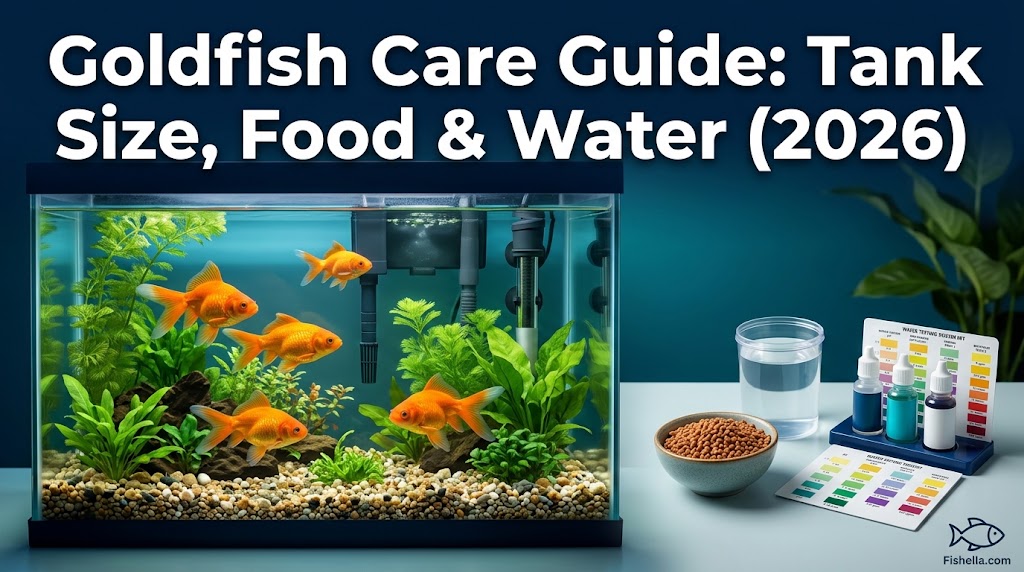
The best way to care for goldfish is to provide a properly sized aquarium, strong filtration, clean water, and a balanced diet. You also need to understand their temperature requirements and maintain a consistent cleaning routine.
This complete goldfish care guide explains everything you need to know before bringing a goldfish home. You will learn about tank size, water parameters, filtration, feeding, tank mates, common health problems, and long-term maintenance.

Whether you are keeping your first fancy goldfish or raising a common goldfish, these practical tips will help you build a healthier aquarium.
Goldfish Care at a Glance
Before buying a goldfish, understand its basic care requirements.
| Care Requirement | General Recommendation |
|---|---|
| Aquarium | 20 gallons or larger for one fancy goldfish; 40 gallons or larger for one common or comet goldfish |
| Temperature | Depends on variety; generally cooler than tropical aquarium fish |
| Ammonia | 0 ppm |
| Nitrite | 0 ppm |
| Nitrate | Preferably below 20 ppm |
| pH | Approximately 6.5–8.5, with stability being important |
| Filtration | Efficient mechanical and biological filtration |
| Diet | Quality goldfish pellets, vegetables, and suitable supplemental foods |
| Feeding | Small portions, usually once or twice daily for healthy adults |
| Water changes | Regular partial changes based on water-test results |
| Lifespan | Often 10–20 years or longer with appropriate care |
These are general starting points, not universal limits. Your goldfish’s variety, adult size, activity level, and aquarium conditions all affect its needs.
1. Understanding Different Types of Goldfish
Goldfish belong to the species Carassius auratus. They have been selectively bred into many varieties with different body shapes, colors, fins, and swimming abilities.
For aquarium care, it is useful to divide goldfish into two main groups.
Common and Single-Tail Goldfish
Common goldfish, comet goldfish, and shubunkins have longer, streamlined bodies and single tails.
They are active swimmers and can grow considerably larger than many beginners expect.
Common characteristics include:
- Longer, streamlined bodies.
- Single tails.
- Strong swimming abilities.
- Higher space requirements.
- Greater suitability for large aquariums or properly maintained ponds.
These varieties are not ideal for small home aquariums. A common goldfish may eventually need a large pond or a very spacious aquarium.
Learn more about adult growth in our guide to how big common goldfish get.
Fancy Goldfish
Fancy goldfish have rounded bodies, double tails, and other distinctive features.
Popular varieties include:
- Oranda
- Ryukin
- Fantail
- Black Moor
- Ranchu
- Pearlscale
Fancy goldfish generally swim more slowly than common goldfish. Some varieties also have delicate eyes, unusual body shapes, or limited swimming abilities.
They need good water quality and a gentle filter current. Avoid sharp decorations that could damage their fins or eyes.
Fancy vs. Common Goldfish
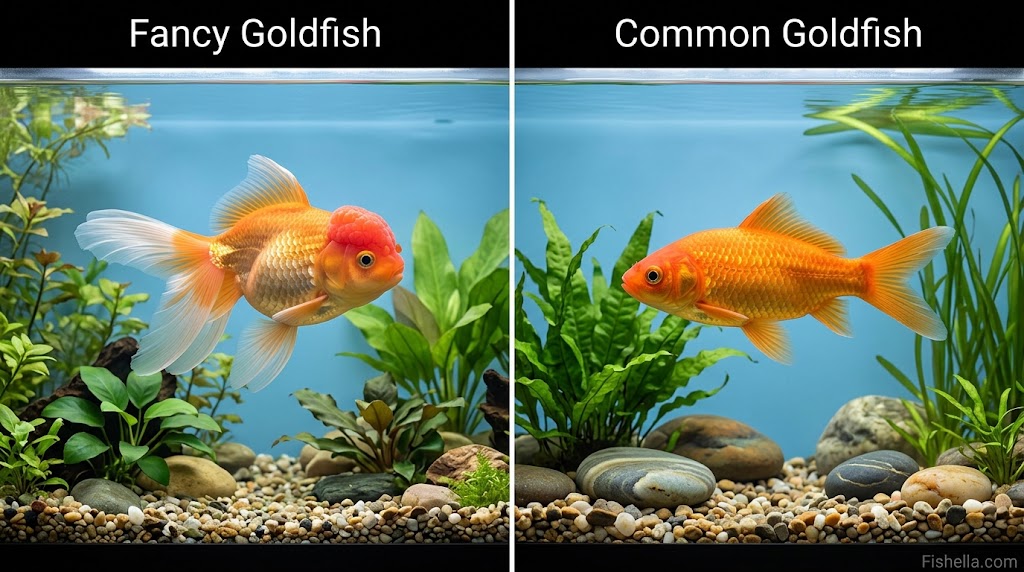
| Feature | Fancy Goldfish | Common/Comet Goldfish |
|---|---|---|
| Body shape | Rounded | Streamlined |
| Tail | Usually double | Single |
| Swimming | Often slower | Usually faster |
| Space needs | Large aquarium | Very large aquarium or pond |
| Current | Gentle flow preferred | Can handle stronger flow |
| Compatibility | Other suitable fancy varieties | Similar active single-tail varieties |
Avoid mixing slow-swimming fancy goldfish with fast common or comet goldfish. Faster fish may outcompete fancy varieties for food.
2. What Size Tank Do Goldfish Need?
Tank size is one of the most important parts of goldfish care.
Goldfish grow throughout their lives when conditions support healthy development. A small fish at a pet store can eventually become a much larger adult.
A larger aquarium also provides more water volume. This helps stabilize temperature and water quality.
Recommended Goldfish Tank Sizes
Use these as conservative starting guidelines:
| Goldfish Type | Starting Aquarium Size |
|---|---|
| One fancy goldfish | 20 gallons |
| Two fancy goldfish | 30–40 gallons or larger |
| One common goldfish | 40 gallons or larger |
| One comet goldfish | 40 gallons or larger |
| Additional goldfish | Increase space according to adult size and waste production |
These figures are not a guarantee that a tank will remain suitable for every adult fish. A larger aquarium may be necessary as the fish grow.
Common and comet goldfish often become better suited to large outdoor ponds with proper depth, filtration, oxygenation, and predator protection.
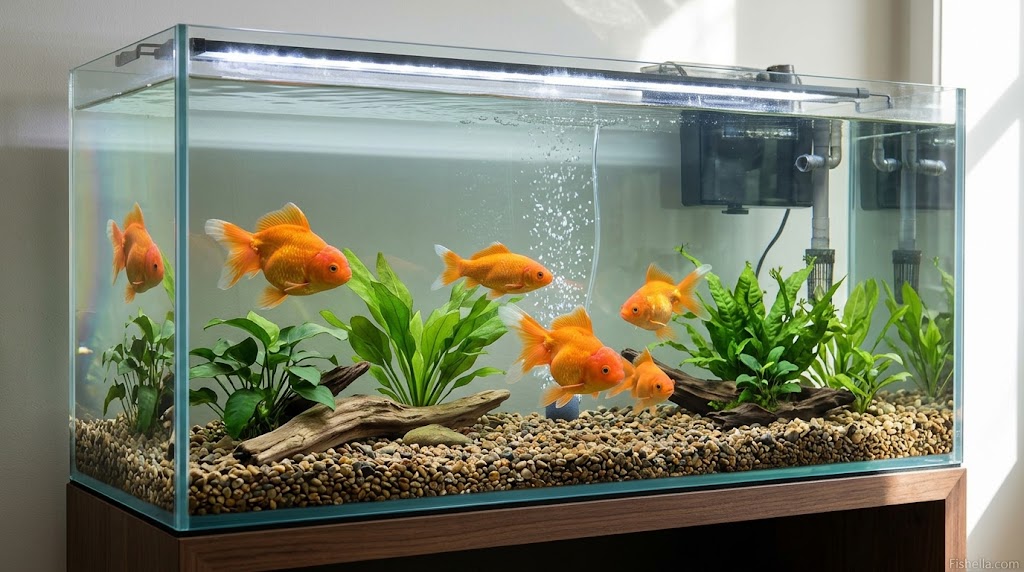
Why Do Goldfish Need So Much Space?
Goldfish produce a significant amount of waste. They also need room to swim and access oxygen-rich water.
An undersized aquarium can create several problems:
- Ammonia can accumulate quickly.
- Nitrate can rise between water changes.
- Oxygen levels can become inadequate.
- Fish have less room to swim.
- Water conditions can change rapidly.
- Overcrowding increases stress.
Choose a long, rectangular aquarium whenever possible. It provides useful swimming space and a larger water surface for gas exchange.
Plan for Adult Size
Never choose an aquarium based only on the size of a young goldfish.
Research its variety and expected adult size before purchasing it. Make sure you can provide suitable housing throughout its life.
3. Can Goldfish Live in a Bowl?
No. A small decorative bowl is not a suitable permanent home for goldfish.
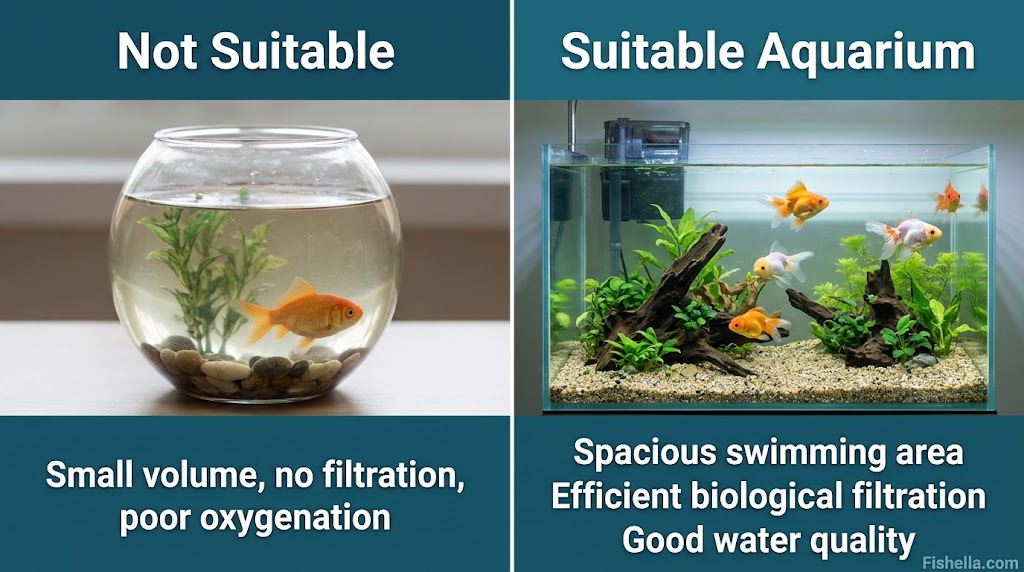
Goldfish need more space, effective filtration, and stable water conditions than small bowls can normally provide. Small bowls are not suitable for goldfish because they limit swimming space and make water quality harder to maintain. Learn more in our guide: Can Goldfish Live in a Bowl?.
A bowl has several disadvantages:
- Limited swimming space.
- Very little water volume.
- Poor room for effective filtration.
- Less stable temperature.
- Faster changes in water quality.
- Limited oxygen exchange.
Goldfish also produce considerable waste. In a small container, harmful substances can accumulate quickly.
Choose a properly sized aquarium with a suitable filter instead.
A larger aquarium makes daily maintenance easier and provides a healthier environment for your fish.
4. Goldfish Water Temperature
Goldfish are generally cool-water fish. They do not need the warm temperatures required by tropical species such as bettas and guppies.
However, different goldfish varieties have different temperature tolerances.
Recommended Temperature by Goldfish Type
| Goldfish Type | General Temperature Guidance |
|---|---|
| Common goldfish | Approximately 50–70°F |
| Comet goldfish | Approximately 50–70°F |
| Shubunkin | Approximately 50–70°F |
| Fancy goldfish | Approximately 59–73°F |
These are general care ranges rather than strict limits. Fancy goldfish care guidance from the Ornamental Aquatic Trade Association identifies approximately 59–73°F as an optimal range.
The most important rule is to avoid sudden temperature changes.
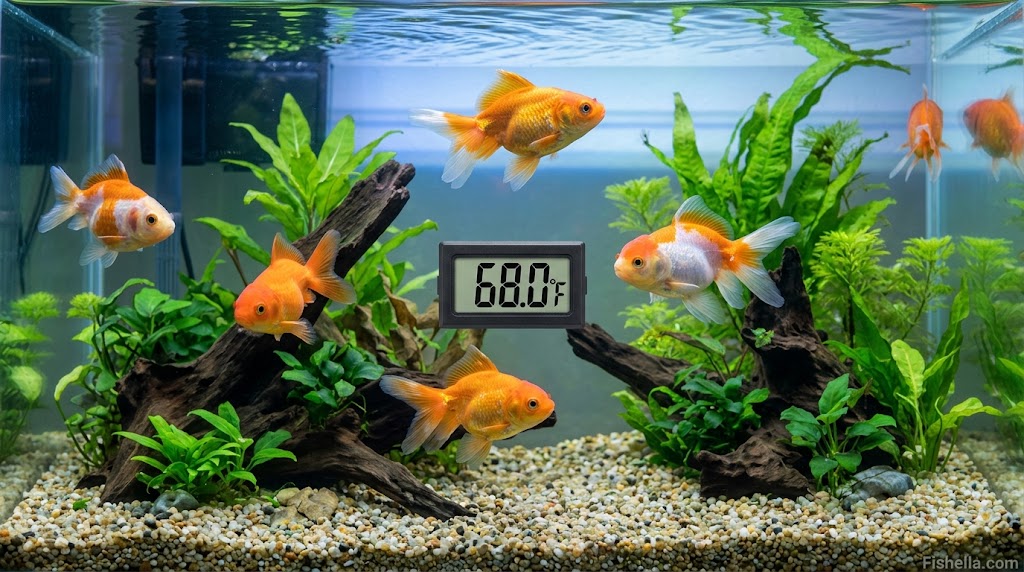
Do Goldfish Need a Heater?
Most indoor goldfish aquariums do not need a heater if the room temperature stays suitable and stable.
However, a thermostat-controlled heater may be useful when:
- Your room becomes unusually cold.
- Temperature changes are frequent.
- You need to prevent sudden temperature drops.
- You are maintaining a specific temperature for a particular variety.
Always use a separate aquarium thermometer. Do not rely only on the heater’s temperature display.
Can Goldfish Live in Warm Water?
Goldfish can tolerate some temperature variation, but excessively warm water can create problems.
Warm water holds less dissolved oxygen than cooler water. This can be particularly concerning in an aquarium with heavy stocking or inadequate surface movement.
If your aquarium becomes too warm, avoid making sudden temperature changes. Improve surface movement and address the source of excess heat.
Keep your aquarium away from direct sunlight and heating equipment.
5. Goldfish Water Parameters
Good water quality is essential for healthy goldfish.
Even a large aquarium can become unsafe if it is not properly maintained. Goldfish produce waste, and beneficial bacteria must process that waste continuously.
Monitor these important water parameters.
Recommended Goldfish Water Parameters
| Parameter | Target |
|---|---|
| Ammonia | 0 ppm |
| Nitrite | 0 ppm |
| Nitrate | Preferably below 20 ppm |
| pH | Approximately 6.5–8.5 |
| Temperature | Appropriate for the goldfish variety |
| GH | Stable and suitable for the fish |
| KH | Sufficient to help maintain stable pH |

Ammonia: 0 ppm
Ammonia comes from fish waste, uneaten food, and decomposing organic matter.
It is toxic to goldfish and can damage their gills and other tissues.
A healthy, established aquarium should maintain ammonia at 0 ppm.
Nitrite: 0 ppm
Beneficial bacteria convert ammonia into nitrite.
However, nitrite is also toxic to fish. Your aquarium should maintain 0 ppm nitrite.
Nitrate: Keep It Low
Another group of beneficial bacteria converts nitrite into nitrate.
Nitrate is less toxic than ammonia and nitrite, but high concentrations can still harm fish.
Regular partial water changes help remove accumulated nitrate.
Aim to keep nitrate below 20 ppm when practical, while also considering your source water.
pH: Maintain Stability
Goldfish generally tolerate a reasonably broad pH range.
A pH around 6.5–8.5 is a useful general reference.
Do not repeatedly add chemicals to chase a particular pH number. Sudden changes can stress fish.
Test your tap water and aquarium water to understand their natural chemistry.
GH and KH
GH measures general hardness, including calcium and magnesium.
KH measures carbonate hardness and helps buffer changes in pH.
Both are useful when evaluating long-term water stability.
If your goldfish are healthy and your water chemistry is stable, avoid unnecessary adjustments.
How Often Should You Test Goldfish Tank Water?
For a new aquarium, test ammonia and nitrite frequently during cycling.
For an established aquarium:
- Test water at least weekly while learning your tank’s maintenance needs.
- Check immediately when fish show unusual behavior.
- Test after adding new fish.
- Check after filter problems or major maintenance.
- Monitor nitrate to guide water changes.
A reliable liquid test kit can help you detect problems that clear-looking water cannot reveal.
6. Do Goldfish Need a Filter?
Yes. A reliable filter is essential for a healthy goldfish aquarium.
Goldfish are heavy waste producers. Their filtration system must handle both solid debris and dissolved waste.
A suitable aquarium filter performs three important jobs.
Mechanical Filtration
Mechanical filtration removes suspended particles from the water.
Examples include:
- Filter sponges.
- Filter floss.
- Mechanical filter pads.
These materials trap waste and help keep aquarium water clear.
Biological Filtration
Biological filtration provides surfaces where beneficial bacteria can live.
These bacteria process toxic ammonia and nitrite through the nitrogen cycle.
Biological filtration is especially important in goldfish aquariums because of their high waste production.
Chemical Filtration
Chemical filtration uses materials such as activated carbon to remove certain dissolved substances.
It can be useful in specific situations, but it does not replace biological filtration or regular water changes.
Which Filter Is Suitable for Goldfish?
You can use different filter types depending on your aquarium size and stocking.

Common options include:
- Canister filters for larger aquariums.
- Hang-on-back filters for suitable smaller setups.
- Sponge filters as additional biological filtration and aeration.
Goldfish need good filtration, but fancy varieties may struggle with very strong currents.
If you are comparing filter types, read our best hang-on-back aquarium filter guide.
Should You Use an Air Pump?
An air pump is not always necessary if your filter creates enough surface movement.
However, additional aeration can be useful in goldfish aquariums.
An air stone or sponge filter can increase surface movement and support oxygen exchange.
Consider additional aeration when:
- Your aquarium is heavily stocked.
- Water temperatures are unusually high.
- Surface movement is weak.
- Fish frequently gasp near the surface.
- Your filter does not provide enough water movement.
Remember that gasping can also indicate poor water quality or illness. Test the water instead of assuming that an air pump will solve every problem.
7. How to Cycle a Goldfish Tank
Before adding goldfish, establish the aquarium nitrogen cycle. Cycling allows beneficial bacteria to develop in your filter and other aquarium surfaces.
These bacteria process waste and help keep the water safe.
How the Nitrogen Cycle Works
The process follows this general sequence:
Fish waste and decomposing food → Ammonia → Nitrite → Nitrate
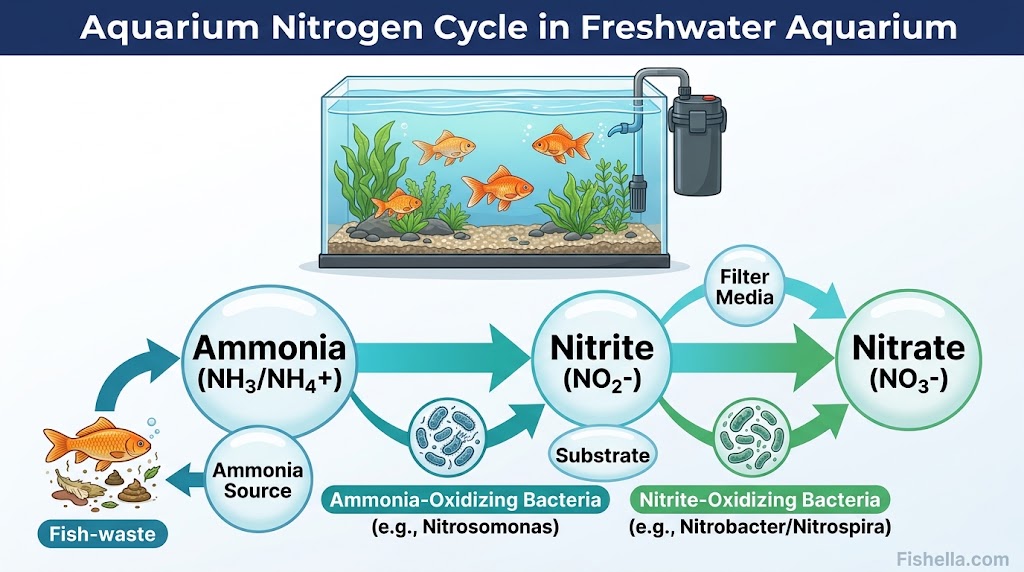
Ammonia and nitrite are harmful to goldfish. Nitrate is less toxic, but it still needs to be controlled.
Why Is Cycling Important?
A new aquarium does not immediately contain enough beneficial bacteria to process fish waste.
Adding goldfish too early can expose them to ammonia and nitrite.
This problem is sometimes called new tank syndrome.
Fishless Cycling: Step by Step
For beginners, fishless cycling is the preferred approach.
- Set up your aquarium with its filter and other equipment.
- Fill it with water and treat the water with an appropriate conditioner.
- Start the filter and provide suitable water circulation.
- Add an appropriate aquarium ammonia source according to a fishless cycling method.
- Test ammonia, nitrite, and nitrate regularly.
- Allow beneficial bacteria to establish themselves.
- Confirm that the filter can process the ammonia source without leaving detectable ammonia or nitrite before adding fish.
Cycling time varies. Some aquariums take several weeks or longer.
Do not rely on a fixed number of days. Use water tests to confirm that the biological filter is working.
For a more detailed explanation, read our guide on how to cycle a fish tank fast.
What If You Already Have Goldfish in an Uncycled Tank?
If you already own goldfish, do not leave them in unsafe water while waiting for a new cycle.
Test ammonia and nitrite frequently. Perform appropriate partial water changes with conditioned, temperature-matched water when needed.
Maintain filtration and avoid overfeeding. Continue monitoring until the biological filter becomes established.
8. Goldfish Feeding Guide
Goldfish are omnivores. They eat a mixture of plant-based and animal-based foods.
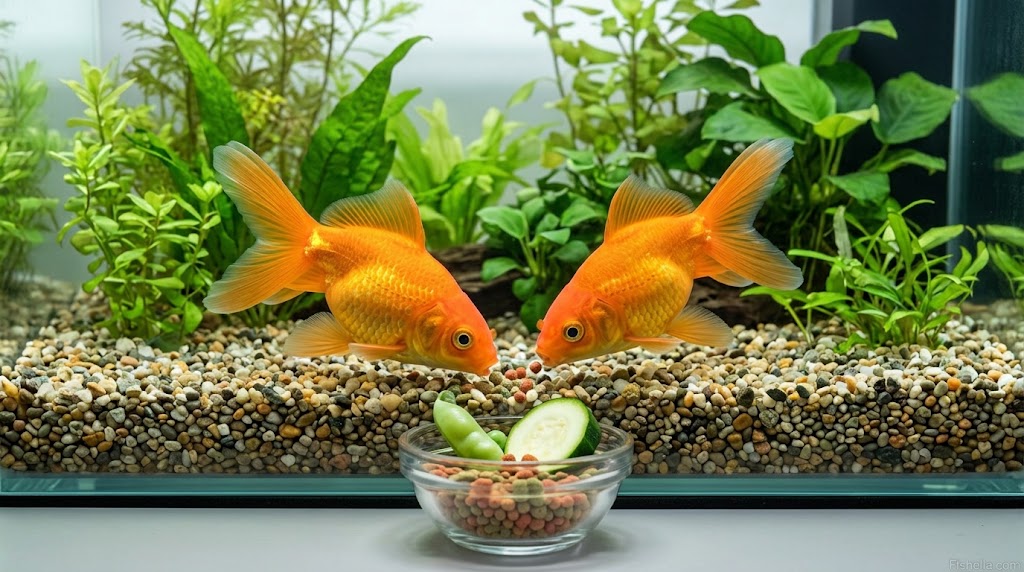
A balanced diet supports growth, body condition, and overall health. However, overfeeding is one of the most common mistakes among beginners. Choosing the right diet is essential for goldfish health and growth. Read our guide to the best goldfish food to compare suitable pellets, flakes, and nutritious feeding options.
Best Food for Goldfish
Choose a quality food formulated specifically for goldfish.
Suitable options include:
Goldfish pellets: A practical staple food for everyday feeding.
Goldfish flakes: Another convenient option, especially for smaller fish.
Frozen foods: Brine shrimp, daphnia, and other suitable foods can provide variety.
Vegetables: Peas, zucchini, spinach, and other suitable vegetables can supplement the diet.
Sinking Pellets vs. Floating Pellets
Both types can be suitable, depending on your goldfish.
Sinking pellets allow fish to feed below the surface.
They may be particularly useful for fancy goldfish that struggle with buoyancy or frequently gulp air at the surface.
Floating pellets are easier to observe during feeding, but some fish may swallow excess air while eating at the surface.
Observe your fish and choose a suitable food format.
Can Goldfish Eat Vegetables?
Yes. Vegetables can provide useful variety in a goldfish diet.
Suitable options include:
- Shelled, cooked peas.
- Blanched zucchini.
- Blanched spinach.
- Small portions of lettuce.
- Blanched broccoli.
Wash vegetables thoroughly and remove any seasoning, salt, oil, or sauces.
Cut food into appropriately sized pieces. Remove leftovers so they do not decompose in the aquarium.
Vegetables should supplement a complete goldfish diet rather than replace it.
Can Goldfish Eat Tropical Fish Food?
Goldfish can sometimes eat other fish foods, but a goldfish-specific formula is generally a better everyday choice.
Different fish foods have different nutritional profiles.
Choose food according to your goldfish’s dietary needs rather than using tropical flakes as its only regular diet.
How Often Should You Feed Goldfish?
Many healthy adult goldfish do well with one or two small feedings daily.
However, the correct amount depends on:
- Fish size.
- Age and growth stage.
- Food type.
- Water temperature.
- Activity level.
- Overall body condition.
Feed small portions and observe how quickly your fish eat.
Avoid leaving uneaten food in the aquarium.
What Happens If You Overfeed Goldfish?
Overfeeding creates several problems.
Uneaten food decomposes and increases organic waste. This can raise ammonia and place additional pressure on your biological filter.
Excessive feeding can also contribute to digestive problems and unhealthy weight gain.
A consistent feeding routine is much safer than giving large meals occasionally.
9. How to Clean a Goldfish Tank
Goldfish aquariums need regular maintenance because these fish produce substantial waste.
However, cleaning does not mean removing everything from the aquarium.
Your goal is to remove waste while protecting beneficial bacteria.
Step 1: Test the Water
Check ammonia, nitrite, nitrate, and other important parameters.
Your results help you understand whether your current maintenance routine is working.
Step 2: Remove Uneaten Food and Debris
Use an aquarium net or siphon to remove visible waste.
Pay attention to areas where food and fish waste collect.
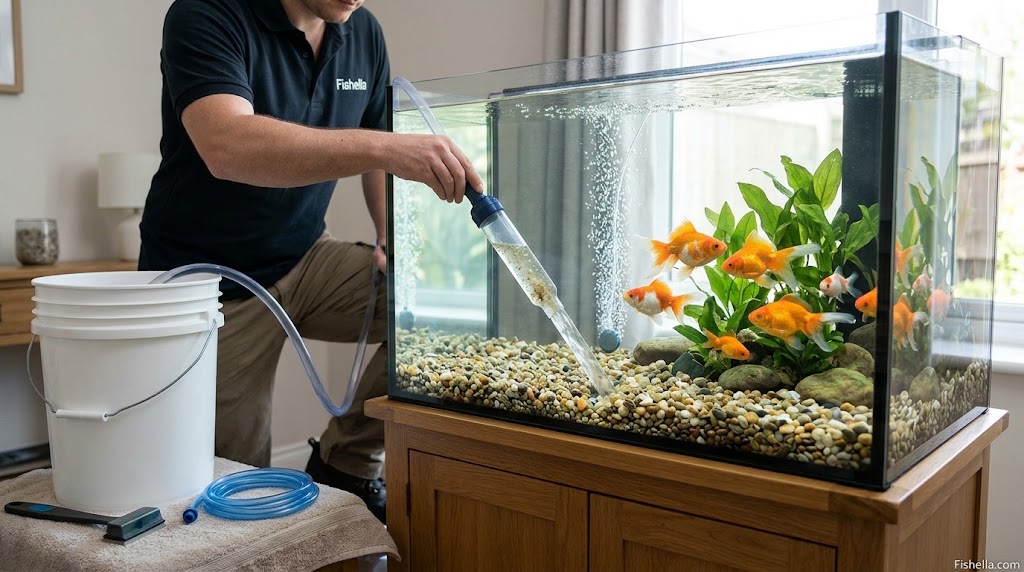
Step 3: Vacuum the Substrate
A gravel vacuum helps remove trapped debris from the bottom of the aquarium.
Move it carefully around the substrate to avoid disturbing your fish unnecessarily.
Step 4: Clean the Aquarium Glass
Use an aquarium-safe algae scraper or sponge.
Never use soap, household detergents, or chemical cleaners inside your aquarium.
Step 5: Perform a Partial Water Change
Remove a portion of the old aquarium water and replace it with properly conditioned water. The replacement water should be close to the aquarium’s existing temperature.
Step 6: Check the Filter
Inspect the filter and make sure water is flowing properly.
If the media is dirty, gently rinse reusable biological media in removed aquarium water.
Avoid replacing all biological media at once.
For more detailed instructions, read our how to clean a fish tank guide.
10. How Often Should You Change Goldfish Tank Water?
There is no single water-change percentage that works for every goldfish aquarium.
Your schedule depends on:
- Aquarium size.
- Number of goldfish.
- Filter capacity.
- Feeding routine.
- Nitrate levels.
- Source-water quality.
- Overall aquarium conditions.
A weekly partial water change is a useful starting routine for many home aquariums, but heavily stocked tanks may require more frequent maintenance.
Use water tests to decide whether your schedule is sufficient.
Important Water-Change Tips
Always follow these precautions:
- Treat replacement tap water with an appropriate aquarium water conditioner.
- Match the replacement water temperature closely to the aquarium.
- Avoid sudden changes in pH and other water conditions.
- Use a clean bucket reserved for aquarium maintenance.
- Do not replace all filter media during routine water changes.
- Never use soap or household cleaning products on aquarium equipment.
Tap water may contain chlorine or chloramine. Both can harm fish and beneficial bacteria.
For more information about choosing a suitable treatment product, see our best aquarium water conditioner guide.
11. Goldfish Tank Mates
Goldfish can live with compatible tank mates, but choosing the right companions requires careful planning.
The safest approach is to keep goldfish with other fish that have similar temperature, space, feeding, and behavior requirements.
Can Fancy Goldfish Live Together?
Yes. Compatible fancy goldfish varieties can often share an aquarium when there is enough space and filtration.
For example, suitable combinations may include:
- Oranda and fantail.
- Ryukin and fantail.
- Ranchu and other suitable fancy varieties.
However, differences in swimming ability and feeding behavior still matter.
Observe all fish to make sure slower swimmers receive enough food.
Can Common Goldfish Live Together?
Common, comet, and shubunkin goldfish can often share suitable large aquariums or ponds.
They are active swimmers and need plenty of room.
Avoid placing them in small aquariums simply because they are still young.
Goldfish Tank Mates to Avoid
Avoid mixing goldfish with:
- Bettas.
- Guppies.
- Neon tetras.
- Angelfish.
- Discus.
- Other tropical fish with very different temperature requirements.
Small fish may also become food for larger goldfish.
Do not add another fish without checking its adult size, temperament, and environmental needs.
Remember that every additional fish increases the aquarium’s waste load.
12. Common Goldfish Health Problems
Even with proper care, goldfish can develop health problems.
Good water quality, suitable nutrition, and a stable environment can reduce many risks.
However, you should learn to recognize changes in appearance and behavior.
Signs of an Unhealthy Goldfish
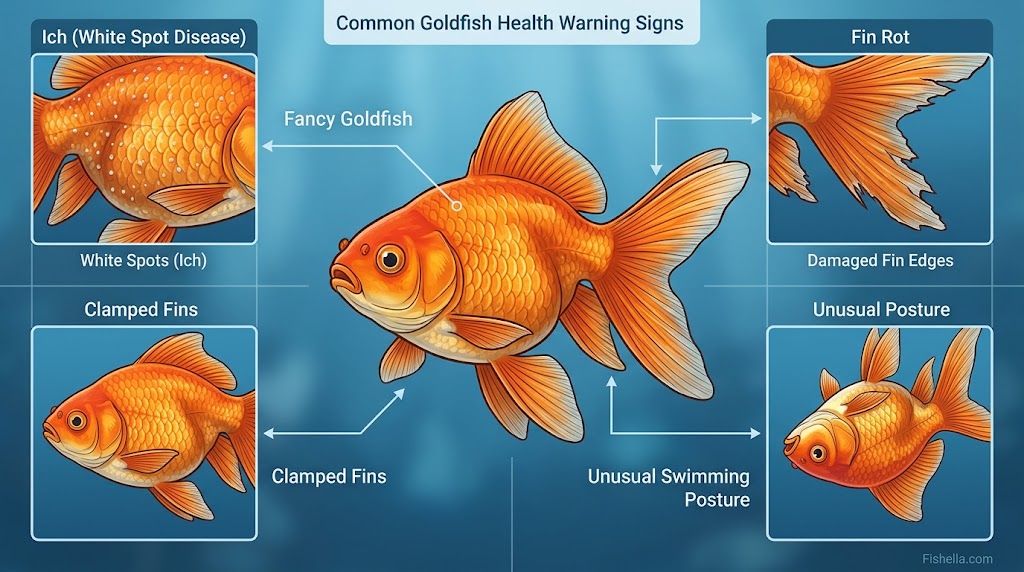
Watch for:
- Loss of appetite.
- Unusual swimming.
- Clamped fins.
- Rapid breathing.
- White spots.
- Swollen abdomen.
- Raised scales.
- Torn fins.
- Unusual discoloration.
- Staying at the bottom for extended periods.
- Gasping near the water surface.
These symptoms can have different causes. Do not diagnose a disease based on one sign alone.
Common Goldfish Health Conditions
Ich (White Spot Disease)
Ich is a parasitic infection that can produce small white spots on the body and fins.
Affected fish may rub against decorations, lose appetite, or show unusual behavior.
Fin Rot
Fin deterioration can be associated with poor water quality, bacterial infections, or physical damage.
Look for progressive damage, discoloration, and ragged fin edges.
Swim Bladder and Buoyancy Problems
Goldfish may struggle to maintain normal swimming positions.
Possible signs include floating, sinking, tilting, or difficulty staying upright.
Buoyancy problems can have several causes, including digestive issues, infection, and anatomical problems.
Dropsy
Dropsy describes a collection of symptoms involving fluid buildup and swelling.
Affected fish may develop raised scales that resemble a pinecone.
It is a serious warning sign and needs prompt professional assessment.
Ammonia or Nitrite Poisoning
Poor water quality can damage gills and interfere with normal fish function.
Affected fish may gasp, breathe rapidly, become lethargic, or lose appetite.
What Should You Do If Your Goldfish Looks Sick?
Start by testing the water.
Check:
- Ammonia.
- Nitrite.
- Nitrate.
- pH.
- Temperature.
Then inspect the filter and review recent changes to the aquarium.
Do not automatically add medication or salt without understanding the problem. Incorrect treatments can make some conditions worse.
For persistent or severe symptoms, consult an aquatic veterinarian or qualified fish-health professional.
The Merck Veterinary Manual provides additional veterinary information about fish health and disease.
13. How Long Do Goldfish Live?
Goldfish can live for many years when kept in suitable conditions.
Their lifespan depends on variety, genetics, diet, water quality, and overall care.
Some goldfish live 10–20 years or longer.
Common and comet goldfish can also grow considerably larger than many people expect.
What Helps Goldfish Live Longer?
Provide:
- Enough swimming space.
- Reliable biological filtration.
- Stable water temperature.
- Regular water testing.
- A balanced diet.
- Appropriate stocking.
- Consistent partial water changes.
- Early attention to health problems.
Goldfish should be treated as long-term pets, not temporary decorations.
Before purchasing one, consider whether you can provide suitable care throughout its life.
14. Quarantining New Goldfish
Quarantine is an important step when introducing new goldfish to an established aquarium.
New fish may carry parasites or infections without showing obvious symptoms.
A separate quarantine aquarium helps you observe new arrivals before they join your existing fish.
Basic Quarantine Guidelines
- Prepare a separate, appropriately sized aquarium.
- Provide filtration and suitable aeration.
- Use properly conditioned water.
- Monitor ammonia and nitrite carefully.
- Observe appetite, swimming, fins, and body condition.
- Keep separate nets and maintenance equipment.
- Seek professional advice if symptoms appear.
A quarantine period of several weeks is a useful precaution. The exact period should depend on the source of the fish, health history, and any symptoms.
Do not medicate healthy fish automatically. Treatments should be based on a known or reasonably suspected problem.
15. Goldfish Lighting and Aquarium Decorations
Goldfish need a consistent day-and-night cycle.
Aquarium lighting helps maintain a regular routine and allows you to observe your fish.
A daily lighting period of around 8–10 hours is a reasonable starting point.
Avoid leaving aquarium lights on all day and night.
Choose Safe Decorations
Goldfish need open swimming space and safe surroundings.
Choose:
- Smooth aquarium rocks.
- Rounded decorations.
- Aquarium-safe plants.
- Open swimming areas.
- Decorations without sharp edges.
Fancy goldfish need particular care because their fins and eyes can be delicate.
Can Goldfish Live With Live Plants?
Yes, but goldfish may eat or uproot some aquarium plants.
Hardier plants may be more suitable, depending on the fish and aquarium conditions.
Secure plants properly and make sure they do not block swimming space or filtration equipment.
16. Goldfish Care Mistakes Beginners Should Avoid
Beginners commonly make mistakes because goldfish are often marketed as easy, low-maintenance pets.
Avoid these problems:
1. Keeping Goldfish in Small Bowls
Small bowls cannot provide suitable long-term space and stable water conditions.
2. Choosing a Tank Based on Baby Size
Always plan for adult growth.
3. Overfeeding
Excess food increases waste and can affect water quality.
4. Skipping the Nitrogen Cycle
An uncycled aquarium can expose goldfish to toxic ammonia and nitrite.
5. Ignoring Water Tests
Clear water does not necessarily mean safe water.
6. Using Weak Filtration
Goldfish need efficient mechanical and biological filtration.
7. Mixing Incompatible Fish
Different species have different temperature, feeding, and space requirements.
8. Making Sudden Temperature Changes
Rapid changes can stress goldfish.
9. Replacing All Filter Media at Once
This can remove a large portion of beneficial bacteria.
10. Ignoring Early Health Problems
Unusual swimming, appetite changes, or breathing problems should never be ignored.
17. A Simple Goldfish Care Routine
A consistent routine makes goldfish care easier.
You do not need to spend hours cleaning the aquarium every day. A few simple tasks can help maintain a healthy environment.
Daily Goldfish Care
- Observe your goldfish.
- Check their appetite.
- Look for unusual swimming.
- Check the water temperature.
- Make sure the filter is running.
- Remove uneaten food.
Weekly Goldfish Care
- Test ammonia and nitrite.
- Check nitrate and pH.
- Perform an appropriate partial water change.
- Vacuum the substrate when needed.
- Remove visible debris.
- Inspect the filter.
- Check for signs of illness.
Monthly or Periodic Goldfish Care
- Inspect filter media.
- Check all aquarium equipment.
- Clean decorations when necessary.
- Inspect plants for damage.
- Review your water-test records.
- Check whether your goldfish need more space.
Your actual schedule should depend on water-test results and aquarium conditions.
18. Goldfish Care Checklist
Before bringing goldfish home, make sure you can provide the following:
- A properly sized aquarium.
- A suitable filter.
- Adequate oxygen exchange.
- Stable water temperature.
- A properly cycled aquarium.
- A reliable water test kit.
- Aquarium water conditioner.
- Quality goldfish food.
- Regular partial water changes.
- Safe decorations and substrate.
- Compatible tank mates, if any.
- A quarantine setup or plan.
- Daily observation and long-term maintenance.
If you can meet these requirements, you will have a much better foundation for keeping healthy goldfish.
Frequently Asked Questions About Goldfish Care
Are Goldfish Easy to Care For?
Goldfish can be suitable for beginners who understand their requirements. They need large aquariums, effective filtration, regular water testing, and appropriate feeding. They are not low-maintenance bowl fish.
How Many Goldfish Can I Keep in a 20-Gallon Tank?
A 20-gallon aquarium may serve as a starting point for one fancy goldfish. It is not suitable for several goldfish or a common goldfish. Consider adult size, filtration, and water quality before increasing stocking.
Do Goldfish Need a Heater?
Most goldfish do not need a heater in a stable indoor environment. However, a thermostat-controlled heater may be useful if room temperatures become too cold or fluctuate significantly.
Do Goldfish Need a Filter?
Yes. A reliable filter supports mechanical and biological filtration. Goldfish produce considerable waste, so an appropriately sized filter is essential.
Do Goldfish Need an Air Pump?
Not always. A filter that creates adequate surface movement may provide enough oxygen exchange. An air stone or sponge filter can provide additional aeration when needed.
How Often Should I Feed My Goldfish?
Most healthy adult goldfish can eat small portions once or twice daily. Adjust the amount according to their size, food type, and body condition.
Can Goldfish Eat Vegetables?
Yes. Suitable vegetables include peas, zucchini, spinach, and lettuce. Prepare them without seasoning and offer small portions as part of a balanced diet.
Can Goldfish Live With Betta Fish?
No. Goldfish and bettas have different temperature requirements and care needs. Goldfish also produce much more waste than a typical betta aquarium can handle.
Why Is My Goldfish Staying at the Bottom?
Bottom sitting can result from stress, poor water quality, temperature problems, or illness. Check ammonia, nitrite, nitrate, and temperature. Observe your fish for additional symptoms.
Why Is My Goldfish Not Eating?
Loss of appetite can result from poor water quality, stress, unsuitable temperature, digestive problems, or disease. Check the aquarium conditions and observe other symptoms.
Why Is My Goldfish Gasping at the Surface?
Gasping may indicate low oxygen, poor water quality, or gill problems. Check ammonia and nitrite immediately. Make sure the filter is working and the water surface has adequate movement.
Can Goldfish Live in Tap Water?
Tap water can be used after appropriate treatment. Use an aquarium water conditioner that neutralizes chlorine and chloramine according to its instructions.
How Long Do Goldfish Live?
Goldfish can live 10–20 years or longer with suitable care. Their lifespan depends on genetics, variety, aquarium conditions, nutrition, and disease prevention.
Final Thoughts: Give Your Goldfish the Right Care
Goldfish need more than a small bowl and occasional feeding. They require enough swimming space, reliable filtration, clean water, proper nutrition, and consistent maintenance.
The most important step is choosing an aquarium that suits your goldfish’s variety and adult size. Establish the nitrogen cycle before adding fish, monitor water parameters, and avoid overfeeding.
Remember that goldfish are long-term pets. Good planning and consistent care can help them stay healthy for many years.
For more beginner-friendly aquarium advice, explore the Fish Care section on Fishella.
Pingback: Can Goldfish Live in a Bowl? What Experts Advise