
Affiliate Disclosure: This article contains Amazon affiliate links. As an Amazon Associate, Fishella earns from qualifying purchases at no extra cost to you.
Choosing the best aquarium water conditioner helps protect fish when you add tap water to your aquarium. Chlorine and chloramine are common drinking water disinfectants that can harm fish if Choosing the best aquarium water conditioner helps make tap water safer for your fish. Many water supplies contain chlorine or chloramine, which can harm fish if untreated.
For most freshwater aquariums, Seachem Prime is a strong overall choice because it treats both chlorine and chloramine. Other products offer different features, including heavy-metal treatment and protective slime-coat ingredients.

In this guide, we compare five aquarium water conditioners based on their manufacturer instructions, treatment claims, dosage, and intended use. You will learn which option suits your aquarium, how much to use, and what to check before buying.
The goal is simple: help you choose the right dechlorinator for your freshwater tank without paying for features you do not need. Explore our best Betta water conditioner buying guide to compare Betta-safe water treatments and choose the right option for your aquarium.
Why US Aquarium Owners Need a Water Conditioner
Many public water suppliers in the United States use chlorine or chloramine to disinfect drinking water. These disinfectants help control harmful germs as water travels through distribution pipes.
According to the US Environmental Protection Agency (EPA), more than one in five Americans uses drinking water treated with chloramines. Chloramine provides longer-lasting disinfection than chlorine as water moves through pipes. It also does not disappear reliably when tap water is left standing.
This matters to aquarium owners because chlorine and chloramine can harm fish and beneficial filter bacteria if they enter an aquarium untreated. The CDC explains that chlorine can be removed by letting water stand for a few days, but chloramine cannot be removed this way.

Before adding tap water to your aquarium, check your local water utility’s annual water quality report. Find out whether your supply uses chlorine, chloramine, or another disinfectant. Then choose a water conditioner that specifically treats the disinfectant in your water.
What Does an Aquarium Water Conditioner Do?
Depending on its formula, an aquarium water conditioner may:
- Treat chlorine: Neutralize chlorine in tap water.
- Treat chloramine: Treat chloramine when the product specifically lists it on the label.
- Address certain heavy metals: Help neutralize or bind metals, depending on the manufacturer’s claims.
- Provide additional protection: Some formulas include ingredients marketed to support fish skin or slime coat.
Not every conditioner provides all these features. Compare the product label and dosage instructions before buying.
Using the right conditioner is an important step when preparing tap water for a new freshwater aquarium or routine water changes. It helps protect your fish while you maintain a healthy aquarium.
Always treat replacement tap water according to the manufacturer’s instructions before adding it to your tank.
How We Evaluated Aquarium Water Conditioners
We compared aquarium water conditioners using manufacturer product information, published dosage instructions, and their intended uses.
Our goal is to help beginner and experienced fishkeepers choose a suitable conditioner without paying for features they may not need.
We considered five main factors:
- Chlorine treatment: Whether the manufacturer states that the product treats chlorine.
- Chloramine treatment: Whether chloramine treatment is specifically listed on the product label.
- Dosage and concentration: How much conditioner is needed to treat a given volume of water.
- Additional features: Whether the formula addresses heavy metals, ammonia, or other water-treatment concerns according to the manufacturer.
- Value: How much water a bottle can treat based on its listed dose and bottle size.
We also considered ease of use and suitability for routine freshwater aquarium maintenance.
Our review method: This is a research-based product comparison. We reviewed manufacturer specifications and instructions rather than conducting personal laboratory tests. We identify manufacturer claims as product claims and do not present them as independent test results.
Product formulas and instructions can change. Always check the current bottle label before use.
Top Water Treatment Products Compared
| Product | Best For | What It Treats | Manufacturer’s Standard Dose |
|---|---|---|---|
| Seachem Prime | Best Overall | Chlorine, chloramine, ammonia, nitrite, nitrate, and some heavy metals | 5 mL per 50 US gallons of new water |
| API Tap Water Conditioner | Best Simple Dechlorinator | Chlorine, chloramine, and heavy metals | 1 mL per 10 gallons for chlorine; 5 mL per 30 gallons for chloramine |
| Tetra AquaSafe Plus | Best for Routine Water Changes | Chlorine, chloramine, and heavy metals; includes slime-coat protective ingredients | 5 mL per 10 US gallons |
| Fritz Complete | Best All-in-One Alternative | Chlorine, chloramine, heavy metals, ammonia, nitrite, and nitrate | 5 mL per 50 US gallons |
| API Stress Coat | Best Aloe Vera Formula | Chlorine, chloramine, and heavy metals; includes aloe vera for fish skin and slime-coat support | 5 mL per 10 US gallons |
These doses are based on the manufacturers’ published instructions. Always check the directions on your bottle because formulas and labels can change. For routine water changes, calculate the dose using the amount of new tap water you are adding. API Tap Water Conditioner has a separate dosage for chlorine and chloramine, so use the correct rate for your water supply.
Individual Product Reviews
1. Seachem Prime — Best Overall Aquarium Water Conditioner
Seachem Prime is a concentrated aquarium water conditioner for freshwater and saltwater tanks. It is my top pick for general aquarium use because one small dose treats a large amount of tap water.
It removes chlorine and chloramine. Seachem also states that Prime temporarily detoxifies ammonia, nitrite, and nitrate. This can be useful during water changes or when dealing with temporary water-quality problems.

Prime does not replace your biological filter. It does not remove ammonia or nitrite from the aquarium. You still need to test your water and maintain a properly cycled filter.
Dosage: Use 5 mL for every 50 US gallons of new water. Add it to the replacement water before adding that water to your aquarium. You can also dose directly into the tank according to Seachem’s instructions.
Pros
- Highly concentrated formula.
- Treats chlorine and chloramine.
- Also provides temporary ammonia and nitrite detoxification claims.
- Suitable for freshwater and saltwater aquariums.
Cons
- Small water changes require careful measuring.
- Does not replace water changes or biological filtration.
Best for: Fish keepers who want a concentrated, multi-purpose conditioner for regular aquarium maintenance. For more help choosing the right water conditioner, read our detailed comparison of Seachem Prime vs. API Stress Coat to see how their features and benefits differ. Manufacturer details: Pime
2. API Tap Water Conditioner — Best Simple Dechlorinator
API Tap Water Conditioner is a concentrated option for treating tap water before adding it to your aquarium. It is designed to neutralize chlorine and chloramine and detoxify heavy metals.
This product is a straightforward choice if your main goal is to prepare tap water for routine water changes. It does not advertise the same ammonia and nitrite detoxification features as Seachem Prime or Fritz Complete.
Dosage: For chlorine and heavy metals, use 1 mL per 10 US gallons of tap water. For chloramine, use 5 mL per 30 US gallons. Follow the correct rate for your water supply.
Pros
- Treats chlorine and chloramine.
- Detoxifies certain heavy metals.
- Concentrated formula.
- Suitable for freshwater and saltwater aquariums.
Cons
- Requires different doses for chlorine and chloramine.
- Does not offer the same additional nitrogen-compound claims as Prime.
Best for: Aquarium owners who want a simple, concentrated tap water dechlorinator.
Manufacturer details: API Fishcare
3. Tetra AquaSafe Plus — Best for Routine Water Changes
Tetra AquaSafe Plus is designed to make tap water safer for fish during aquarium setup and routine water changes. It neutralizes chlorine, chloramine, and heavy metals.
Its formula also contains protective colloids that help protect fish gills and delicate membranes. Tetra says these ingredients provide a protective slime coating.
AquaSafe Plus is easy to use, but it is less concentrated than Seachem Prime and Fritz Complete. You need more product to treat the same amount of water.
Dosage: Add 5 mL for every 10 US gallons of water. Use it when setting up a tank, performing partial water changes, or replacing evaporated water as directed by the manufacturer.
Pros
- Treats chlorine and chloramine.
- Helps neutralize heavy metals.
- Includes protective slime-coat ingredients.
- Suitable for freshwater and marine aquariums.
Cons
- Requires more conditioner per gallon than concentrated options.
- Does not advertise Prime’s ammonia and nitrite detoxification claims.
Best for: Fish keepers who prefer a simple conditioner with additional protective ingredients for routine water changes.
Manufacturer details: tetra-fish.com
4. Fritz Complete — Best All-in-One Alternative
Fritz Complete is a concentrated water conditioner for freshwater and saltwater aquariums. It treats chlorine, chloramine, and heavy metals. Fritz also states that it detoxifies ammonia, nitrite, and nitrate.This makes it another option for fish keepers who want more than a basic dechlorinator. Its standard dosage is similar to Seachem Prime, so a small amount treats a large volume of new water.
Remember that detoxifying nitrogen compounds does not replace biological filtration. Continue testing your aquarium water and maintaining the nitrogen cycle.
Dosage: Use 5 mL per 50 US gallons. Fritz recommends adding it to tap water before adding that water to the aquarium.
Pros
- Treats chlorine and chloramine.
- Detoxifies ammonia, nitrite, and nitrate according to Fritz.
- Concentrated formula.
- Suitable for freshwater and saltwater aquariums.
Cons
- Small doses require accurate measuring.
- Adequate water movement and aeration are important when dosing.
Best for: Fish keepers looking for a concentrated alternative to Seachem Prime.
Manufacturer details: Fritz Aquatics
5. API Stress Coat — Best for Slime-Coat Support
API Stress Coat is a tap water conditioner that treats chlorine, chloramine, and heavy metals. Its formula also contains aloe vera, which API says helps protect fish skin and support the natural slime coat.
This product is worth considering if you want a dechlorinator with additional slime-coat support. However, it is not a fish medication and should not replace proper treatment for injuries or diseases.
API Stress Coat also appears in our Seachem Prime vs. API Stress Coat comparison, where you can read a more detailed comparison of the two products.
Dosage: Use 5 mL per 10 US gallons of new water when treating tap water. Follow the product label for other uses.
Pros
- Treats chlorine and chloramine.
- Neutralizes heavy metals.
- Contains aloe vera.
- Suitable for freshwater and saltwater aquariums.
Cons
- Requires more product per gallon than concentrated conditioners.
- Its slime-coat benefits do not replace proper fish care or medication.
Best for: Fish keepers who want a dechlorinator with added aloe vera and slime-coat support.
Manufacturer details: API Fishcare
Best Aquarium Water Conditioner Dosage Example
Choosing the correct aquarium water conditioner is important, but using the correct dose matters too. Each brand has its own formula and dosage instructions.
For routine water changes, calculate the conditioner dose using the amount of new tap water you are adding. Do not automatically use the full aquarium capacity when treating replacement water in a separate container.
Dosage for 10 US Gallons of New Tap Water
| Water Conditioner | Standard Dose |
|---|---|
| Seachem Prime | 1 mL |
| API Tap Water Conditioner (chlorine) | 1 mL |
| API Tap Water Conditioner (chloramine) | 1.67 mL |
| Tetra AquaSafe Plus | 5 mL |
| Fritz Complete | 1 mL |
| API Stress Coat | 5 mL |
These amounts follow the manufacturers’ standard label directions. API Tap Water Conditioner has different doses for chlorine and chloramine.
Example: Treating Different Amounts of New Water
Use this table when preparing replacement tap water in a separate container.
| New Water | Prime | API Tap (Chlorine) | API Tap (Chloramine) | AquaSafe Plus | Fritz Complete | Stress Coat |
|---|---|---|---|---|---|---|
| 5 gal | 0.5 mL | 0.5 mL | 0.83 mL | 2.5 mL | 0.5 mL | 2.5 mL |
| 10 gal | 1 mL | 1 mL | 1.67 mL | 5 mL | 1 mL | 5 mL |
| 20 gal | 2 mL | 2 mL | 3.33 mL | 10 mL | 2 mL | 10 mL |
| 50 gal | 5 mL | 5 mL | 8.33 mL | 25 mL | 5 mL | 25 mL |
These are calculated standard doses. API Tap Water Conditioner uses its chlorine rate or chloramine rate depending on the disinfectant being treated.
How to Calculate the Dose
You can calculate the amount of conditioner needed with this simple formula:
Required dose = New water volume ÷ Manufacturer’s treatment volume × Standard dose
For example, Seachem Prime treats 50 US gallons with 5 mL.
If you are preparing 10 gallons:
- 10 ÷ 50 = 0.2
- 0.2 × 5 mL = 1 mL
So, you need 1 mL of Seachem Prime for 10 gallons of new tap water.
Important Dosage Tips
- Check whether your tap water contains chlorine or chloramine.
- Read the instructions on your exact product bottle.
- Use a small measuring syringe for accurate doses.
- Treat replacement tap water before adding it to the aquarium whenever possible.
- If adding Prime directly to the aquarium, Seachem says to calculate the dose using the aquarium’s total water volume.
- Do not increase the dose just because your fish look stressed. Follow the product’s specific instructions.
Important: Water conditioners do not replace regular water changes, water testing, or biological filtration. Keep checking ammonia, nitrite, and nitrate levels.
How to Properly Use an Aquarium Water Conditioner?
Using an aquarium water conditioner is simple, but the correct method matters. Always follow the instructions on your product label.
For routine water changes, prepare and treat new tap water before adding it to your aquarium whenever possible.

1. Prepare the New Tap Water
Fill a clean bucket with the amount of tap water you need for your water change.
Use a bucket reserved for aquarium maintenance. Never use a container that may contain soap, detergent, or household chemicals.
2. Measure the Correct Conditioner Dose
Check your conditioner bottle for its recommended dosage.
Calculate the amount based on the volume of new water you are treating. For example, Seachem Prime requires 1 mL for 10 US gallons of new water.
Use a measuring syringe to avoid adding too much or too little.
3. Add the Conditioner to the Water
Add the measured conditioner to your prepared tap water.
Mix the water gently to distribute the product evenly. Follow the manufacturer’s instructions for any required waiting time.
4. Match the Water Temperature
Check the temperature before adding new water to the aquarium.
Try to keep it close to your aquarium’s current temperature. Sudden temperature changes can stress fish.
5. Add the Treated Water Slowly
Pour the prepared water into your aquarium slowly.
Avoid disturbing the substrate or stressing your fish. Once the water change is complete, check that your filter and heater are working normally.
6. Test Your Aquarium Water
Use a reliable aquarium test kit to check ammonia, nitrite, and nitrate.
A conditioner does not replace biological filtration or regular water changes. Keep monitoring water quality, especially in new or unstable aquariums.
Important Tips for Aquarium Owners
- Treat every batch of new tap water before adding it to the tank whenever possible.
- Use the correct dosage for your specific conditioner.
- Never assume all water conditioners have the same concentration.
- Do not use household buckets that may contain cleaning chemicals.
- Keep your aquarium filter running during normal water changes.
- Follow the label if your product gives special instructions for direct-to-tank dosing.
Remember: A good water conditioner makes tap water safer by treating harmful disinfectants. Proper water changes, stable temperature, and a healthy biological filter are still essential for fish health.
Common Mistakes When Using Aquarium Water Conditioners
Aquarium water conditioner is easy to use, but small mistakes can affect water quality and fish safety. Avoid these common problems when treating tap water.
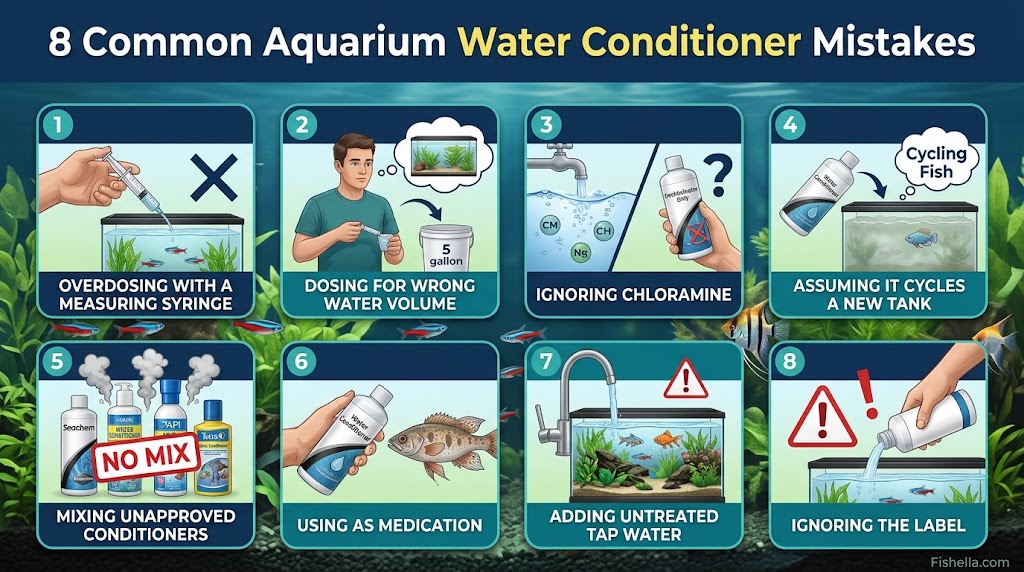
1. Using the Wrong Amount
Adding too little conditioner may leave chlorine or chloramine untreated. Adding too much can also be risky, especially with concentrated products.
Always measure the dose with a suitable syringe or measuring tool. Follow the instructions on your specific bottle.
2. Calculating the Dose Incorrectly
For routine water changes, many conditioners are dosed according to the amount of new tap water being added.
For example, if you replace 5 gallons of water, calculate the dose for 5 gallons—not automatically for the full 20-gallon aquarium.
However, some products have separate instructions for direct-to-tank treatment. Follow the manufacturer’s directions for that method.
3. Ignoring Chloramine in Tap Water
Some water supplies use chloramine instead of chlorine. A conditioner that treats chlorine but does not adequately treat chloramine may not protect your fish.
Check your local water supplier’s report or test your tap water. Choose a conditioner whose label specifically states that it treats chloramine.
4. Assuming Conditioner Replaces the Aquarium Cycle
Water conditioner does not establish a healthy biological filter.
Even when a product claims to detoxify ammonia or nitrite temporarily, it does not replace beneficial bacteria, water testing, or proper aquarium maintenance.
Keep monitoring ammonia and nitrite, especially in a new or unstable aquarium.
5. Mixing Different Conditioners Without Checking Compatibility
Using several water conditioners together does not automatically provide better protection.
Different formulas may have overlapping ingredients or different instructions. Avoid combining products unless their manufacturers confirm that the combination is safe.
Choose one suitable conditioner and follow its label.
6. Using Conditioner as Fish Medication
Water conditioner is designed to treat tap water and certain water contaminants. It is not a general treatment for fish diseases.
If your fish show white spots, damaged fins, unusual swimming, or other signs of illness, identify the problem and use an appropriate treatment.
7. Adding Untreated Tap Water During Water Changes
Never assume that tap water is safe for fish just because it looks clean.
Treat new tap water with a suitable conditioner before adding it to the aquarium. Also check that the replacement water is close to the tank’s temperature.
8. Ignoring the Product Label
Dosage and instructions can vary between brands and formulas. A dose that is correct for one conditioner may be wrong for another.
Read the label every time you use a product, especially when switching brands or buying a different formula.
Remember: Use the correct conditioner, measure carefully, and treat every batch of replacement tap water. These simple habits help protect your fish during routine water changes.
What Aquarium Water Conditioner Cannot Do
Aquarium water conditioner helps make tap water safer, but it cannot solve every water quality problem. Understanding its limits helps you maintain a healthier aquarium.
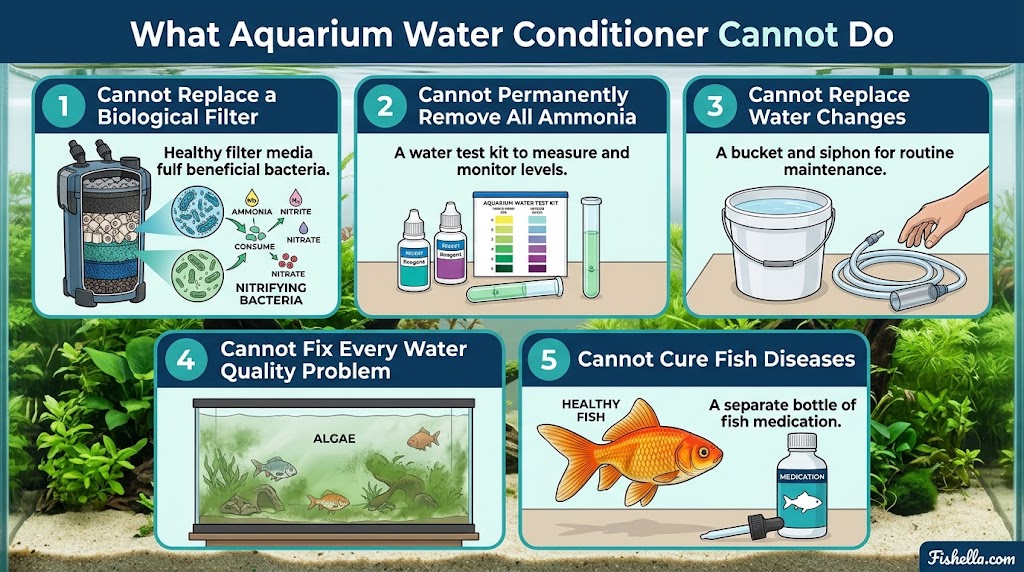
1. It Cannot Replace the Biological Filter
Water conditioner does not establish a healthy colony of beneficial bacteria. Your aquarium still needs a properly cycled biological filter to process fish waste.
Learn more in our guide to fishless cycling.
2. It Cannot Permanently Remove All Ammonia
Some conditioners claim to temporarily detoxify ammonia. However, this does not mean the ammonia has been permanently removed from your aquarium.
Continue testing ammonia and maintaining your biological filter. If levels rise, follow an appropriate water-change and troubleshooting plan.
Read our guide on how to lower ammonia in a fish tank.
3. It Cannot Replace Regular Water Changes
Conditioner does not remove all dissolved waste, excess nutrients, or organic material from aquarium water.
Regular partial water changes remain important. Use a suitable conditioner whenever you add untreated tap water.
4. It Cannot Fix Every Water Quality Problem
Cloudy water, algae growth, high nitrate, and unstable pH can have different causes.
A water conditioner is not a universal solution. Test your water and identify the actual problem before choosing a treatment.
If cloudy water is your concern, read our guide on why aquarium water becomes cloudy.
5. It Cannot Treat Every Fish Disease
A standard water conditioner is not a replacement for disease medication. It does not cure infections, parasites, or fungal diseases.
Identify the symptoms and choose an appropriate treatment when your fish become sick.
The bottom line: Aquarium water conditioner is mainly used to treat tap water before it enters your tank. A healthy aquarium also needs biological filtration, regular water changes, and routine water testings.
Frequently Asked Questions About Aquarium Water Conditioners
What is the best aquarium water conditioner?
Seachem Prime is a strong overall choice for many freshwater aquariums. It treats chlorine and chloramine and is highly concentrated. However, the best option depends on your tank, water supply, and preferred features.
Do I need water conditioner for every water change?
Yes, when you use untreated tap water. Treat each batch of new tap water before adding it to your aquarium. Follow the dosage instructions on your product.
How long does aquarium water conditioner take to work?
Many conditioners work quickly when used correctly. Follow the manufacturer’s instructions for the specific product. You generally do not need to leave treated water sitting overnight unless the product label says otherwise.
Can I add water conditioner directly to my fish tank?
Some products allow direct-to-tank treatment. However, the correct dose may differ from treating replacement water in a separate bucket. Follow the manufacturer’s instructions carefully.
Does water conditioner remove ammonia?
Some conditioners claim to temporarily detoxify ammonia. This does not mean they permanently remove it. Continue testing your water and maintaining a healthy biological filter.
Is aquarium water conditioner safe for all fish?
A suitable conditioner can be used with many freshwater fish when dosed correctly. Always check the product label for species, aquarium type, and dosage instructions.
Can I use too much aquarium water conditioner?
Yes. Incorrect dosing can cause problems, especially with concentrated products. Measure carefully and never increase the dose without checking the manufacturer’s instructions.
Should I use water conditioner in a betta fish tank?
Yes, if you use untreated tap water. Choose a conditioner suitable for freshwater aquariums and follow its label. For Betta-specific product recommendations, read our best Betta water conditioner guide.
Is water conditioner the same as beneficial bacteria?
No. Water conditioner treats certain substances in tap water, such as chlorine and chloramine. Beneficial bacteria help break down fish waste in the biological filter.
Learn more in our guide to the best beneficial bacteria for aquariums.
Final Verdict: Which Aquarium Water Conditioner Should You Buy?
Choosing the best aquarium water conditioner depends on your needs and tap water supply.
Seachem Prime is our best overall pick because it is concentrated and treats chlorine and chloramine. API Tap Water Conditioner is a simple option for basic dechlorination. Tetra AquaSafe Plus and API Stress Coat offer additional protective ingredients, while Fritz Complete is another concentrated option.
Before buying, check your local water supply and compare each product’s treatment claims and dosage instructions.
Most importantly, use the correct amount during every water change. Continue testing your aquarium water and maintaining a healthy biological filter.
A suitable water conditioner is an important part of fish care, but good aquarium maintenance keeps your fish healthy over time.
Pingback: Best Gravel Vacuum for Small Aquarium: 4 Top Picks (2026)