Yes, female betta fish can kill each other, though it’s less common than with males. Females are usually less aggressive than males, but they still establish a pecking order, and that can turn violent in the wrong setup. In a small or bare tank, a bully can chase a weaker fish until it’s injured, stressed, or dead.
That doesn’t mean female bettas can never live together. A group of females, called a betta sorority, can work in a large, heavily planted tank with the right numbers. But it’s not a guaranteed success, and it isn’t the best choice for a first-time fish keeper. If you’re still deciding, our female betta fish care guide covers the basics of keeping a single female happy.
Below, you’ll learn why female bettas fight, how to set up a sorority, how to spot trouble early, and what to do when fish need to be separated.
Do Female Bettas Fight?
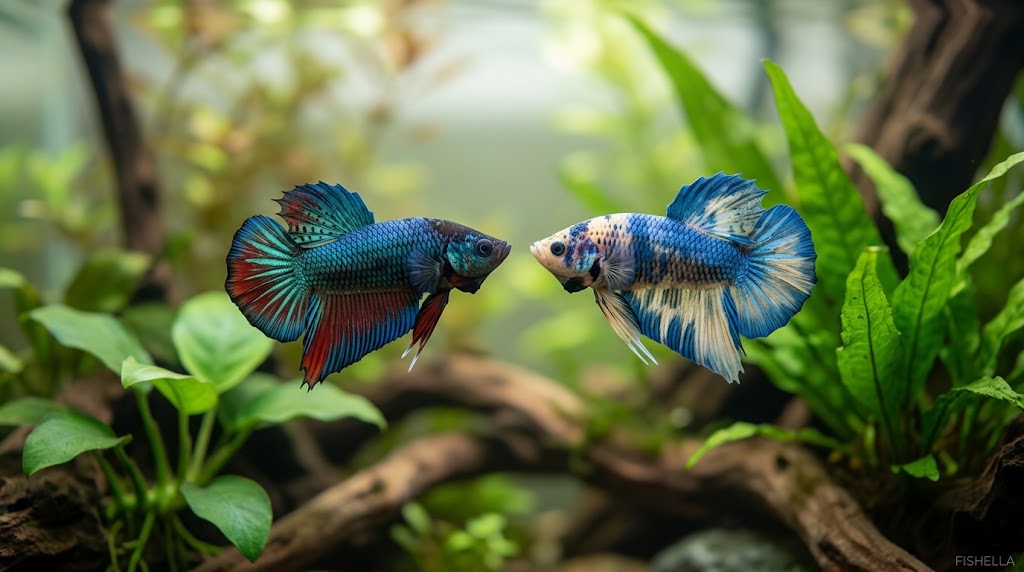
Female bettas do fight, but the fights usually look different from male fights. Males often lock into serious, damaging battles. Females tend to flare, chase, nip, and posture as they sort out who’s in charge.
Some squabbling is normal in the first days or weeks. Once a social order forms, a healthy group often settles down. The trouble starts when one fish keeps targeting another with no relief, or when the tank gives the weaker fish nowhere to escape.
Individual personality matters a lot. Some females are calm, and others are relentless bullies. You can’t always predict which one you’ve bought, which is why a sorority always carries some risk.
Can Female Bettas Live Together?
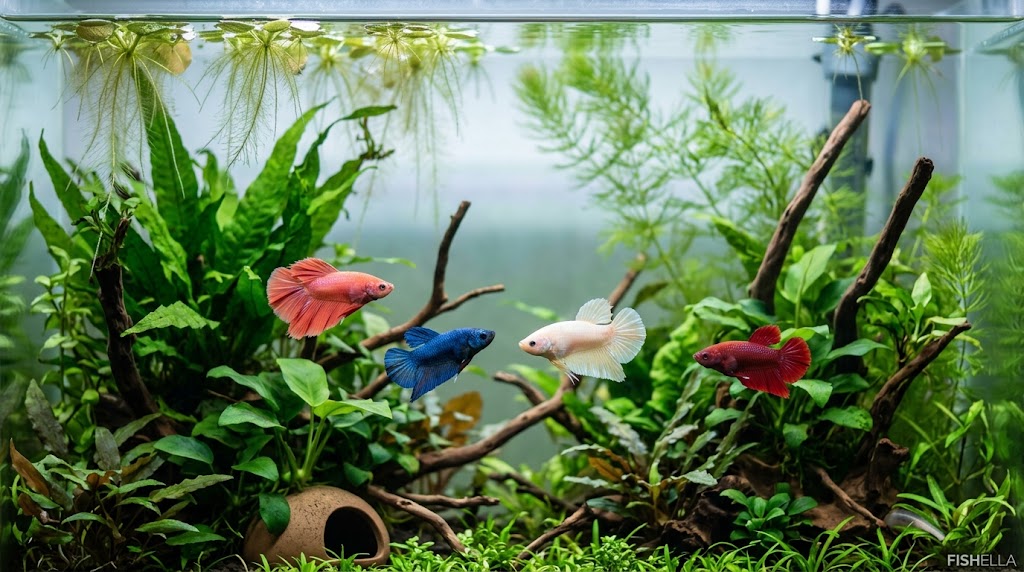
Female bettas can live together in some cases, but it takes the right conditions. Success depends mainly on tank size, group size, decor, and the temperament of the individual fish.
A sorority works best when you:
- Use a large tank, at least 20 gallons.
- Keep an odd number of females, usually 5 to 7.
- Add heavy planting and plenty of hiding spots.
- Introduce all the fish at the same time.
- Watch the group closely for the first few weeks.
Even then, keep a backup plan. A spare tank or tank divider means you can pull out a problem fish quickly.
Why Female Betta Fish Aggression Happens
Betta aggression comes from their natural instincts. These are territorial fish, and they defend space, food, and status. Cramped tanks make this worse because fish can’t get out of each other’s line of sight.
Common triggers include:
- Too little space. Fish that can’t retreat keep running into each other.
- Too few fish. With only two or three females, one often becomes the target. More fish spread the aggression around.
- Bare tanks. Without plants and decor, there’s no way to break up sight lines.
- Mixed introductions. A new fish added to an established group is usually treated as an intruder.
- Competition for food. Bold fish can guard the feeding area.
What Is the Best Tank Setup for a Betta Sorority?
The best sorority setup is a large, heavily planted tank with lots of visual barriers and stable water. Bigger is safer. Length also matters, since more floor space gives fish more room to get away from each other.
Tank Size
Plan on at least 20 gallons. A 20-gallon “long” tank is popular because it has more horizontal swimming room than a standard 20-gallon. If you can go larger, you’ll have more margin for error.
How Many Females Should You Keep?
Most sorority guides suggest 5 to 7 females in a tank of 20 gallons or more. An odd number helps prevent the group from splitting into pairs, and a larger group spreads out aggression so no single fish takes all of it. Avoid keeping just two or three, since that’s when one fish often gets singled out.
Plants and Hiding Spots
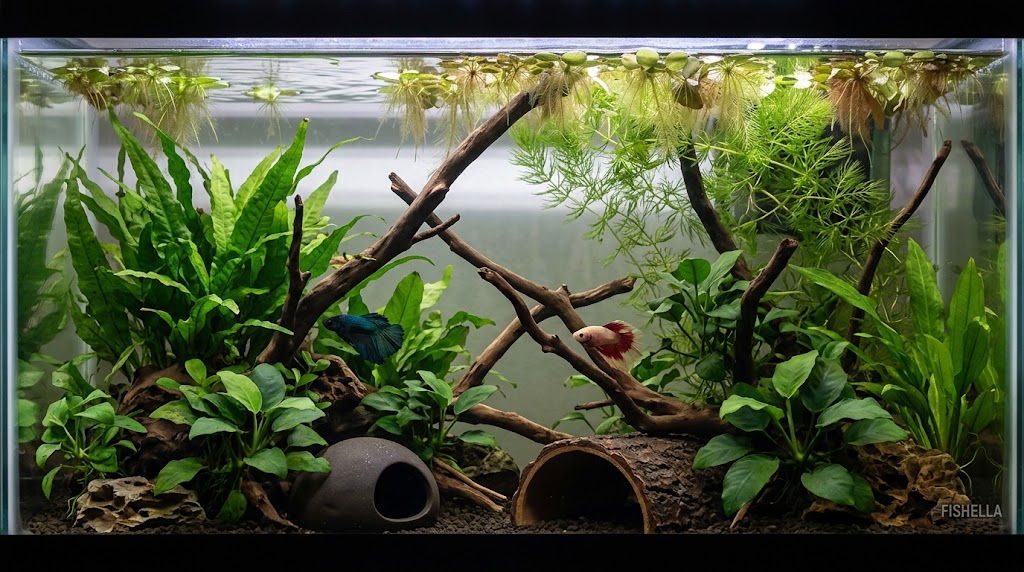
Heavy planting is one of the most important parts of a sorority. Dense plants create barriers that break line of sight, so fish can rest without being chased. Live plants also help with water quality by taking up some waste.
Good options include:
- Live plants such as java fern, anubias, hornwort, and floating plants like frogbit
- Betta caves, half logs, and ceramic decor
- Driftwood with plenty of nooks
- Tall background plants and dense floaters to cover the surface
Aim for many hiding places rather than a few. Each fish should be able to disappear from view when it needs to.
Filtration and Heater

Bettas do best in warm, stable water, typically around 78 to 80°F. Use an adjustable heater and a reliable thermometer, since room temperature swings can stress fish.
Choose a gentle filter. Bettas have long, delicate fins and don’t handle strong currents well. A sponge filter or a filter with adjustable flow works well. A filter also supports the beneficial bacteria that break down waste, which matters even more in a tank with several fish.
Water Quality in Betta Sororities
More fish means more waste, so water quality needs extra attention. In a healthy, cycled tank, ammonia and nitrite should read zero, and nitrate should stay low. Many keepers aim for nitrate under 20 ppm, though some fish tolerate a bit more.
Do regular partial water changes, often around 25 to 30 percent weekly, and test your water with a liquid test kit. Always treat new tap water before it goes in the tank, since chlorine and chloramine can harm fish. A good water conditioner for aquariums neutralizes these chemicals, so it’s worth choosing one you trust. If readings creep up, change water more often. Poor water quality stresses fish, and stressed fish are more likely to fight and get sick.
If you’re new to cycling and water testing, our guide on how to take care of tropical fish walks through the fundamentals before you add any fish.
How Do You Introduce Female Bettas Safely?
The safest method is to add all the fish at the same time. That way, no one owns the territory, and everyone starts on equal footing.
- Set up and cycle the tank first. Don’t add fish to an uncycled tank.
- Quarantine new fish. Keep new bettas in a separate tank for two to four weeks to watch for illness.
- Rearrange the decor right before adding the group so nobody has a claimed spot.
- Feed the fish beforehand so they’re less likely to be aggressive over food.
- Add all the fish together, ideally with the lights dimmed.
- Watch closely for the first few days and keep checking for weeks.
Quarantining new bettas matters because a single sick fish can spread illness to the whole group. The Merck Veterinary Manual’s aquarium fish section includes guidance on quarantine and biosecurity for the home aquarium. Buying females from the same source and same tank can also help, since fish that already know each other sometimes settle in more smoothly.
Signs a Betta Needs to Be Removed
Some chasing is normal early on. It’s a problem when it doesn’t stop or when a fish shows real harm. Remove a betta if you see:
- Constant chasing with no breaks
- Torn, ragged, or shredded fins
- Missing scales or visible wounds
- A fish hiding all the time and refusing to eat
- Clamped fins, pale color, or lethargy
- One fish clearly bullying others day after day
If a bully is the problem, removing that fish often calms the group. If a victim is the problem, move the victim to a recovery tank. Don’t wait too long, because betta injuries can go from minor to fatal quickly.
How to Separate Fighting Bettas

Act fast when a fight gets serious. Here’s how:
- Use a net or clean cup to gently scoop the aggressor or the injured fish.
- Move it to a separate tank or container that’s warm and filtered or regularly water-changed.
- Use a tank divider if you can’t set up another tank. Solid dividers block sight lines. Clear dividers still let bettas see and flare at each other.
- Cover any gaps. Bettas are good at slipping through small openings and jumping.
- Monitor the removed fish for injuries or illness.
If you must remove multiple fish, consider whether the sorority is the right fit. Some groups never settle, and that’s not a failure on your part. It’s just how those fish behave.
Betta Injuries, Torn Fins, and Fin Rot

Fighting can leave bettas with torn fins, scale loss, and stress. Minor tears often heal in clean water. The bigger concern is infection. Damaged fins can become entry points for bacteria, and poor water quality raises the risk.
Fin rot is a common problem where fins look frayed, ragged, or shortened, sometimes with darkened or reddish edges. It’s often linked to poor water conditions and stress, including stress from bullying. Since several conditions can look similar, avoid guessing at a diagnosis. Keep the fish in clean, warm water, and if things worsen or don’t improve, ask an aquatic or exotic-animal veterinarian for advice. The Merck Veterinary Manual’s overview of aquarium fish health is a useful reference on bacterial disease and common water quality problems.
Stress also weakens the immune system, so a bullied betta becomes more likely to catch other diseases.
Feeding Multiple Bettas
Feeding time can spark competition, so spread the food out. Drop pellets or flakes in a few spots, and use a mix of floating and sinking foods so shy fish get their share.
- Feed small portions once or twice a day.
- Watch each fish to make sure everyone eats.
- Remove uneaten food to protect water quality.
- Use a high-quality betta pellet as the base, with occasional frozen or freeze-dried treats.
Overfeeding fouls the water quickly, and a tank with many bettas can go downhill fast if waste builds up.
Betta Lifespan: How Long Do Bettas Live?
Betta fish age and lifespan depend heavily on care. In captivity, bettas commonly live around three to five years, and some live longer with excellent care. In the wild, Siamese fighting fish generally face harsher conditions and predators, so their lifespans tend to be shorter and are less well documented. For a deeper look, see our article on how long betta fish live.
There’s no clear rule that males or females live significantly longer than the other. Genetics, water quality, diet, temperature, and stress matter more than sex. Claims about the oldest betta fish are often unverified, so treat them with caution.
Life cycle basics: bettas hatch from eggs, grow through a fry and juvenile stage, and typically reach maturity within a few months. Stress and fighting can shorten the life of any betta, which is another reason to keep aggression in check.
Betta Care Guide: The Basics
Whether your bettas live alone or in a sorority, these basics apply:
- Temperature: about 78 to 80°F
- Filtration: gentle flow, cycled tank
- Water changes: regular partial changes, tested with a liquid kit
- Diet: quality betta pellets with occasional treats
- Decor: soft plants and smooth ornaments to protect delicate fins
For a full walkthrough, read our betta fish care guide. The University of Florida IFAS Extension also publishes a fact sheet on the culture and care of Betta splendens if you want a research-based reference.
If you’re not confident about a sorority, keeping one female betta in her own well-heated, filtered tank is a safe, low-stress choice.
Betta Rescue and Rehoming
If your sorority isn’t working, you have options. Consider setting up a second tank, using a divider, or rehoming a fish. Local aquarium clubs, reputable fish stores, and betta rescue groups can sometimes help. Never release an aquarium fish into local waterways, since it can harm native wildlife and the fish won’t survive.
Common Mistakes to Avoid
- Starting with too few females. Two or three tend to create a target.
- Using a small tank. Under 20 gallons rarely works well.
- Skipping plants and hiding spots. Bare tanks invite bullying.
- Adding fish over time. Newcomers are often attacked.
- Skipping quarantine. One sick fish can infect them all.
- Ignoring warning signs. Torn fins and hiding mean it’s time to act.
- Neglecting water quality. Stress and disease follow.
FAQs
Will female betta fish kill each other?
They can, especially in small tanks or poorly set up groups. Serious injury and death are more likely with too few fish, too little space, or a very aggressive individual. A large, planted tank lowers the risk but doesn’t remove it.
Can two female bettas live together?
It’s usually not recommended. With only two, one often bullies the other. Larger groups of five to seven spread aggression more evenly.
How big should a betta sorority tank be?
At least 20 gallons, preferably a long-style tank. Larger tanks give more room to escape and make it easier to keep water stable.
Why is my female betta chasing the others?
She may be establishing rank, defending territory, or guarding food. Brief chasing is normal. If it’s constant or injuries appear, separate her.
Can I add a new betta to an established sorority?
It’s risky. Established fish often see newcomers as intruders. If you must, quarantine the new fish first and rearrange the tank before adding her, and be ready to remove her.
How long do betta fish live?
In captivity, commonly around three to five years, sometimes longer. Good water quality and low stress help.
Do male and female bettas live the same length of time?
Generally, yes. Care quality matters far more than sex.
What should I do if my betta has torn fins?
Keep the water clean and warm, separate the fish if it’s being bullied, and watch for signs of infection. If it worsens, consult an aquatic veterinarian.
Conclusion
So, will female betta fish kill each other? They can, but a well-planned setup greatly reduces the risk. A large tank of 20 gallons or more, five to seven females, dense plants, plenty of hiding spots, and steady water quality give a sorority its best chance. Keep a backup tank or divider ready, watch for warning signs, and be willing to separate any fish that needs it.
Your practical takeaway: if you’re new to bettas, start with a single female in her own tank by following our female betta fish care tips, and only try a sorority once you’re comfortable with water testing and reading fish behavior.