
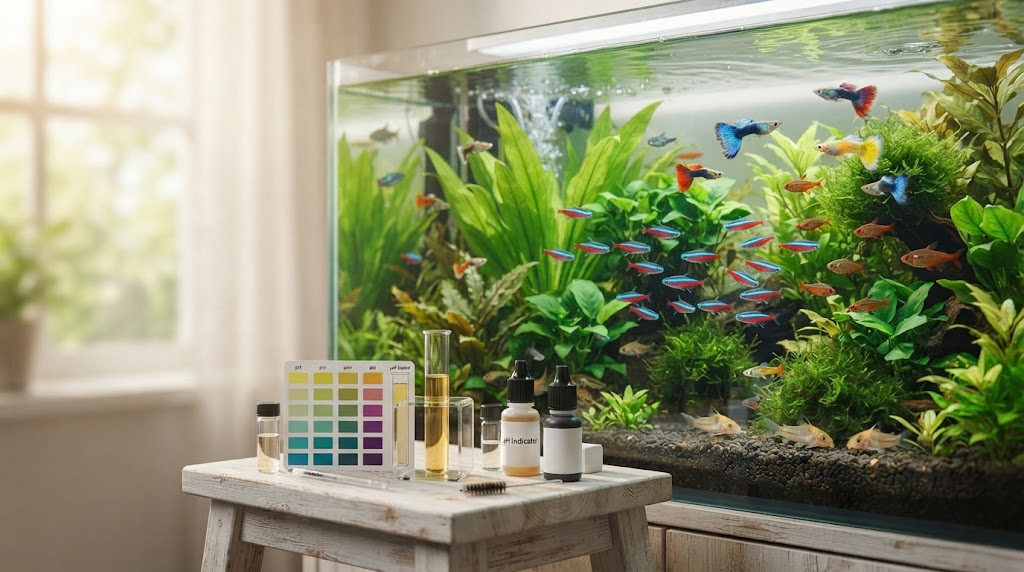
Find the ideal pH for freshwater fish tank setups, learn how to test it, and discover safe ways to raise or lower pH. A simple step-by-step guide for beginners. Your fish live in their water 24 hours a day. That makes water chemistry one of the biggest parts of their health, and pH is one of the first numbers new fish keepers learn about.
Many beginners search for the ideal pH for freshwater fish tank care and hope for one magic number The truth is simpler and kinder. Most fish do well in a range, and they do best when that range stays steady. A stable pH that suits your fish usually beats a “perfect” pH that keeps swinging up and down.
This guide shows you what pH means, how to test it, and how to adjust it safely if you need to.
1. What Is pH and Why Does It Matter for Freshwater Fish?
pH tells you how acidic or alkaline your water is. The scale runs from 0 to 14. Most freshwater aquariums fall between about 6.0 and 8.5.
- Below 7.0 is acidic.
- Around 7.0 is neutral.
- Above 7.0 is alkaline (also called basic).
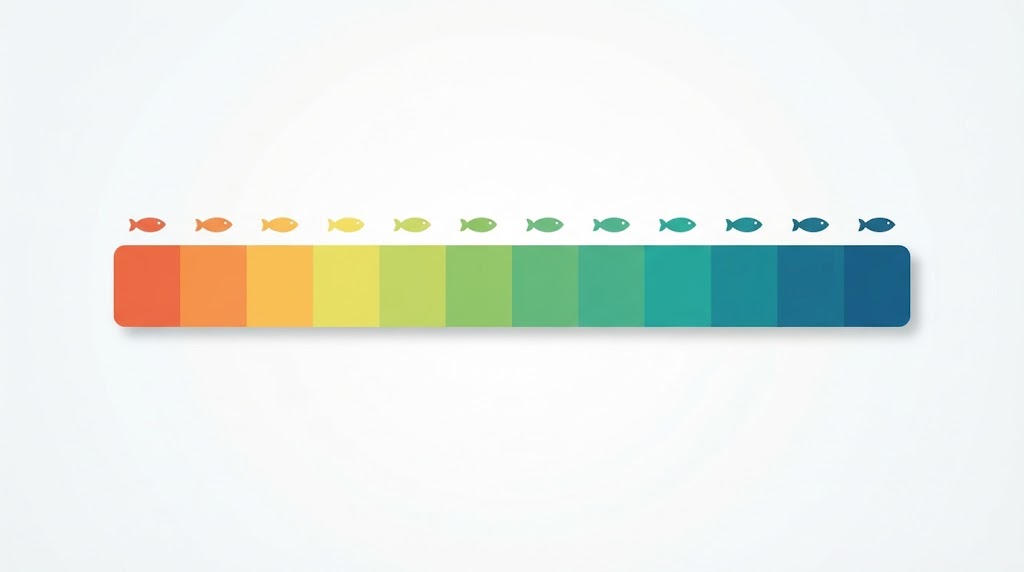
The scale is not a straight line. Each whole number is a tenfold change. So water at pH 6.0 is ten times more acidic than water at pH 7.0.
Fish are sensitive to this. A fast pH swing can stress them, and stressed fish are more likely to get sick. Merck Veterinary Manual notes that poor water quality is the most common cause of environmentally induced diseases, which is why testing matters. A veterinary water-quality article from WAVMA also notes that rapid changes in pH are detrimental to fish, so a stable pH is very important. merckvetmanualvin
How pH Differs From Ammonia, Nitrite, and Nitrate
pH is one of several aquarium water parameters. It works differently from the others.
- Ammonia comes from fish waste and rotting food. It is toxic.
- Nitrite is made when helpful bacteria break down ammonia. It is also toxic.
- Nitrate is the end product of that process. It is far less harmful, but high levels still cause stress.
Ammonia and nitrite are poisons. pH is more like a “setting” for the water. But pH can make ammonia more dangerous. Merck notes that rising pH increases ammonia toxicity. merckvetmanual
If your tank is new, learn how to cycle a fish tank fast so these toxins stay at zero.
2. What Is the Ideal pH for Freshwater Fish Tank Setups?
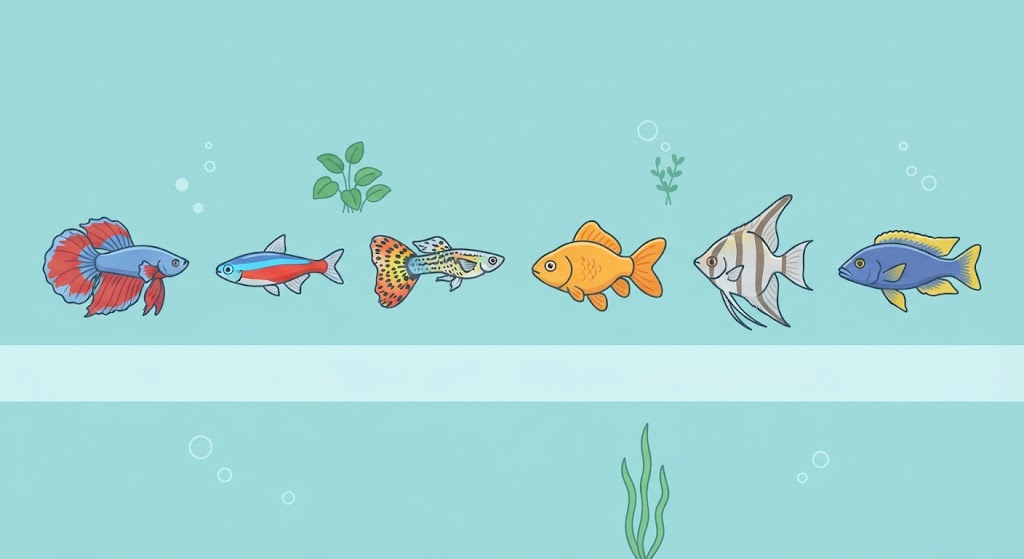
The ideal pH for freshwater fish tank water depends on the species you keep, not on one universal number. Different species come from different waters. Some live in soft, acidic rivers. Others live in hard, alkaline African lakes.
The table below shows common ranges. These are general guides. Check the needs of your exact species, and ask where your fish came from.
| Fish | Suitable pH Range | Notes |
|---|---|---|
| Betta fish | 6.5–7.5 | Do well in neutral water |
| Neon tetras | 6.0–7.0 | Prefer softer, slightly acidic water |
| Guppies | 7.0–7.8 | Handle neutral to slightly hard water |
| Goldfish | 7.0 to 7.5 | Prefer neutral to slightly alkaline water |
| Angelfish | 6.0 to 8.0 | Adapt well to a middle range |
| African cichlids | 7.8–8.6 | Need hard, alkaline water |
Notice that these ranges overlap in some places, but not all. Neon tetras and African cichlids should never share a tank. Their needs are too far apart.
The best approach is to pick fish that fit your tap water. Do that, and you rarely need to adjust anything. If you are still planning your tank, our guide to setting up a freshwater aquarium can help you choose.
3. Stable pH vs Perfect pH: Which Matters More?
Stable pH vs perfect pH is one of the most important ideas in this guide. For most beginners, stable wins.
Say your tap water is pH 7.6 and your guppies are thriving. That is a good tank. Adding chemicals to push it down to 7.0 can cause swings that hurt your fish more than the “wrong” number ever did.
When Should You Adjust pH?
Adjust pH only when there is a real reason. Good reasons include:
- Your pH is far outside your fish’s range, such as pH 8.2 with neon tetras.
- You are setting up a tank for fish with special needs, such as African cichlids.
- Your pH keeps dropping because of low buffering. (More on KH below.)
Here is a simple example. If your tap water is pH 7.4 and you want to keep bettas, do nothing. That is already fine. If your tap water is pH 5.8 and you want guppies, you will likely need a gentle, slow plan to raise it. Remember, the ideal pH for freshwater fish tank success is one that suits your fish and stays steady.
4. How to Test Aquarium pH Accurately
Testing is how you find out what is really happening in your tank. Aquarium water testing is cheap, quick, and one of the best habits you can build.
A good fish tank pH testing kit is the first thing to buy. You have two main choices.
Liquid Test Kits
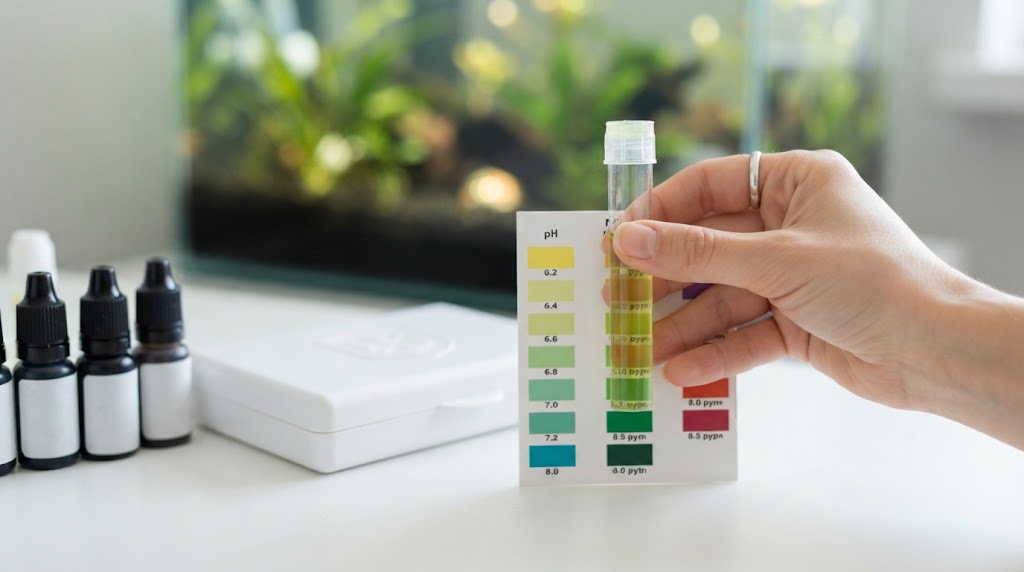
Liquid kits use drops of reagent that change the water’s color. Many beginners find them more accurate than strips. Here is how to use one:
- Rinse the test tube with tank water.
- Fill it to the line with tank water (usually 5 mL).
- Add the drops the instructions call for.
- Cap the tube and shake or swirl as directed.
- Wait the full time on the label.
- Compare the color to the chart in good light, ideally daylight or a white background.
pH Test Strips
Strips are fast and easy. You dip one in the water, wait a few seconds, and match the colors on the bottle. They are great for quick checks. They are usually a little less exact than liquid tests.
Tips for More Accurate Readings
- Check the expiration date. Old reagents give bad results.
- Use the exact number of drops. Hold bottles upside down for even drops.
- Time the test carefully. Reading too early or too late changes the color.
- Use good lighting. Colored light can fool your eyes.
- Test at the same time each day. pH can shift slightly over a day, so this gives you a fair comparison.
- Keep your hands and tubes clean. Soap or lotion can spoil a test.
If your fish are sick and your results look odd, test twice. It is worth the extra minute.
5. How Often Should You Test Aquarium pH?
Testing often is the easiest way to protect the ideal pH for freshwater fish tank conditions over time. Regular testing helps you catch small changes before they become big ones. Here is a simple schedule.
New tanks: Test pH, ammonia, and nitrite every day or every other day while the tank cycles. UF/IFAS suggests that nitrite should be tested every other day when an aquarium is first set up. ufl
Established tanks: Test pH about once a week, or at least every two weeks. Test right before a water change to see how your tank behaves over time.
Tanks with sick or stressed fish: Test right away, and then daily until things settle. Check pH, ammonia, nitrite, and nitrate together. Poor water quality is a common hidden cause of fish trouble.
Keep a notebook or a phone note with dates and numbers. A slow slide from 7.2 to 6.6 over a month tells a story. You will only see it if you write the numbers down.
6. How to Raise pH in Aquarium Water Safely
If you have confirmed that your pH is too low for your fish, you can raise it gently. If you are wondering how to raise pH in aquarium water, here are the safest methods. All of them work by adding minerals that harden the water and add buffering.
Crushed coral. Put a small amount in a mesh bag in your filter, or mix some into the substrate. It dissolves slowly and adds calcium and carbonate. It is a popular choice for African cichlid tanks.
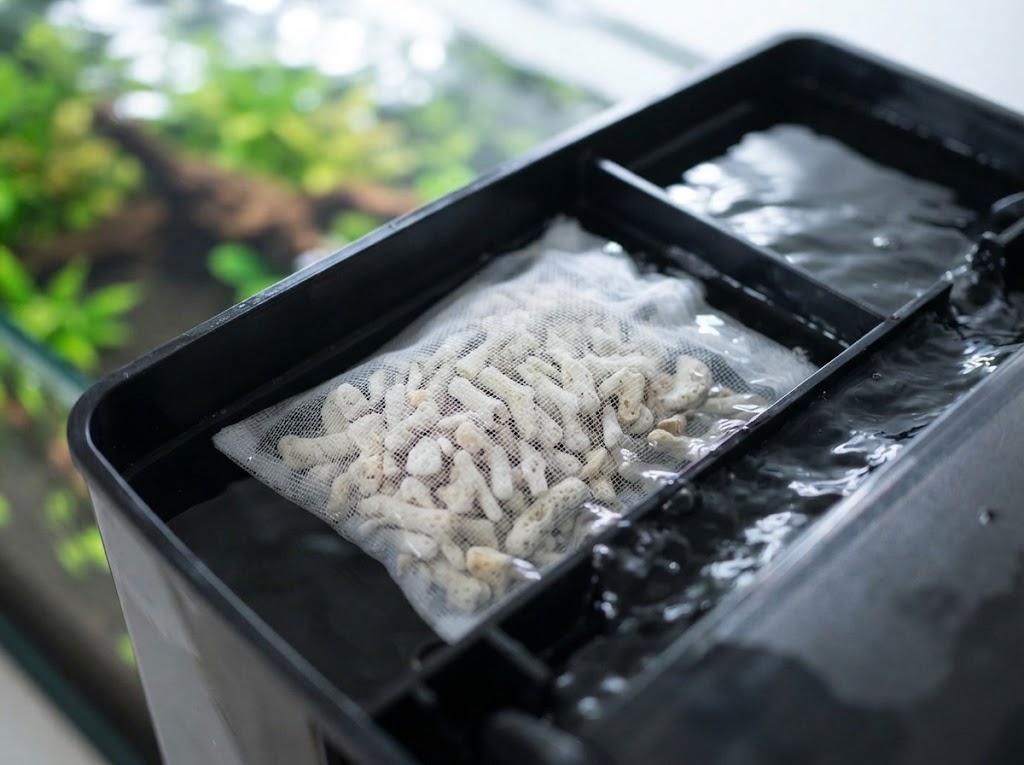
Aragonite. This is a calcium-rich sand or gravel that dissolves slowly. It works much like crushed coral and is easy to use as a substrate.
Aquarium buffers. Products made for freshwater tanks can raise pH and KH. Read the label closely. Use the smallest dose that works, and do not combine several products.
Go Slowly
The most important rule is to make changes gradually. A pH change of more than about 0.2 to 0.3 in a day can shock fish. An FAO aquaponics guide warns that changes of about 0.3 within 12 hours can be problematic or even lethal for fish. farmhub
A sensible plan is to add a little, wait a day, and test again. Small steps are safer than quick fixes.
7. How to Lower Aquarium pH Naturally
Some fish, like neon tetras, prefer softer, more acidic water. If you need to know how to lower aquarium pH naturally, these are gentle options.
Driftwood. Wood releases tannins into the water. Tannins can lower pH slightly and tint the water tea-brown. That tint is harmless, and many fish like it. Soak new driftwood first so it sinks and loses some of its tannins.
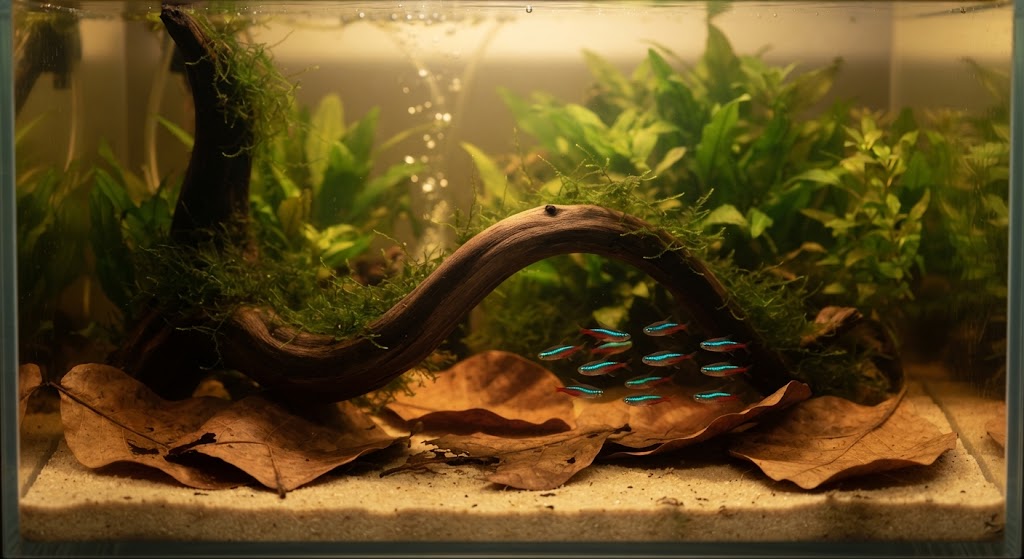
Indian almond leaves. These leaves release tannins as they break down. They also give shelter and a natural look. Many keepers use them in betta and tetra tanks.
Botanicals. Items like alder cones and seed pods act in a similar way. They add tannins and a natural feel.
What to Know Before You Try
These methods are mild. They do not work like a switch. They also change more than pH. They can darken the water and soften it a little.
If your tap water has high KH or is strongly buffered, lowering pH can be very hard. The water will resist change and spring back. In that case, you may do better by choosing fish that suit your water. Another option is to mix tap water with RO (reverse osmosis) water, which has very few minerals. Make that change slowly and test often.
8. How to Keep Aquarium pH Stable
Stability comes from buffering. That is where KH comes in.
KH (carbonate hardness) measures how well your water resists pH changes. High KH means a steadier pH. Low KH means pH can drop quickly, sometimes without warning. UF/IFAS explains that alkalinity is important because it buffers the pH of water. You can read their fact sheet on alkalinity and hardness. ufl. Good buffering helps you hold the ideal pH for freshwater fish tank inhabitants without constant adjustments.
Here is how to keep your tank steady:
- Do regular partial water changes. Over time, pH drifts lower as waste builds up and buffering is used up. Fresh water refills the buffer. Our guide on how to clean a fish tank shows an easy routine.
- Avoid unnecessary chemicals. Every product you add can move your pH or KH. Add only what you need.
- Know your decorations. Limestone, some rocks, and shells can raise pH and hardness. Driftwood can lower it. Check before adding new items.
- Check your substrate. Aragonite and crushed coral raise pH. Plain gravel and sand usually do not.
- Watch algae and lights. Plants and algae use carbon dioxide during the day and can cause small daily pH swings. A steady aquarium light schedule helps, and so does keeping fish tank algae under control.
- Test your tap water pH. This is the step most beginners skip. Fill a glass, let it sit for a few hours, and test it. Then test again after a few days. Some tap water changes pH as gas leaves the water.
Knowing your source water tells you what your tank will return to after every water change.
9. Common Aquarium pH Mistakes to Avoid
Every beginner makes some of these. Here is what to watch for.
- Chasing a perfect pH. A steady 7.4 is better than a tank that bounces between 6.8 and 7.6.
- Making sudden pH changes. Fast swings stress fish. Go slowly.
- Testing only after fish get sick. By then, the problem may be days old. Test on a schedule.
- Ignoring KH. If KH is very low, your pH may crash, even if today’s reading looks fine.
- Using household chemicals. Do not use vinegar, lemon juice, or cleaning products. Their effects are hard to control and can be dangerous to fish.
- Adding too many pH products. Products can fight each other and cause wild swings. Pick one method and stick with it.
- Skipping tap water tests. If you do not know your starting point, you cannot plan changes well.
10. Frequently Asked Questions
What is the ideal pH for freshwater fish tank water?
There is no single number. Most community freshwater fish do well between about 6.5 to 7.5. Check your species, and aim to keep the pH steady.
Is 7.5 pH too high for freshwater fish?
No. A pH of 7.5 is fine for many fish, including guppies, goldfish, bettas, and angelfish. It is a bit high for fish like neon tetras, which prefer softer, slightly acidic water.
How can I raise aquarium pH naturally?
Crushed coral and aragonite are the most common choices. They dissolve slowly and add minerals that raise pH and KH. Make changes in small steps and test often.
How can I lower aquarium pH naturally?
Driftwood, Indian almond leaves, and botanicals can lower pH a little. High KH makes this harder. Mixing in RO water can help, but do it slowly.
How often should I test aquarium pH?
Test daily or every other day in a new tank. In an established tank, once a week is a good habit. Test right away if your fish look sick.
Is stable pH better than perfect pH?
Usually, yes. Fish handle a steady pH well, even if it is not exactly ideal. Big swings are what cause stress.
What is the best fish tank pH testing kit?
For beginners, a liquid freshwater test kit is a good choice. It is usually more accurate than strips. Look for a kit that also tests ammonia, nitrite, and nitrate, so you can see the full picture. Always check the expiration date.
Conclusion
The ideal pH for freshwater fish tank success depends on the fish you keep. Bettas, tetras, guppies, goldfish, angelfish, and cichlids all have different needs. The key is to match your fish to your water, test it regularly, and avoid big, quick changes.
If you need to adjust pH, go slowly. Use gentle tools like crushed coral or driftwood, and keep an eye on KH. For most beginners, stable, suitable pH is more important than hitting one exact number.
Test, write down your results, and enjoy your fish. You are already on the right track.
Sources: Merck Veterinary Manual: Environmental Diseases of Aquatic Systems · UF/IFAS: Water Quality Notes, Alkalinity and Hardness · UF/IFAS: Water Quality Notes, pH
Species pH ranges are general guidelines drawn from common aquarium practice. Always check the needs of your specific fish.
Pingback: Betta Fish Laying on Side: Common Causes & Simple Fixes