
Affiliate Disclosure: This article contains affiliate links. If you purchase a product through these links, Fishella may earn a small commission at no additional cost to you. As an Amazon Associate, Fishella earns from qualifying purchases. We only recommend products we believe may be useful to aquarium owners. Our opinions and recommendations remain independent.
Choosing the best aquarium salt for freshwater fish can make a difference when you need a suitable product for aquarium maintenance or a specific fish-care situation. However, not every aquarium salt works the same way, and using the wrong type or amount can create problems for your fish.
Some products provide sodium chloride for freshwater aquarium use, while others contain mineral blends designed for different purposes. You also need to consider whether your aquarium contains live plants, shrimp, snails, or sensitive fish.
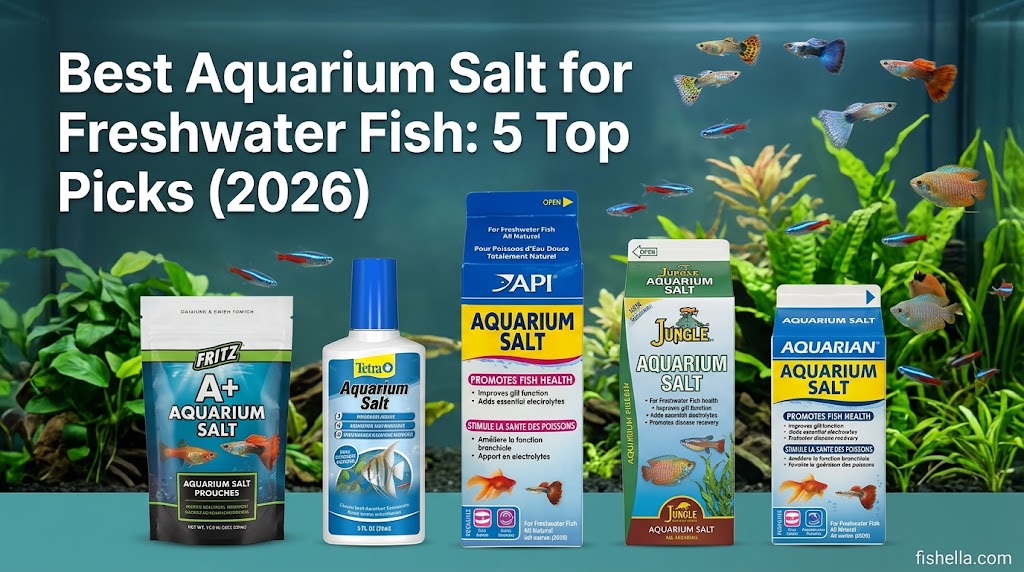
In this guide, we compare five freshwater aquarium salt products, explain their differences, and help you choose the right option for your setup. You’ll also learn what to check before buying, how to understand product directions, and which mistakes to avoid.
Quick recommendation: API Aquarium Salt is a strong starting choice for general freshwater aquarium use. Fritz A+ is another option worth considering if you want a product with detailed manufacturer instructions for different applications. Tetra and Jungle offer additional freshwater-specific alternatives. Not sure how many gallons your tank holds? Use our aquarium volume calculator to find out.
Quick Comparison: Best Aquarium Salt for Freshwater Fish
Our top pick: API Aquarium Salt for aquarium owners who want a widely established freshwater-specific product with clearly published directions.
| Product | Best For | Main Advantage | Important Consideration |
|---|---|---|---|
| API Aquarium Salt | Best overall | Clear freshwater-specific instructions | Use carefully with live plants |
| Fritz A+ Aquarium Salt | Versatile freshwater use | Multiple documented applications | Different applications require different instructions |
| Tetra Aquarium Salt | Beginner-friendly option | Specifically formulated for freshwater aquariums | Check the package for current dosage |
| Jungle Aquarium Salt | General aquarium maintenance | Simple freshwater aquarium use | Follow the package directions |
| Aquarian Aquarium Salt | Larger-package option | 36-ounce freshwater product | Compare its label and value before buying |
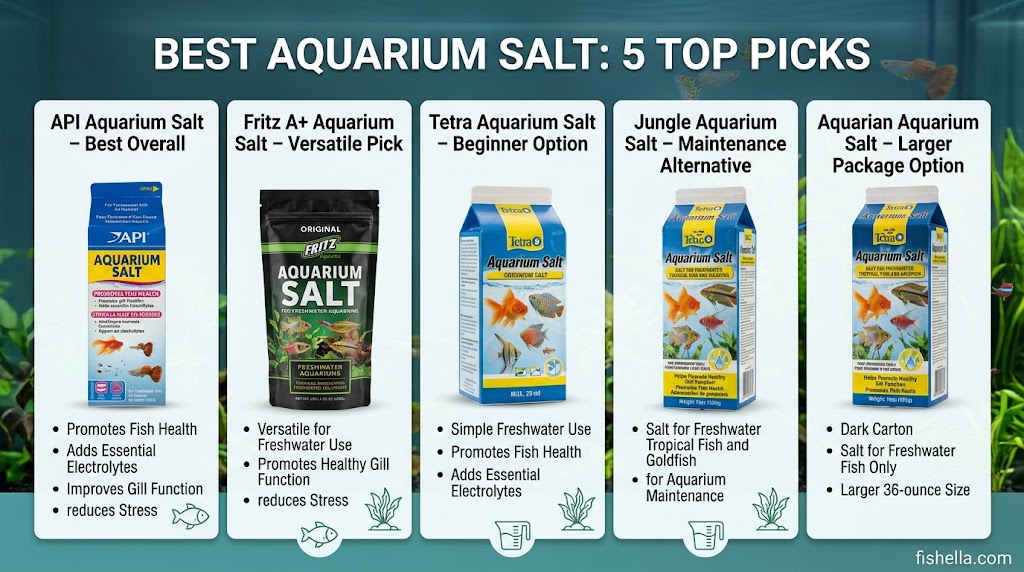
1. API Aquarium Salt – Best Overall
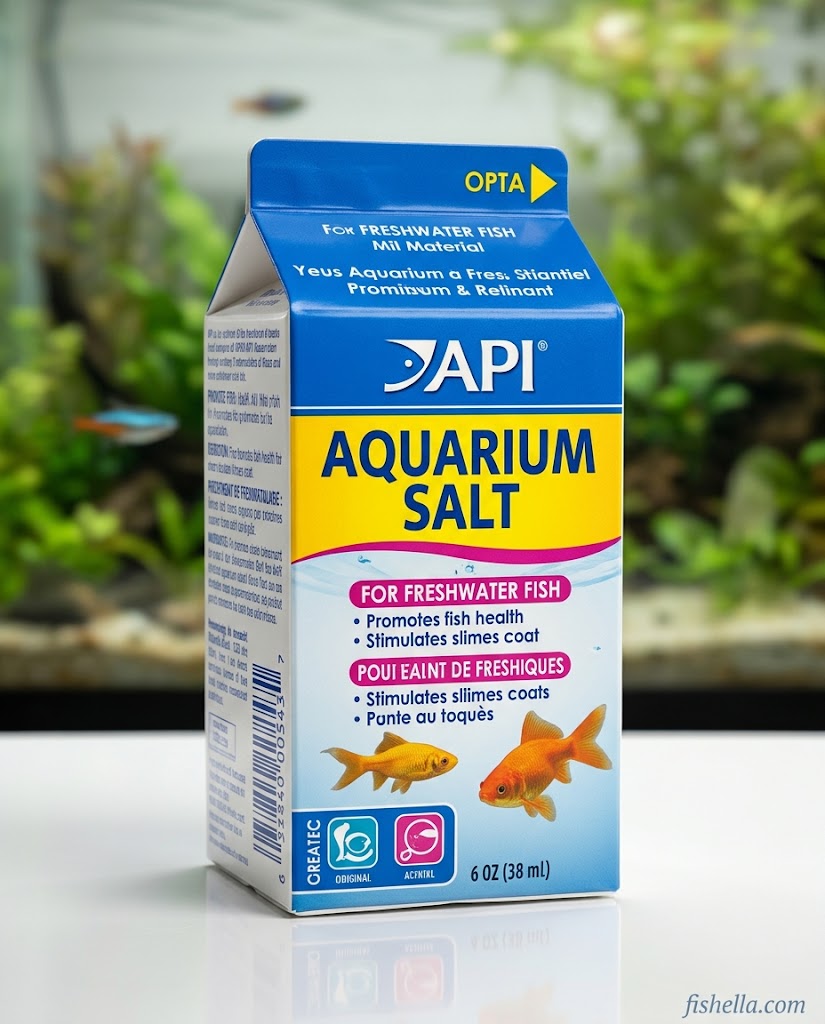
API Aquarium Salt is one of the most recognizable freshwater aquarium salt products. It is made for freshwater fish and provides sodium chloride for aquarium applications.
The manufacturer describes several intended uses, including new aquarium setup, water changes, and supporting fish during certain health problems.
Key Features
- Designed for freshwater aquariums.
- Made from evaporated seawater.
- Provides electrolytes.
- Supports normal gill function and osmoregulation.
- Available in several package sizes.
- Includes manufacturer dosing instructions.
Why We Recommend API Aquarium Salt
The biggest advantage of API Aquarium Salt is its straightforward product information.
You can check the manufacturer’s directions before purchasing and determine whether the product suits your aquarium. The brand also offers different package sizes, which makes it easier to choose an amount based on your needs.
API provides a published standard dosage of one rounded tablespoon per five US gallons of aquarium water. Always check the instructions on your specific package.
Another important point is that aquarium salt does not evaporate or get removed through ordinary filtration. You should not automatically add another full-tank dose whenever you top off evaporated water.
Pros
- Established aquarium product.
- Clear freshwater-specific instructions.
- Multiple package sizes.
- Suitable for various freshwater aquarium applications when used as directed.
- Manufacturer provides product information and safety guidance.
Cons
- Requires careful measurement.
- Some live plants may be sensitive to salt.
- Not a replacement for disease-specific medication.
- Incorrect repeated dosing can cause salt accumulation.
Best for: Freshwater aquarium owners who want a familiar product with clearly published instructions.
Buying recommendation: Check the official API Aquarium Salt product page for current package sizes and product directions.
2. Fritz A+ Aquarium Salt – Best for Versatile Freshwater Applications
Fritz A+ Aquarium Salt is another established option for freshwater fish owners.
Fritz describes this product as a source of essential electrolytes that supports freshwater fish health and osmoregulation. Its product instructions cover several applications, including freshwater aquarium conditioning and specialized salt baths.
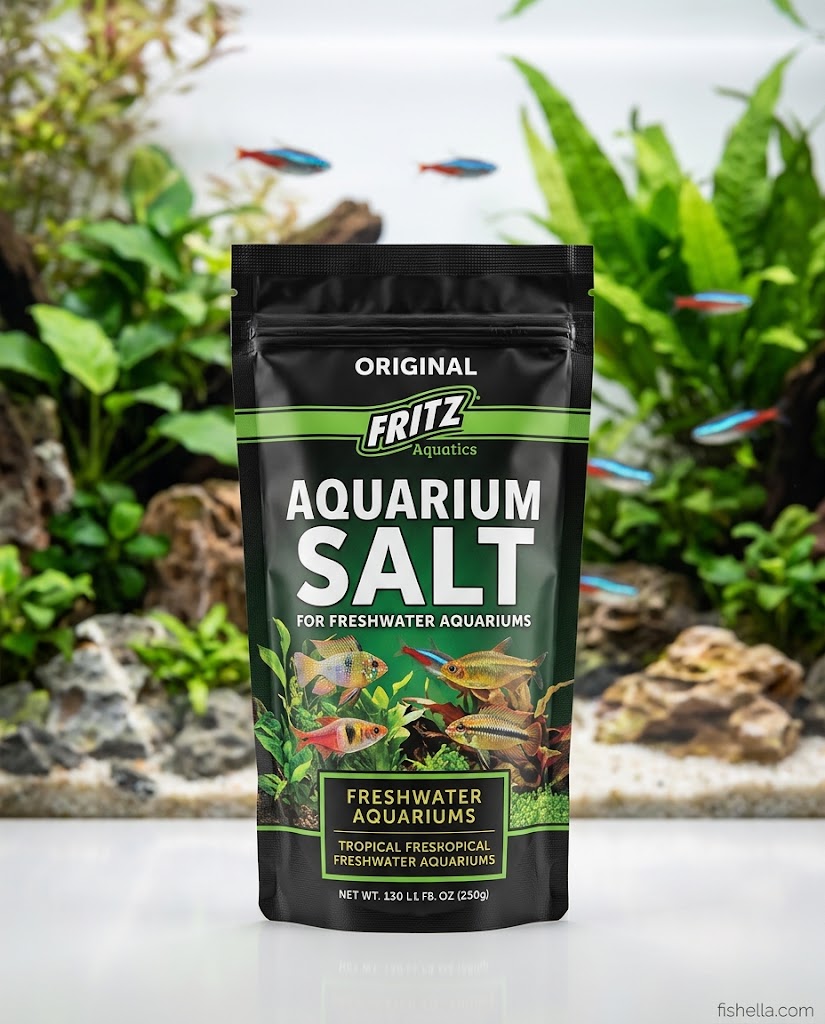
This makes it worth considering if you want a product with more detailed application guidance.
Key Features
- Designed for freshwater aquarium use.
- Provides essential electrolytes.
- Supports osmoregulation.
- Manufacturer documents different applications.
- Available in 1-pound, 2-pound, and larger packages.
Why We Recommend Fritz A+
One useful feature of Fritz A+ is the detailed product information.
The manufacturer provides separate instructions for tropical community and goldfish tanks, livebearer tanks, and specialized external parasite baths.
However, these applications use different concentrations. Do not confuse a routine aquarium dose with a concentrated treatment bath.
For tropical community and goldfish tanks, Fritz specifies one tablespoon per five gallons in its product directions. Its specialized livebearer and bath instructions are different and should not be treated as general-purpose dosing advice.
If you are treating a sick fish, consider using a separate hospital tank when appropriate and follow professional guidance.
Pros
- Detailed manufacturer instructions.
- Several package sizes.
- Suitable for different freshwater applications when used correctly.
- Useful product documentation.
Cons
- Different applications require different concentrations.
- Specialized salt baths can be stressful or dangerous if performed incorrectly.
- Salt-sensitive plants require extra caution.
- Not a universal fish medication.
Best for: Experienced fishkeepers who want a freshwater salt product with documented application options.
Buying recommendation: Check the Fritz A+ product label and confirm that you are purchasing the correct product rather than a marine salt mix.
3. Tetra Aquarium Salt – Best for Beginners
Tetra Aquarium Salt is specifically formulated for freshwater fish tanks, including tropical and goldfish aquariums.
It is another option for beginners who want a product from an established aquarium brand.
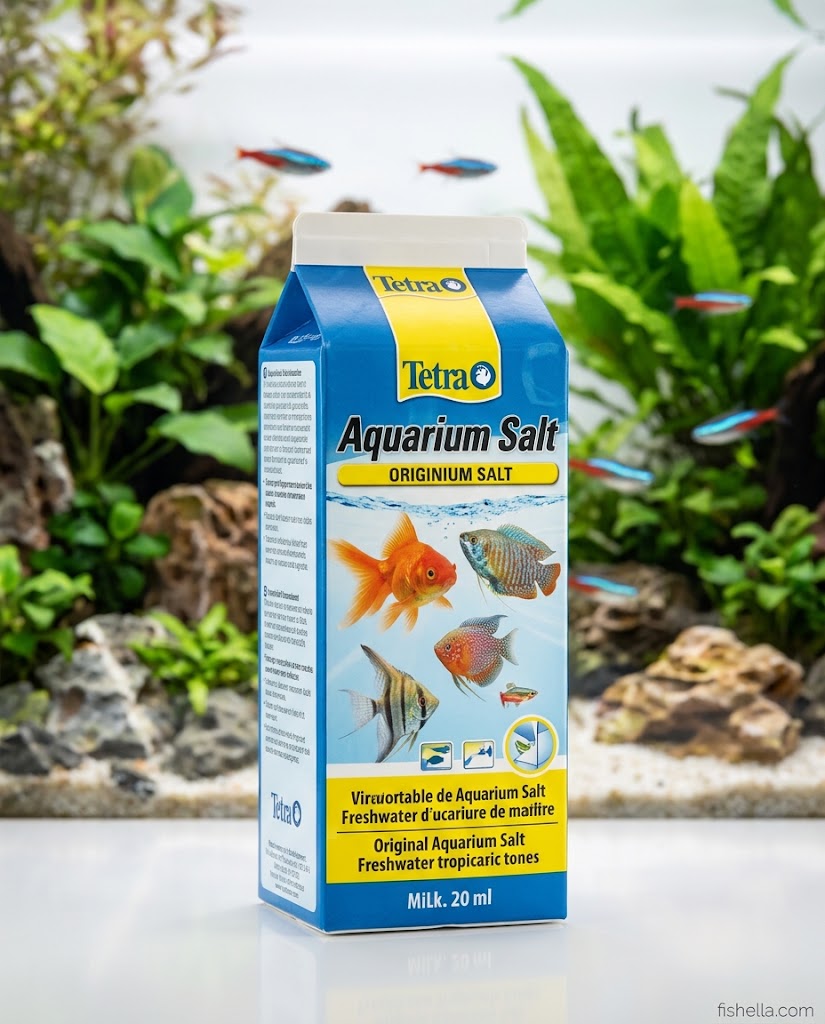
Tetra describes several uses, including providing electrolytes, introducing new fish, aquarium maintenance, and cleaning aquarium accessories.
Key Features
- Formulated for freshwater aquariums.
- Suitable for tropical and goldfish aquarium applications.
- Provides beneficial electrolytes.
- Can be used for certain aquarium maintenance tasks.
- Compatible with Tetra water conditioners and its aquarium care products according to the manufacturer.
Why We Recommend Tetra Aquarium Salt
Tetra offers an alternative to API and Fritz for aquarium owners who prefer its product range.
One advantage is that the manufacturer explains its intended uses and provides guidance about freshwater fish and live plants.
However, do not assume that every freshwater aquarium needs salt every month. Choose an application based on the manufacturer’s current instructions and your fish’s actual needs.
Tetra also warns that some live plants may be sensitive to salt, so plant compatibility deserves attention before purchasing.
Pros
- Established aquarium brand.
- Specifically formulated for freshwater fish.
- Suitable for tropical and goldfish aquarium applications.
- Multiple uses described by the manufacturer.
- Useful alternative to other freshwater salt products.
Cons
- Some live plants may be sensitive.
- Requires correct measurement.
- Not a substitute for targeted fish medication.
- Current package directions should be checked before use.
Best for: Beginners looking for a freshwater-specific product from a familiar aquarium brand.
Buying recommendation: Check the current package instructions for the correct application and dosage.
4. Jungle Aquarium Salt – Best for General Aquarium Maintenance
Jungle Aquarium Salt is another freshwater aquarium product worth comparing.
The manufacturer describes it as a product for reducing fish stress, providing beneficial electrolytes, cleaning aquarium accessories, and hatching brine shrimp eggs.
Its product description also recommends adding it with water changes to help condition aquarium water.
Key Features
- Aquarium-specific salt product.
- Provides beneficial electrolytes.
- Intended for freshwater aquarium applications.
- Can be used for certain accessory-cleaning tasks.
- Can be used for brine shrimp egg hatching.
Why We Recommend Jungle Aquarium Salt
Jungle provides another option for fishkeepers who do not necessarily want to purchase API or Fritz.
Its product description covers several aquarium-related applications, which makes it worth comparing when shopping for freshwater aquarium salt.
However, the manufacturer does not provide a complete numerical dosage in the product information reviewed for this guide.
For that reason, check the physical package before purchasing and do not estimate a dose based on another brand’s instructions.
Pros
- Designed for aquarium use.
- Multiple intended applications.
- Alternative to more widely recognized brands.
- Useful for aquarium accessory cleaning when properly prepared.
Cons
- Current dosage information should be verified on the package.
- Availability can vary.
- Live plants may require additional caution.
- Not intended to replace targeted disease treatment.
Best for: Aquarium owners who want an alternative freshwater salt product for general aquarium applications.
Buying recommendation: Verify the product label and package instructions before using it.
5. Aquarian Aquarium Salt – Best Larger-Package Option
Aquarian Aquarium Salt is another freshwater-specific option worth comparing, particularly if you prefer a larger package.
This product is marketed under the Aquarian name by API and comes in a 36-ounce package.
It uses sodium chloride and carries freshwater aquarium directions similar to API Aquarium Salt.
Key Features
- Specifically labeled for freshwater fish.
- 36-ounce package.
- Sodium chloride-based product.
- Manufacturer provides dosage instructions.
- Intended for aquarium setup, water changes, and certain fish-care applications.
Why We Recommend Aquarian Aquarium Salt
The main reason to consider Aquarian is its package size.
A larger package may offer better value if you already know that this product suits your aquarium and you expect to use it regularly.
However, remember that Aquarian and API Aquarium Salt are closely related product offerings from the same manufacturer. They should not be treated as two completely different salt formulations.
Compare the package instructions, cost per ounce, and availability before deciding which one to buy.
Pros
- Freshwater-specific product.
- Larger package.
- Clearly identified sodium chloride ingredient.
- Published manufacturer instructions.
Cons
- Less product differentiation from API Aquarium Salt.
- Larger packages may be unnecessary for small aquariums.
- Requires the same precautions regarding salt accumulation and sensitive plants.
Best for: Aquarium owners who prefer a larger package and have confirmed that its instructions suit their aquarium.
Which Aquarium Salt Should You Buy?
The best choice depends on your aquarium and how you intend to use the product.
Here is a simple buying recommendation:
| Your Requirement | Recommended Product |
|---|---|
| General freshwater aquarium use | API Aquarium Salt |
| Multiple documented freshwater applications | Fritz A+ Aquarium Salt |
| Beginner-friendly alternative | Tetra Aquarium Salt |
| Alternative for aquarium maintenance | Jungle Aquarium Salt |
| Larger package option | Aquarian Aquarium Salt |
For most beginners, I would start by comparing API and Tetra.
If you need more detailed application instructions, compare Fritz A+. If package size and value matter most, compare API and Aquarian before making a purchase.
Do not buy a product simply because it claims to treat several fish problems. Check its actual ingredients, intended applications, and safety instructions.
What to Look for Before Buying Aquarium Salt
Before purchasing aquarium salt, compare the following factors.
1. Check the Ingredients
Always read the ingredient information.
Standard freshwater aquarium salt is generally sodium chloride. Epsom salt contains magnesium sulfate, while marine salt mixes contain a combination of salts and minerals intended to recreate seawater.
These products have different purposes.
Avoid assuming that any product with the word salt on its packaging is appropriate for your freshwater aquarium.
2. Choose a Freshwater-Specific Product
Check whether the manufacturer specifically identifies the product for freshwater aquariums.
Do not confuse freshwater aquarium salt with reef or marine salt mixes.
A marine salt mix is designed to create saltwater conditions. It is not the right product for routine use in an ordinary freshwater community aquarium.
3. Compare Package Sizes
A small package may suit an aquarium owner who only needs occasional use.
A larger package may offer better value if you have several aquariums or regularly use the product for an approved application.
However, do not purchase more salt than you can reasonably store and use.
Keep the package sealed, dry, and away from children and pets.
4. Read the Dosage Instructions
A good product should provide clear directions.
Check:
- Recommended quantity.
- Aquarium water volume.
- Intended application.
- Frequency of use.
- Species-specific precautions.
- Instructions for live plants and other aquarium inhabitants.
Never assume that two brands have identical dosing instructions.
5. Consider Your Aquarium Inhabitants
Before buying aquarium salt, consider everything living in your aquarium.
Some fish species tolerate salt better than others. Certain freshwater plants, shrimp, and snails may be sensitive to increased salinity.
If your aquarium contains sensitive inhabitants, consider whether a separate hospital tank is a better option.
6. Check the Manufacturer’s Product Information
Product packaging can change, and manufacturers may update instructions.
Read the latest label before buying. If the product does not clearly explain its intended use, choose an alternative with better documentation.
How Much Aquarium Salt Should You Use?
The correct aquarium salt dosage depends on the product, fish species, intended use, and aquarium conditions.
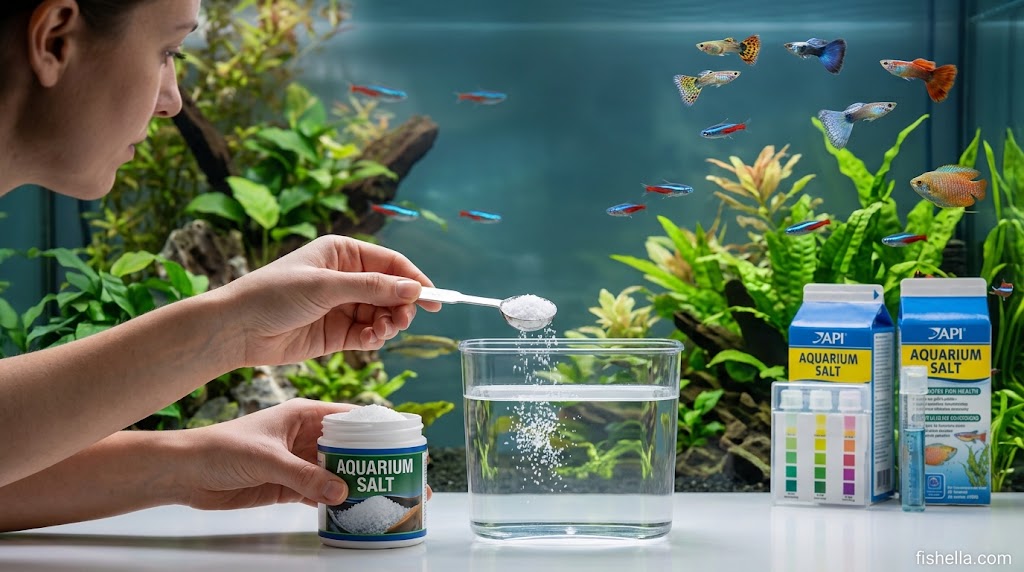
For example, API Aquarium Salt provides a standard manufacturer instruction of:
1 rounded tablespoon per 5 US gallons (approximately 19 liters) of aquarium water.
Fritz A+ provides a similar standard instruction for tropical community and goldfish tanks.
However, specialized treatment applications can require completely different concentrations.
Do not use a concentrated bath dosage as a routine aquarium dosage.
Aquarium Salt Dosage: Important Examples
| Aquarium Salt Product | Manufacturer’s Published Standard Guidance |
|---|---|
| API Aquarium Salt | 1 rounded tablespoon per 5 US gallons |
| Fritz A+ Aquarium Salt | 1 tablespoon per 5 gallons for tropical community and goldfish tanks |
| Tetra Aquarium Salt | Follow the current package directions |
| Jungle Aquarium Salt | Follow the current package directions |
| Aquarian Aquarium Salt | 1 rounded tablespoon per 5 US gallons |
These are product-label references, not a recommendation to add salt to every freshwater aquarium.
Important Dosage Warning
Aquarium salt does not evaporate and is not removed by ordinary biological filtration.
This means the salt can accumulate if you repeatedly add it without accounting for what remains in the aquarium.
When replacing water, calculate the replacement volume and follow the manufacturer’s instructions. Do not automatically dose the entire aquarium again when only a small amount of water has been replaced.
Also, topping off evaporated water does not remove salt. Only actual water removal and replacement reduce the amount of salt in the aquarium.
If you are treating fish, calculate the actual water volume carefully and use a separate treatment tank when appropriate.
Is Aquarium Salt Safe for Freshwater Fish?
Aquarium salt can be appropriate for certain freshwater fish applications when you choose the correct product and concentration.
However, it is not automatically safe for every species or aquarium.
Fish regulate the balance of water and electrolytes in their bodies through osmoregulation. Salt changes the surrounding water chemistry, so the concentration matters.
The Merck Veterinary Manual discusses salt use in aquarium fish management and explains why concentration and species tolerance matter.
Before using aquarium salt:
- Identify your fish species.
- Check the manufacturer’s instructions.
- Avoid unnecessary repeated dosing.
- Monitor fish behavior.
- Maintain good aeration.
- Watch for unusual stress or breathing problems.
- Seek aquatic veterinary guidance when treating serious illness.
If your fish show signs of distress after salt exposure, do not continue increasing the dose. Regular water testing and proper maintenance help maintain healthy aquarium water and prevent unnecessary stress on fish.
Is Aquarium Salt Safe for Live Plants?
Not always.
Some freshwater aquarium plants tolerate low salt exposure better than others, but sensitive species can experience damage.
Salt can affect plant growth, leaf condition, and overall health depending on the concentration and exposure time.
If you maintain a planted aquarium, do not assume that a product labeled for freshwater fish is automatically safe for every plant.
Consider these precautions:
- Check plant compatibility before dosing.
- Avoid unnecessary salt additions.
- Use a separate hospital tank for treatment when appropriate.
- Follow the product label.
- Monitor plants after any exposure.
For a heavily planted aquarium, using a separate treatment setup can be a better choice than exposing the entire aquarium. Explore the best live plants for betta tanks to create a healthier, natural habitat for your fish.
Is Aquarium Salt Safe for Shrimp and Snails?
Shrimp and snails deserve special attention.
Freshwater invertebrates can respond differently to changes in salinity. Some are particularly sensitive to sudden changes.
Do not use a fish salt treatment in a shrimp or snail aquarium without checking species-specific compatibility.
If your aquarium contains cherry shrimp, Amano shrimp, nerite snails, mystery snails, or other invertebrates, check the treatment instructions before adding salt.
A separate treatment tank can reduce unnecessary exposure to your main aquarium inhabitants.
Aquarium Salt vs. Epsom Salt: What’s the Difference?
Aquarium salt and Epsom salt are different products.
| Feature | Aquarium Salt | Epsom Salt |
|---|---|---|
| Main compound | Sodium chloride | Magnesium sulfate |
| Common purpose | Certain freshwater aquarium applications | Specific magnesium sulfate applications |
| Main minerals | Sodium and chloride | Magnesium and sulfate |
| Interchangeable? | No | No |
Aquarium salt is not a substitute for Epsom salt, and Epsom salt is not a substitute for standard freshwater aquarium salt.
Choose the product based on the specific problem you are addressing.
Do not add either product simply because a fish looks unhealthy. First identify the likely cause and determine whether the treatment is appropriate.
Can Aquarium Salt Treat Ich, Fin Rot, or Other Fish Diseases?
Aquarium salt has applications in fish health management, but it is not a universal disease treatment.
Different fish diseases require different approaches.
For example:
- Ich requires an appropriate parasite treatment plan.
- Fin rot requires attention to water quality, possible infection, and the cause of fin damage.
- Fungal infections may require a specific antifungal treatment.
- Bacterial infections may require targeted medication.
Salt may have a supporting role in certain situations, but you should not rely on it as the only treatment for every condition.
For a detailed disease-specific approach, read our guides:
- Common Freshwater Fish Diseases: Symptoms and Treatment
- Betta Fin Rot: Symptoms, Causes, Treatment and Recovery
- Betta Fish Ich: Symptoms, Treatment, and Prevention
These guides cover disease identification and treatment separately, so you can choose the right approach instead of guessing with aquarium salt.
Common Mistakes to Avoid When Using Aquarium Salt
Even a suitable aquarium salt product can cause problems if you use it incorrectly.
Avoid these common mistakes:
1. Using table salt without checking its ingredients
Household salt may contain additives or anti-caking agents. Use a clearly identified aquarium product unless you have reliable species-specific guidance for an alternative.
2. Confusing aquarium salt with marine salt
Marine salt mixes are designed for saltwater aquariums. They are not interchangeable with freshwater aquarium salt.
3. Adding salt during every top-off
Salt does not evaporate with water. Adding more salt whenever you replace evaporated water can increase the concentration.
4. Overdosing
More salt does not automatically produce better results. Excessive concentrations can stress or harm fish.
5. Ignoring live plants and invertebrates
Always check compatibility before adding salt to a planted aquarium or an aquarium containing shrimp and snails.
6. Treating every disease with salt
Salt does not replace proper diagnosis or targeted medication.
7. Mixing different treatments without checking compatibility
Do not combine aquarium salt with other medications unless the manufacturer or an aquatic veterinarian confirms that the combination is appropriate.
Frequently Asked Questions
What is the best aquarium salt for freshwater fish?
API Aquarium Salt is a strong general-purpose choice because it is specifically designed for freshwater aquariums and provides clear manufacturer instructions. Fritz A+ and Tetra Aquarium Salt are also worth comparing.
Can I use regular table salt in my freshwater aquarium?
Do not automatically use household table salt. It may contain additives that you have not checked. Choose an aquarium-specific product with clear ingredients and directions.
How much aquarium salt should I add to a 10-gallon tank?
API’s standard label instruction is one rounded tablespoon per five US gallons. However, do not treat this as a recommendation for every aquarium. Consider existing salt levels, fish species, plants, and the actual reason for using salt.
Should I add aquarium salt during every water change?
Follow the product’s instructions and account for salt remaining in the aquarium. Because salt does not evaporate, automatically replacing the full-tank quantity during every partial water change can cause accumulation.
Does aquarium salt kill beneficial bacteria?
Do not assume that ordinary aquarium salt dosing automatically destroys your biological filter. However, high concentrations and inappropriate treatment conditions can affect aquarium inhabitants and system stability. Monitor water quality and follow the product directions.
Can I use aquarium salt with betta fish?
Some fishkeepers use aquarium salt in certain betta-care situations, but bettas still require careful dosing and species-specific consideration. It is not a guaranteed treatment for fin rot or ich.
Read our Betta Fish Care Guide for more information about maintaining a healthy betta aquarium.
Can I use aquarium salt with goldfish?
Some freshwater aquarium salt products specifically include goldfish in their manufacturer instructions. Always use the correct concentration and consider the other inhabitants in the aquarium.
Is aquarium salt safe for guppies?
Guppies are freshwater livebearers, but that does not mean every salt concentration is appropriate. Follow the manufacturer’s species-specific directions and avoid unnecessary increases in salinity.
Does aquarium salt raise pH?
Standard sodium chloride aquarium salt is not intended as a pH-adjusting product. Do not use it to correct an aquarium pH problem.
How do I remove aquarium salt from a freshwater tank?
Partial water changes with appropriately conditioned freshwater gradually reduce salt concentration. The amount of water you replace determines how much salt you remove.
Avoid sudden changes that could stress your fish.
Can I use aquarium salt in a planted tank?
You should be cautious. Some aquatic plants are sensitive to salt, especially at higher concentrations. A separate treatment tank is often preferable when treating fish.
Is aquarium salt the same as marine salt?
No. Freshwater aquarium salt and marine salt mixes have different compositions and purposes. Use the product designed for your aquarium type.
Final Verdict: Which Aquarium Salt Should You Buy?
The best aquarium salt for freshwater fish depends on your aquarium setup and intended application.
After comparing the five options, API Aquarium Salt is our overall recommendation for freshwater aquarium owners who want a familiar product with clear manufacturer instructions.
Fritz A+ is worth considering if you want detailed guidance for multiple freshwater applications. Tetra offers another established freshwater-specific option, while Jungle provides an alternative for general aquarium maintenance. Aquarian is worth comparing if you prefer a larger package.
Before purchasing, check the ingredients, package size, dosage, and compatibility with your fish and plants.
Most importantly, remember that aquarium salt is not essential for every freshwater aquarium and is not a universal cure for fish diseases. Use it only when the application is appropriate.
Our final buying advice: Start with API Aquarium Salt, compare Fritz A+ and Tetra as alternatives, and always follow the current manufacturer instructions. Choosing the right product and using it correctly matters much more than simply buying the most expensive option.
Pingback: Betta Fish Ich: Symptoms, Treatment, and Prevention