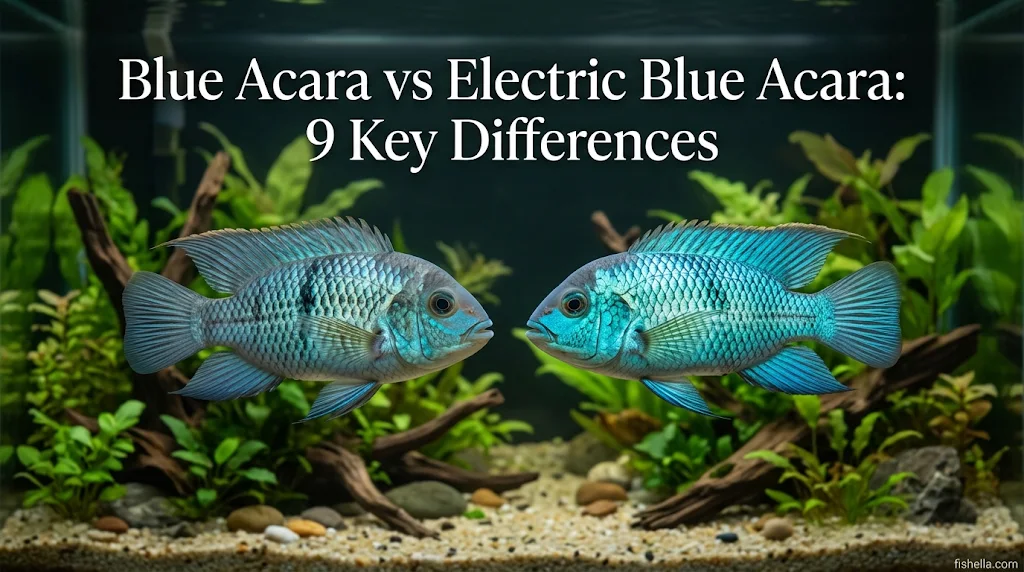
The Blue Acara is a beautiful freshwater cichlid known for its shimmering blue-green scales, curious personality, and interesting behavior. It is a popular choice for aquarium keepers who want a colorful fish with the personality of a cichlid without choosing one of the most aggressive species.
The Blue Acara (Andinoacara pulcher) needs a minimum 30-gallon aquarium for one adult fish, while a 40–55-gallon tank provides more swimming space and a better environment for a pair. This colorful freshwater cichlid thrives in warm, clean water with stable parameters, a varied diet, and suitable tank mates. Known for its shimmering blue-green scales and relatively peaceful temperament, the Blue Acara is a good choice for aquarists who want an attractive cichlid without the aggression of larger species. Not sure how many gallons your tank holds? Use our aquarium volume calculator to find out.
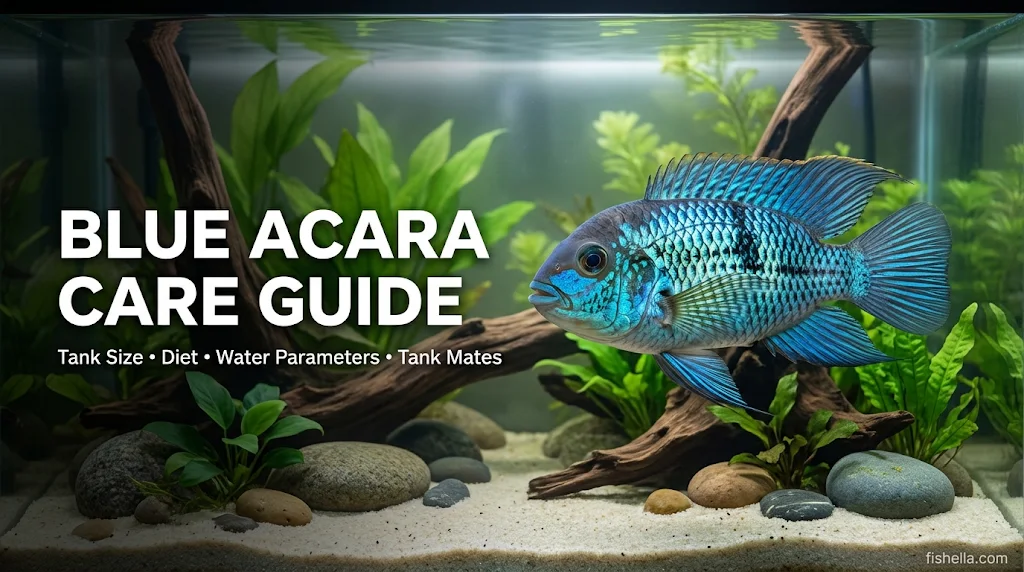
However, keeping a Blue Acara healthy requires more than providing a tank and regular food. You need enough swimming space, stable water conditions, proper filtration, a balanced diet, and compatible tank mates. These fish can also become territorial, especially when they form a breeding pair.
Blue Acara care is manageable for beginners who understand basic aquarium maintenance and can provide a suitable setup. The species can grow to approximately 6.3 inches (16 cm), so it needs a spacious aquarium rather than a small community tank.
In this complete guide, you’ll learn how to care for a Blue Acara, choose the right tank size, maintain water parameters, select suitable foods, understand its temperament, identify compatible tank mates, and provide the right environment for breeding. We’ll also explain the difference between a regular Blue Acara and an Electric Blue Acara.
Whether you’re considering your first cichlid or adding another species to an established freshwater aquarium, this guide will help you make an informed decision.
Freshwater fish care starts with a clean, stable aquarium and the right water conditions. Choose fish that suit your tank size and temperament. Feed a balanced diet and maintain proper filtration. Regular water testing and tank maintenance help keep your fish healthy.
Blue Acara Care: Quick Facts
Before purchasing this fish, review its basic requirements.
| Care information | Details |
|---|---|
| Common name | Blue Acara |
| Scientific name | Andinoacara pulcher |
| Family | Cichlidae |
| Fish type | Freshwater cichlid |
| Natural distribution | Trinidad and Venezuela |
| Adult size | Up to approximately 6.3 inches |
| Temperament | Semi-aggressive |
| Care level | Beginner to intermediate |
| Diet | Omnivore |
| Swimming area | Middle and lower aquarium |
| Water temperature | Approximately 72–82°F |
| pH | 6.5–8.0 |
| General hardness | Depends on source and local water conditions |
| Aquarium setup | Spacious, filtered freshwater aquarium |
| Breeding type | Egg layer |
| Parental behavior | Both parents may guard eggs and larvae |
These figures are starting points for aquarium planning. Individual fish, breeding conditions, and local water chemistry can affect their requirements.
1. What Is a Blue Acara Fish?
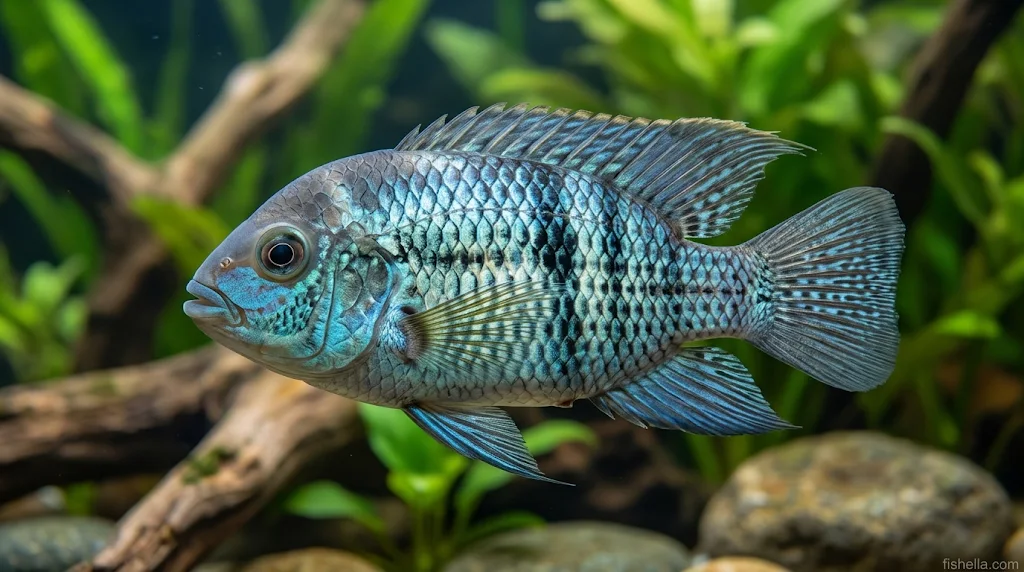
The Blue Acara (Andinoacara pulcher) is a freshwater fish belonging to the Cichlidae family. It is native to parts of northern South America and the Caribbean region, with documented populations in Venezuela and Trinidad.
Its scientific name is important because aquarium shops sometimes use similar common names for different fish. Identifying the actual species helps you find more accurate care information.
Blue Acaras are known for their attractive coloration and interesting behavior. They spend much of their time exploring the aquarium, investigating decorations, and searching the substrate for food.
Unlike some larger and more aggressive cichlids, Blue Acaras can be relatively manageable in a properly planned community aquarium. However, they are still territorial fish. Their behavior can change when they mature, establish a territory, or begin breeding.
According to FishBase, adults inhabit both standing waters and clear, flowing streams. Their natural diet includes worms, crustaceans, and insects. They also reproduce in captivity, and both parents can protect their eggs and larvae.
Scientific reference: FishBase – Andinoacara pulcher.
Where Do Blue Acara Fish Come From?
Blue Acaras originate from freshwater environments in their natural range, including Venezuela and Trinidad.
Their habitat includes different types of freshwater systems. This is one reason they can tolerate a reasonable range of water conditions in aquariums.
In nature, they search for small food organisms and use their surroundings for shelter and protection. Their aquarium environment should provide similar opportunities for exploration.
You do not need to recreate a natural river perfectly. However, providing suitable substrate, hiding areas, clean water, and enough swimming space can help your fish behave normally.
Why Are Blue Acaras Popular?
Several characteristics make this fish attractive to freshwater aquarium keepers.
- Their blue-green coloration stands out in freshwater aquariums.
- They have interesting and curious behavior.
- They are generally less aggressive than many larger cichlids.
- They accept a variety of prepared and frozen foods.
- They can form breeding pairs and show parental behavior.
- They can adapt to a properly maintained home aquarium.
However, their attractive appearance should not be the only reason to purchase one. Consider their adult size and long-term space requirements first.
2. Blue Acara Appearance, Color and Adult Size
Blue Acaras have a compact, oval-shaped body with attractive blue and green markings. Their scales can reflect light, giving them a shimmering appearance.
Their coloration may look different under various aquarium lighting conditions.
A healthy fish often displays:
- Blue-green iridescent markings.
- Small reflective spots along the body.
- Blue patterns around the face and cheeks.
- Darker body markings.
- Well-formed dorsal and anal fins.
- Clear eyes and an active swimming pattern.
Their appearance can change with age, mood, breeding activity, and general health.
How Big Do Blue Acara Get?
A Blue Acara can reach approximately 16 cm, or 6.3 inches, in total length.
FishBase records this maximum size for the species. Individual aquarium specimens may remain smaller depending on genetics, age, diet, and environmental conditions.
You should plan for the adult size rather than purchasing an aquarium based on the size of a young fish.
A juvenile may look comfortable in a small aquarium, but it will need more room as it grows.
How Fast Do Blue Acara Grow?
Growth depends on several factors.
Young fish generally grow faster when they receive appropriate nutrition, stable water conditions, and enough space.
Poor water quality, overcrowding, inadequate feeding, and chronic stress can affect normal development.
There is no single growth schedule that applies to every Blue Acara. Avoid trying to force rapid growth through excessive feeding.
Instead, provide a varied diet and maintain good aquarium conditions.
Regular Blue Acara vs. Electric Blue Acara
Aquarium shops often sell two types under similar names:
- Regular Blue Acara.
- Electric Blue Acara.
Understanding the difference is important when purchasing this fish.
The regular Blue Acara is the species Andinoacara pulcher. It has a naturally attractive blue-green appearance with darker body markings.
The Electric Blue Acara is a selectively bred, intensely blue form associated with the same species. It is especially popular because of its bright, metallic-looking coloration.
| Feature | Regular Blue Acara | Electric Blue Acara |
|---|---|---|
| Scientific identification | Andinoacara pulcher | Bred color form associated with A. pulcher |
| Appearance | Blue-green with darker markings | More intense electric-blue appearance |
| Body coloration | More natural-looking patterns | Brighter, more uniform blue |
| Aquarium requirements | Suitable spacious freshwater setup | Similar general care requirements |
| Behavior | Can be territorial | Can be territorial |
Do not assume that the brighter color means the fish needs a completely different aquarium.
Both forms require suitable space, stable water conditions, and proper nutrition. Individual fish can still differ in temperament and health.
When buying an Electric Blue Acara, ask the seller about its breeding background and identification.
3. What Size Tank Does a Blue Acara Need?
Aquarium size is one of the most important parts of Blue Acara care.
These fish need enough room to swim, explore, and establish territories. A cramped aquarium can increase stress and make aggressive encounters more difficult to manage.
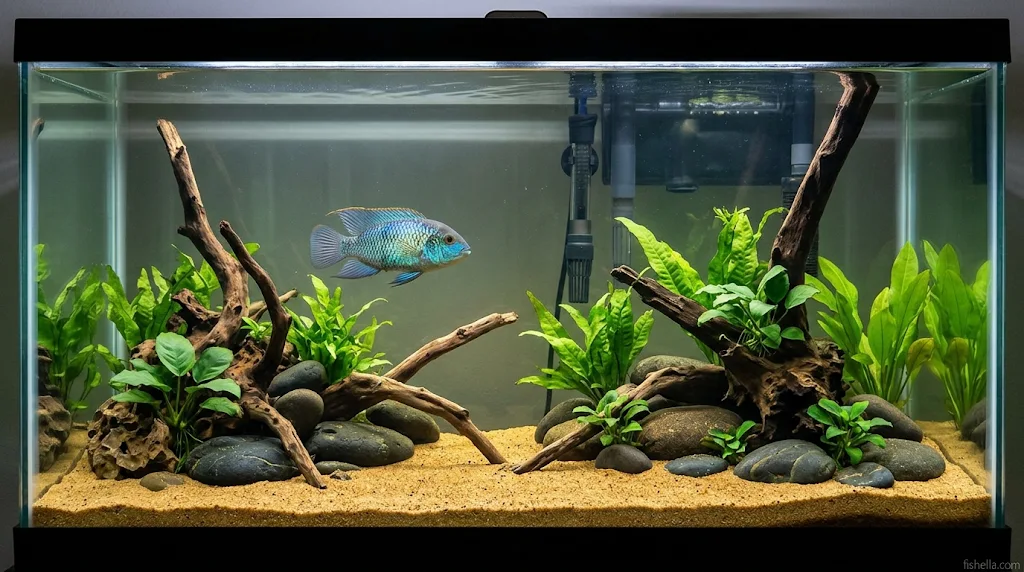
For practical home aquarium planning, I recommend a 40-gallon tank as a starting point for one adult Blue Acara.
For a compatible pair, consider at least 55 gallons, with a larger aquarium preferred when adding other fish.
These are conservative planning recommendations rather than universal biological minimums. Aquarium dimensions, filtration, stocking density, and individual behavior also matter.
Recommended Blue Acara Tank Sizes
| Aquarium setup | Practical recommendation |
|---|---|
| One adult Blue Acara | 40 gallons |
| Compatible pair | 55 gallons or larger |
| Pair with community fish | 75 gallons or larger |
| Larger community setup | 90 gallons or larger, depending on stocking |
A larger aquarium usually provides more swimming space and makes it easier to maintain stable water conditions.
Remember that adding more fish increases the aquarium’s biological load. You may need stronger filtration and more frequent water changes.
Can Blue Acara Live in a 20-Gallon Tank?
A 20-gallon aquarium is not a suitable permanent home for an adult Blue Acara.
A young fish may temporarily fit in a smaller tank, but that does not make it an appropriate long-term setup.
As the fish grows, it needs more swimming space and room to establish a territory.
A small aquarium can also experience faster changes in temperature and water quality.
If you want to keep this species, plan for its adult requirements before buying it.
Is a 40-Gallon Tank Enough for Blue Acara?
A 40-gallon aquarium is a reasonable starting choice for one adult specimen when it has suitable dimensions, filtration, and maintenance.
However, tank volume alone does not determine whether an aquarium is appropriate.
A long aquarium generally provides more horizontal swimming space than a tall aquarium with the same volume.
Consider the following:
- Length of the aquarium.
- Available swimming area.
- Substrate and decoration placement.
- Filter capacity.
- Number of fish.
- Water-change routine.
For a community aquarium or breeding pair, a larger tank is a better investment.
4. Blue Acara Water Parameters
Stable water conditions are essential for keeping Blue Acaras healthy.
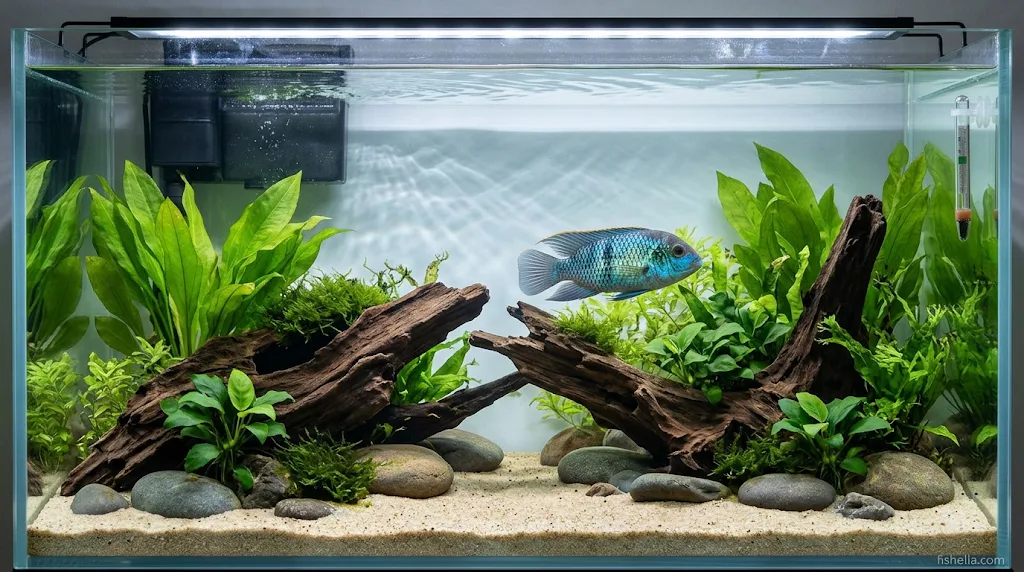
Although the species can tolerate a reasonable range of freshwater conditions, sudden changes can cause stress.
You should test your aquarium water regularly rather than relying on appearance alone.
Recommended Blue Acara Water Parameters
| Parameter | Practical target |
|---|---|
| Temperature | 72–82°F |
| pH | 6.5–8.0 |
| Ammonia | 0 ppm |
| Nitrite | 0 ppm |
| Nitrate | Ideally below 20 ppm |
| Water hardness | Maintain a stable, suitable level for the source water |
The pH range is supported by FishBase. The temperature range is a practical aquarium-care range; individual reference sources may recommend slightly different temperatures.
The most important rule is to avoid sudden changes.
What Temperature Is Best for Blue Acara?
A temperature of approximately 76–80°F is a practical target for many home aquariums.
The broader range of 72–82°F can be used as a general reference, but you should not frequently move the temperature between its extremes.
Use a reliable aquarium heater if your room temperature changes.
A separate thermometer helps you check the actual water temperature rather than relying only on the heater setting.
If your aquarium becomes too warm, dissolved oxygen can decrease. Good surface movement and suitable filtration help maintain healthy conditions.
What pH Does Blue Acara Need?
Blue Acaras can live in slightly acidic to moderately alkaline freshwater.
A pH range of approximately 6.5–8.0 is a useful reference.
Do not make unnecessary adjustments just to achieve a particular number.
Sudden pH changes can be more stressful than maintaining a stable pH that is slightly different from your preferred target.
Test both your aquarium water and your source water if you experience repeated problems.
What Water Hardness Is Suitable?
Water hardness describes the amount of dissolved minerals, mainly calcium and magnesium, in water.
FishBase records a hardness tolerance reference for the species, while aquarium references differ in their recommended ranges.
For a home aquarium, stability is important. Avoid making major changes to hardness without understanding your source water.
If you use reverse-osmosis water, remember that it may require appropriate remineralization.
Do not use completely mineral-free water without understanding how to prepare it for freshwater fish.
Why Are Ammonia and Nitrite Important?
Ammonia and nitrite are harmful substances that can develop when the aquarium’s biological filtration is not working properly. Ammonia is released by fish waste and decomposing organic matter. Learn how to choose the right equipment with our guide to the best hang-on-back aquarium filters for maintaining clean and healthy aquarium water.
Beneficial bacteria in the biological filter help convert ammonia into nitrite and then nitrate.
Your goal should be:
- Ammonia: 0 ppm.
- Nitrite: 0 ppm.
- Nitrate: kept under control through maintenance.
The Merck Veterinary Manual explains how ammonia, nitrite, and nitrate affect aquarium fish and why biological filtration is essential.
Read: Merck Veterinary Manual – Environmental Diseases of Aquatic Animals.
5. How to Set Up a Blue Acara Aquarium
A good aquarium setup provides swimming space, shelter, and a suitable environment for natural behavior.
Blue Acaras do not need an extremely complicated aquarium.
However, they benefit from a carefully arranged layout with open swimming areas and secure decorations.
Choose a Suitable Substrate
Sand or smooth aquarium gravel can work well.
A fine substrate is useful because Blue Acaras may investigate the bottom while searching for food.
Avoid sharp materials that could damage their bodies or mouths.
If you choose gravel, select smooth pieces and avoid decorations with sharp edges.
Add Rocks and Driftwood
Rocks and driftwood provide hiding places and help create separate territories.
You can arrange decorations to form natural boundaries without filling the entire aquarium.
Before adding rocks, make sure they are aquarium-safe and stable.
Avoid stacking heavy rocks where they could fall and damage the glass or injure your fish.
Can You Keep Live Plants With Blue Acara?
Yes, but plant selection and placement matter.
Blue Acaras may disturb the substrate while digging or exploring.
Plants that are loosely rooted in the gravel can become uprooted.
Consider hardy plants such as:
- Java fern.
- Anubias.
- Java moss.
- Amazon sword, if securely planted.
Java fern and Anubias can be attached to rocks or driftwood.
Avoid assuming that every plant will remain untouched. Observe your fish and rearrange the aquarium if necessary.
Provide Open Swimming Space
Decorations should not block the entire aquarium.
Leave a clear area where your Blue Acara can swim freely.
A balanced layout should include:
- Open swimming space.
- Hiding places.
- Stable decorations.
- A suitable substrate.
- Areas that allow fish to establish territories.
Do not overcrowd the aquarium with unnecessary ornaments.
Choose a Reliable Aquarium Filter
Good filtration is essential because Blue Acaras produce waste that must be processed by the aquarium’s biological filter.
A suitable hang-on-back filter or canister filter can work.
Choose a filter based on the actual aquarium volume, stocking level, and manufacturer’s flow specifications.
A filter should provide:
- Mechanical filtration to remove suspended debris.
- Biological filtration to support beneficial bacteria.
- Appropriate water circulation.
Avoid excessive current if your fish struggles to swim comfortably.
For additional help choosing equipment, read Fishella’s guide:
Best Hang-On-Back Aquarium Filters.
You can also learn about biological filtration in our Best Aquarium Filter Media guide.
Do Blue Acara Need an Air Pump?
An air pump is not always necessary if the filter already provides sufficient surface movement.
However, additional aeration can be useful in heavily stocked aquariums or when oxygen levels may become low.
The goal is adequate gas exchange and good water circulation, not simply adding bubbles for appearance.
6. Aquarium Cycling Before Adding Blue Acara
Never add a Blue Acara to an uncycled aquarium simply because the water looks clean.
A new aquarium needs an established biological filtration system.
The nitrogen cycle allows beneficial microorganisms to process fish waste.
The basic process is:
- Fish waste and decomposing organic matter release ammonia.
- Beneficial bacteria convert ammonia into nitrite.
- Other beneficial bacteria convert nitrite into nitrate.
- Water changes and plant uptake help control nitrate.
A new filter may take several weeks to establish an effective biological community.
Do not rely on a fixed number of days. Test the water to confirm that the aquarium is cycled.
Before adding your fish, confirm that the aquarium can process an appropriate ammonia source without detectable ammonia or nitrite remaining.
The Merck Veterinary Manual explains that new tank syndrome can occur when the biological filter has not developed enough capacity.
For more information, read:
Merck Veterinary Manual – Management of Aquarium Fish.
7. What Do Blue Acara Eat?
Blue Acaras are omnivores. Their natural diet includes small animal-based foods such as worms, crustaceans, and insects.
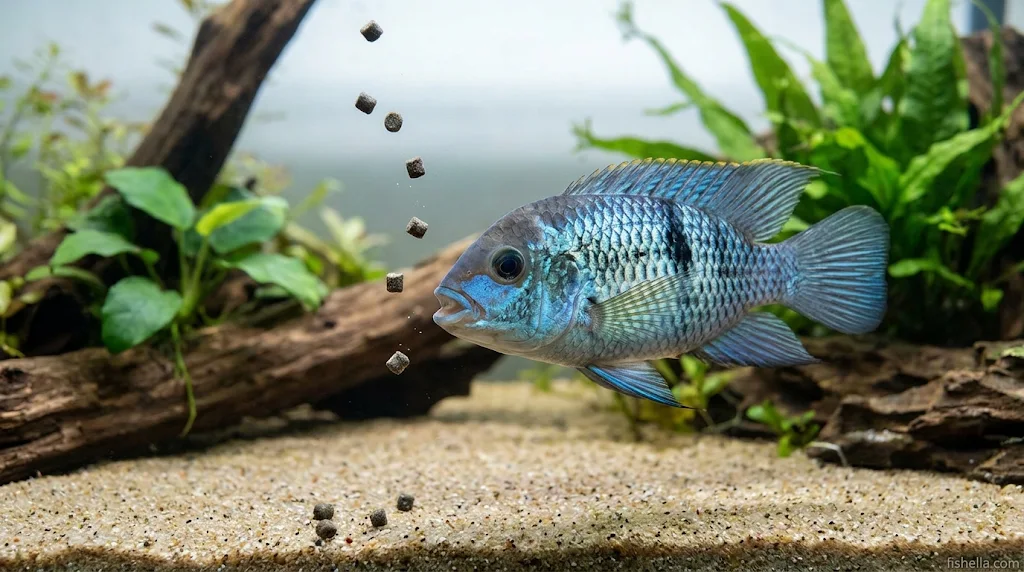
In an aquarium, they usually accept a variety of prepared and frozen foods.
A varied diet helps provide the nutrients required for normal growth and health.
Best Foods for Blue Acara
Consider these food options:
1. Quality Cichlid Pellets
A suitable cichlid pellet can serve as the main food.
Choose a reputable product with appropriate nutritional content and pellet size.
2. Frozen Bloodworms
Bloodworms can be offered occasionally as part of a varied diet.
They should not replace a nutritionally complete staple food.
3. Brine Shrimp
Brine shrimp provide variety and can be offered frozen or appropriately prepared.
4. Mysis Shrimp
Mysis shrimp are another useful food option for many freshwater carnivorous and omnivorous fish.
5. Insect-Based Foods
Some prepared foods contain insect ingredients. These can contribute to dietary variety.
6. Other Suitable Prepared Foods
A quality omnivore or cichlid formula can help provide a balanced nutritional foundation.
How Often Should You Feed a Blue Acara?
Adult Blue Acaras can generally be fed once or twice daily.
Offer small portions that the fish can consume within a few minutes.
Young fish may require smaller, more frequent meals.
However, feeding schedules should be adjusted to the fish’s size, activity, and body condition.
Do not feed extra food simply because your fish appears interested.
Can Blue Acara Eat Vegetables?
Blue Acaras are omnivores, so suitable plant-based ingredients can form part of their diet.
A quality prepared omnivore or cichlid food may already contain these ingredients.
If offering fresh vegetables, use only aquarium-safe options that have been properly prepared and offered in small portions.
Remove uneaten pieces promptly.
Why Should You Avoid Overfeeding?
Excess food can break down and increase waste in the aquarium.
This can contribute to poor water quality and additional pressure on the biological filter.
Overfeeding may also contribute to unhealthy body condition.
Feed measured portions and observe how much your fish actually consumes.
8. Blue Acara Temperament and Behavior
Blue Acaras are generally described as semi-aggressive freshwater cichlids.
Their behavior can vary significantly between individuals.
Some specimens may spend much of their time exploring the aquarium without bothering other fish.
Others may defend particular areas or chase tank mates.
Territorial behavior can become more noticeable during breeding.
Are Blue Acara Aggressive?
Blue Acaras are not among the most aggressive cichlids, but they should not be considered completely peaceful.
They may show aggression when:
- Defending a spawning area.
- Protecting eggs or fry.
- Competing for food.
- Establishing a territory.
- Living in an overcrowded aquarium.
- Sharing space with incompatible fish.
The best way to reduce conflict is to provide enough room and carefully select tank mates.
Can Blue Acara Live Alone?
Yes.
A Blue Acara does not require a partner to live a healthy life.
A single specimen can be kept in an appropriately sized aquarium with good water quality and suitable enrichment.
Keeping one fish can also make territorial management easier.
Do Blue Acara Recognize Their Owners?
Many aquarium fish learn to associate people with feeding.
A Blue Acara may swim toward the front of the aquarium when its owner approaches.
This behavior is often associated with food anticipation and familiarity.
It is better to describe this as learned behavior rather than assuming the fish recognizes its owner in the same way a dog does.
9. Best Blue Acara Tank Mates
Choosing tank mates requires more planning than simply selecting fish that have similar water requirements.
Blue Acaras can coexist with some medium-sized freshwater species, but compatibility depends on temperament, adult size, aquarium dimensions, and individual behavior.
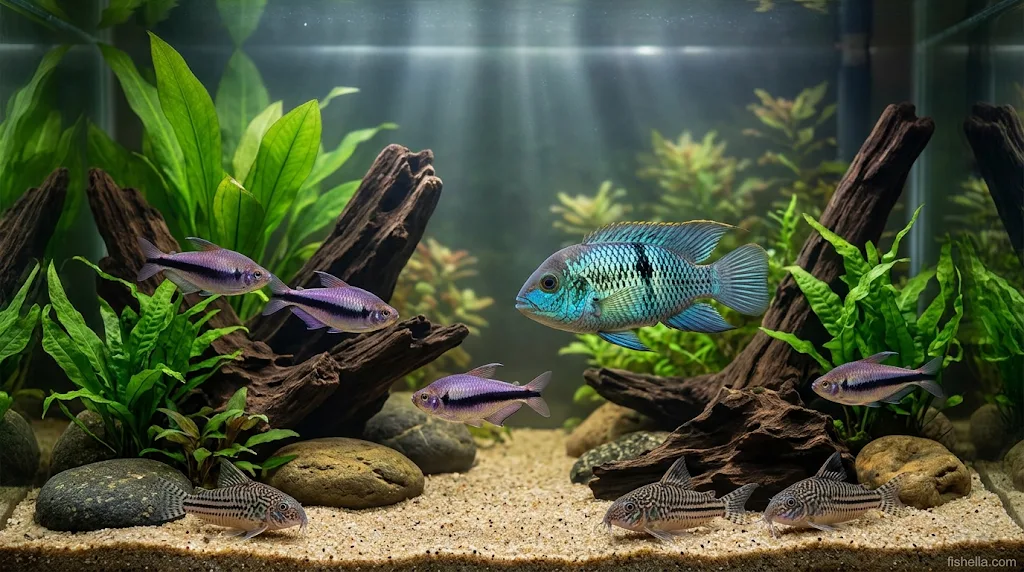
A fish that works in one aquarium may not work in another.
What Makes a Good Blue Acara Tank Mate?
Look for fish that:
- Are not small enough to be easily swallowed.
- Have compatible water requirements.
- Can tolerate similar aquarium temperatures.
- Are not excessively aggressive.
- Have enough space to establish their own areas.
- Can compete appropriately for food without constant conflict.
Always consider the adult size of every species.
Potential Blue Acara Tank Mates
The following fish may be considered for carefully planned community aquariums.
1. Larger Rainbowfish
Some larger rainbowfish may work with Blue Acaras.
They are active swimmers and can add movement to a community aquarium.
Choose species with compatible water requirements and enough room to swim.
2. Bristlenose Pleco
A Bristlenose Pleco may be a possible companion in a spacious aquarium.
Provide separate hiding areas and make sure the pleco receives suitable food.
Do not assume that a bottom-dwelling fish will automatically avoid conflict.
3. Larger Corydoras Species
Some larger Corydoras species may be considered, but this combination needs careful planning.
Corydoras are social fish and should be kept in suitable groups.
The aquarium must provide enough bottom space, and the Blue Acara must not repeatedly harass them.
If the cichlid becomes aggressive, this may not be a suitable combination.
4. Larger, Peaceful South American Cichlids
Certain similarly sized cichlids may coexist with Blue Acaras in a large aquarium.
However, this is a more advanced stocking decision.
Do not mix cichlids solely because they come from the same continent.
Individual temperament and territorial behavior are important.
5. Robust Medium-Sized Community Fish
Some medium-sized fish may be suitable if their behavior, size, and water requirements match.
Research each species separately before purchasing it.
Fish to Avoid Keeping With Blue Acara
Avoid fish that are too small, extremely aggressive, or unable to tolerate similar water conditions.
Examples of combinations requiring particular caution include:
- Small neon tetras.
- Small guppies.
- Tiny shrimp.
- Very small community fish.
- Highly aggressive cichlids.
- Fish with significantly different temperature requirements.
A small fish may become prey even if the Blue Acara does not show obvious aggression.
Can Blue Acara Live With Angelfish?
This combination is not guaranteed to work.
Angelfish are also cichlids, and individual behavior can vary.
A large aquarium may provide enough space for some individuals, but territorial conflict can still occur.
Monitor both species carefully and provide a backup aquarium if necessary.
Can Blue Acara Live With Oscar Fish?
This is generally not a combination I would recommend for an ordinary community aquarium.
Oscars grow much larger and can become powerful, territorial fish.
Their size, feeding requirements, and behavior can create problems for Blue Acaras.
A species-specific setup is usually a safer choice.
Can Blue Acara Live With Goldfish?
No, this is not a suitable combination.
Goldfish have different temperature preferences and aquarium requirements.
Goldfish also produce substantial waste and are generally better kept in appropriate goldfish setups.
Read Fishella’s Goldfish Care Guide, if this is a species you’re considering keeping separately.
How to Introduce New Tank Mates
Do not simply release new fish into an established Blue Acara aquarium without preparation.
Follow a careful introduction process:
- Quarantine new fish in a separate suitable aquarium.
- Observe them for signs of illness.
- Check that water conditions are compatible.
- Rearrange decorations if necessary to reduce established territories.
- Introduce fish carefully.
- Observe feeding and swimming behavior.
- Separate fish if repeated chasing or injuries occur.
Never assume that a peaceful first introduction guarantees long-term compatibility.
10. Male vs. Female Blue Acara
Male and female Blue Acaras can look similar, particularly when they are young.
Some mature males may grow larger and develop longer, more pointed fins.
Females may have a slightly rounder appearance and shorter fins.
However, these differences are not reliable enough to identify every fish.
How to Identify a Male Blue Acara
Mature males may show:
- A larger body.
- Longer dorsal and anal fins.
- More extended fin tips.
- More pronounced coloration during breeding.
These characteristics can vary between individuals.
How to Identify a Female Blue Acara
Mature females may show:
- A somewhat smaller body.
- Shorter or rounder fins.
- A rounder abdomen when carrying eggs.
Again, appearance alone may not provide a certain identification.
Can You Keep One Male and One Female Together?
Yes, but a male and female do not automatically form a compatible pair.
They may tolerate one another, establish a territory, or show aggression.
A breeding pair needs enough space and suitable spawning areas.
A larger aquarium gives you more options for managing territorial behavior.
11. Blue Acara Breeding Guide
Blue Acaras are egg-laying fish. They can reproduce in captivity when a compatible pair forms and conditions are suitable.
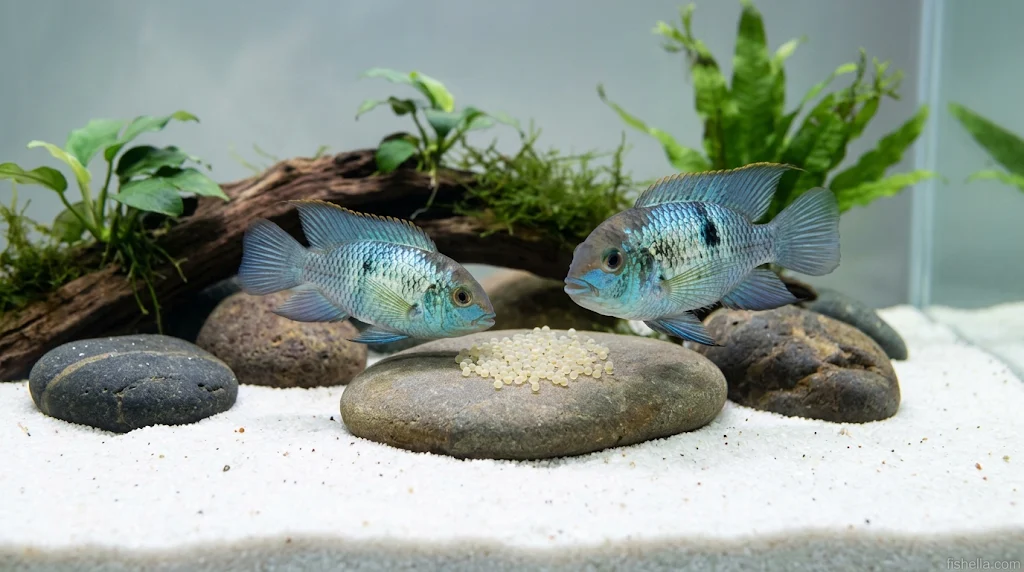
Both parents may participate in guarding the eggs and larvae.
This parental behavior is one of the interesting characteristics of the species.
How Do Blue Acara Breed?
A pair may begin by selecting and cleaning a suitable spawning surface.
This could be a flat rock or another smooth area.
The female lays eggs, and the male fertilizes them.
After spawning, the parents may guard the eggs and protect the developing larvae.
The pair can become territorial during this period.
Blue Acara Breeding Tank Setup
If you plan to breed Blue Acaras, prepare a suitable aquarium before attempting to encourage spawning.
Consider providing:
- Adequate aquarium space.
- Stable water parameters.
- A flat spawning surface.
- Smooth substrate.
- Suitable filtration.
- Hiding areas.
- Nutritious food.
Do not overcrowd the breeding aquarium.
The parents need enough room to establish a territory and defend their eggs.
How to Tell if Blue Acara Are Ready to Breed
Potential signs include:
- Increased interest in a particular surface.
- Cleaning a rock or flat area.
- Spending more time together.
- Defending a particular part of the aquarium.
- Increased territorial behavior.
These signs can suggest spawning preparation, but they do not guarantee that eggs will appear.
How Do Blue Acara Eggs Develop?
After spawning and fertilization, the parents may guard the eggs. The exact development period depends on water temperature and other conditions.
Avoid giving an exact hatching schedule as a guarantee. Observe the eggs without disturbing the parents.
If the aquarium is shared with other fish, the eggs and young may be at greater risk.
How to Care for Blue Acara Fry
Newly hatched fry initially rely on nutrients stored in their yolk sacs.
Once they become free-swimming, they need appropriately sized food.
Possible options include:
- Newly hatched brine shrimp.
- Microworms.
- Suitable commercial fry food.
Feed small portions frequently enough to support growth without polluting the aquarium.
Maintain good filtration and monitor water quality closely.
Do not use strong filter intakes that could draw in small fry.
Should You Remove the Parents?
There is no single rule for every breeding aquarium.
Some Blue Acara pairs provide parental care, while the outcome can depend on individual behavior and aquarium conditions.
Observe the parents and fry carefully.
If the adults begin attacking their young or other fish threaten them, separation may be necessary.
Plan a suitable grow-out aquarium if you intend to raise a large number of fry.
12. Common Blue Acara Health Problems
Blue Acaras are generally considered hardy fish when kept in suitable conditions. However, they can still develop health problems.
Poor water quality, stress, inadequate nutrition, and introduced pathogens can affect their health. It is important to understand that similar symptoms can have different causes.
Do not diagnose a disease based on one visible sign.
Ich
Ich is a parasitic disease that can cause small white spots on a fish’s body and fins.
Other possible signs include:
- Scratching against decorations.
- Reduced activity.
- Clamped fins.
- Changes in breathing.
White spots are not the only possible explanation for every skin problem.
Seek an accurate diagnosis before selecting a treatment.
Fin Damage and Fin Rot
Damaged fins may result from aggression, sharp decorations, poor water conditions, or infection.
Look for:
- Ragged fin edges.
- Redness.
- Progressive deterioration.
- Reduced activity.
First, check water quality and inspect the aquarium for possible injuries.
If the condition continues to worsen, seek advice from a qualified aquatic veterinarian or experienced fish-health professional.
Hole-in-the-Head Lesions
Some cichlids can develop pitted lesions around the head and lateral line. These lesions are sometimes referred to as hole-in-the-head disease.
Their causes can be complex, and they should not automatically be attributed to one specific food or parasite. Poor husbandry may contribute to health problems, but a diagnosis requires proper assessment.
Loss of Appetite
A Blue Acara may stop eating for several reasons.
Possible causes include:
- Stress after transportation.
- Poor water quality.
- Incorrect temperature.
- Aggression from tank mates.
- Illness.
- Inappropriate food.
Check the aquarium first.
If the fish continues refusing food or develops other symptoms, seek professional advice.
Signs That Your Blue Acara May Be Unwell
Watch for changes such as:
- Unusual swimming.
- Rapid or labored breathing.
- Clamped fins.
- Loss of appetite.
- Unusual spots or lesions.
- Swelling.
- Repeated scratching.
- Hiding much more than usual.
One unusual behavior does not automatically mean disease. Compare the fish’s behavior with its normal routine and check the aquarium water.
How to Prevent Health Problems
Prevention is an important part of fish care.
Follow these practices:
- Maintain stable water conditions.
- Keep ammonia and nitrite at zero.
- Perform regular partial water changes.
- Avoid overcrowding.
- Feed a varied and suitable diet.
- Quarantine new fish.
- Maintain biological filtration.
- Avoid unnecessary medication.
- Remove uneaten food.
- Observe your fish regularly.
The Merck Veterinary Manual provides additional guidance on aquarium management, water quality, and quarantine.
13. Blue Acara Lifespan
A Blue Acara’s lifespan can vary depending on genetics, nutrition, water quality, and general aquarium conditions.
It is difficult to give one exact lifespan that applies to every aquarium specimen.
Do not treat a commonly repeated online lifespan figure as a guarantee.
A well-maintained aquarium can help reduce avoidable stress and support normal health throughout the fish’s life.
How to Help Your Blue Acara Live Longer
Focus on the factors you can control.
Maintain clean water: Regular testing and appropriate water changes help prevent water-quality problems.
Provide enough space: An appropriately sized aquarium allows normal movement and territorial behavior.
Offer balanced food: Use suitable staple foods and provide variety without overfeeding.
Avoid incompatible tank mates: Constant chasing and fighting can cause chronic stress.
Maintain the filter: Protect the biological filtration system and avoid unnecessary disruption.
Quarantine new fish: This reduces the risk of introducing some parasites and infectious conditions.
14. Weekly Blue Acara Aquarium Maintenance
A consistent maintenance routine helps keep the aquarium stable.
The exact schedule depends on stocking, feeding, filtration, and water-test results.
Here is a practical starting routine.
Daily Tasks
- Check that your Blue Acara is swimming normally.
- Observe its appetite.
- Check the aquarium temperature.
- Remove uneaten food.
- Watch for aggressive behavior.
Weekly Tasks
- Test ammonia, nitrite, and nitrate.
- Check pH when appropriate.
- Inspect the filter.
- Clean the viewing glass.
- Perform a partial water change based on water conditions.
- Remove accumulated debris from the substrate.
Monthly Tasks
- Inspect filter equipment.
- Check heaters and thermometers.
- Review the aquarium’s stocking level.
- Inspect decorations for sharp edges.
- Check whether plants or decorations need adjustment.
Do not replace all biological filter media at once.
Cleaning methods should preserve the beneficial bacteria that support the nitrogen cycle.
How Often Should You Change Blue Acara Tank Water?
A weekly partial water change is a useful starting routine for many aquariums.
The amount depends on stocking, nitrate accumulation, and other water-test results.
Use properly conditioned replacement water with a suitable temperature.
Do not rely on topping off evaporated water as a replacement for water changes.
Evaporation removes water but leaves most dissolved minerals and waste behind.
15. Is Blue Acara Good for Beginners?
Blue Acaras can be a good choice for beginners who understand the basics of freshwater aquarium maintenance.
They are not among the most difficult cichlids to keep, but they still require adequate space and careful stocking decisions.
A beginner should be comfortable with:
- Aquarium cycling.
- Water testing.
- Filter maintenance.
- Regular water changes.
- Feeding routines.
- Choosing compatible fish.
If you are completely new to fishkeeping, learn how the nitrogen cycle works before purchasing a Blue Acara.
A fish that is considered hardy can still become sick in an uncycled or poorly maintained aquarium.
Is Blue Acara a Good First Cichlid?
For someone who already understands basic freshwater fish care, a Blue Acara may be a reasonable first cichlid.
It offers interesting behavior and attractive coloration without requiring the same setup as some very large cichlids.
However, you should not choose it for a small aquarium or an overcrowded community tank.
Make sure you can provide suitable long-term housing.
16. Common Blue Acara Care Mistakes to Avoid
Even experienced aquarium keepers can make mistakes when adding a new species.
Avoid these common problems.
1. Choosing a Tank That Is Too Small
A young fish may look comfortable in a small aquarium.
However, adult size and territorial behavior should guide your tank choice.
2. Adding Fish Before Cycling the Aquarium
A new aquarium may look clean but still lack the biological filtration needed to process fish waste.
Complete the nitrogen cycle and verify it with water tests.
3. Overfeeding
Excess food can contribute to poor water quality.
Feed appropriate portions and remove leftovers.
4. Keeping Incompatible Tank Mates
A fish that appears peaceful at the pet store may behave differently in an established aquarium.
Research adult size and temperament before purchasing.
5. Making Sudden Water Changes
Large, abrupt changes in temperature or water chemistry can stress fish.
Prepare replacement water properly and maintain stable conditions.
6. Ignoring Aggression
Repeated chasing, torn fins, and injuries should not be treated as normal behavior.
Provide additional space or separate incompatible fish.
7. Treating Every Health Problem With Medication
Different conditions can cause similar symptoms.
Test water quality and seek an accurate diagnosis before using medication.
17. Where to Buy a Healthy Blue Acara
You can find Blue Acaras through specialist aquarium stores, reputable local fish shops, and established online aquarium retailers.
Before purchasing, ask about the fish’s identification, source, and health history.
A healthy-looking fish should be active and have clear eyes, intact fins, and no obvious wounds or unusual lesions.
Avoid purchasing a fish that is gasping, swimming abnormally, or showing signs of serious illness.
Questions to Ask Before Buying
- Is this a regular Blue Acara or an Electric Blue Acara?
- What is the fish’s approximate age or size?
- Has it been eating prepared aquarium food?
- Has it been quarantined?
- What water conditions is it currently kept in?
- Has the fish shown signs of illness?
- What is the return or health policy?
Whenever possible, observe the fish eating before purchase.
Should You Buy a Pair?
Not necessarily.
A single Blue Acara can live without a partner.
If you want a breeding pair, understand that two fish may not become compatible simply because one is male and the other is female.
A pair also needs more space and a suitable breeding environment.
18. Blue Acara vs. Other Popular Freshwater Fish
Blue Acaras are different from many small community fish because they are cichlids with territorial behavior.
If you are choosing your next freshwater species, compare their requirements before purchasing.
Blue Acara vs. Betta Fish
Betta fish are smaller freshwater fish with different housing and behavior requirements.
Blue Acaras need a much larger aquarium and may prey on small fish.
These species should not be considered interchangeable community fish.
Read Fishella’s Betta Fish Care Guide if you want to learn about keeping Bettas.
Blue Acara vs. Guppy
Guppies are small livebearing fish.
Blue Acaras grow much larger and may view small guppies as food.
They are not a suitable combination for an ordinary community aquarium.
For guppy-specific care, see Fishella’s Types of Guppies.
Blue Acara vs. Goldfish
Goldfish are coldwater or cool-water freshwater fish, depending on variety and setup.
Blue Acaras are tropical freshwater cichlids.
Their temperature and aquarium requirements differ, so keeping them together is not recommended.
For separate goldfish care, consult Fishella’s goldfish care content.
19. Frequently Asked Questions About Blue Acara Care
How big does a Blue Acara get?
A Blue Acara can reach approximately 6.3 inches (16 cm) in total length. Its actual adult size depends on genetics, nutrition, age, and aquarium conditions.
What size tank does a Blue Acara need?
A 40-gallon aquarium is a sensible starting recommendation for one adult. For a pair, consider at least 55 gallons, with larger tanks preferred for community setups.
Are Blue Acara aggressive?
Blue Acaras are semi-aggressive. They can be relatively peaceful under suitable conditions but may become territorial, especially when breeding.
What do Blue Acara eat?
Blue Acaras are omnivores. They accept suitable cichlid pellets, frozen bloodworms, brine shrimp, mysis shrimp, and other appropriate foods.
What temperature is best for Blue Acara?
A practical aquarium temperature range is approximately 72–82°F. Many keepers aim for a stable temperature around 76–80°F.
What pH does Blue Acara need?
A pH between 6.5 and 8.0 is a useful reference range. Avoid sudden changes and maintain stable water conditions.
Can Blue Acara live alone?
Yes. A single Blue Acara can live without a partner when provided with an appropriately sized aquarium and suitable care.
Can Blue Acara live with other fish?
Yes, certain medium-sized and compatible fish may work. However, compatibility depends on temperament, adult size, aquarium space, and individual behavior.
Can Blue Acara live with guppies?
This is not recommended. Guppies are small and may become prey for an adult Blue Acara.
Can Blue Acara live with angelfish?
Some individuals may coexist in a spacious aquarium, but aggression and territorial behavior can develop. This combination requires careful monitoring and a backup plan.
Can Blue Acara live with Oscar fish?
It is generally not recommended for a typical community aquarium. Oscars grow much larger and may become too aggressive or powerful for a Blue Acara.
Are Blue Acara easy to breed?
They can breed in home aquariums when a compatible pair forms. They lay eggs on suitable surfaces and may protect their eggs and larvae.
How do you tell male and female Blue Acara apart?
Mature males may be larger and have longer fins. Females may be smaller and rounder. However, physical differences are not always reliable.
Can Blue Acara live with Electric Blue Acara?
They are closely related forms associated with the same species. However, compatibility is not guaranteed. Territorial behavior and individual temperament still matter.
How long do Blue Acara live?
Their lifespan varies with genetics, diet, water quality, and general care. Avoid treating any single lifespan estimate as guaranteed for every aquarium fish.
Are Blue Acara good for beginners?
They can suit beginners who understand aquarium cycling, water testing, filtration, and basic fish maintenance. They are not suitable for small or uncycled aquariums.
Do Blue Acara eat plants?
They may disturb rooted plants while digging or exploring. Hardy plants attached to rocks or driftwood can be more practical choices.
Do Blue Acara need a heater?
A heater is useful when room temperatures fluctuate or fall below the desired aquarium range. Use a thermometer to monitor actual water temperature.
Do Blue Acara need an air pump?
Not always. A properly functioning filter can provide enough surface movement. Additional aeration may help in heavily stocked tanks or when oxygen levels are low.
Why is my Blue Acara hiding?
Possible reasons include stress, new surroundings, incompatible tank mates, poor water conditions, or illness. Check the aquarium environment and observe other symptoms.
Why is my Blue Acara not eating?
Transportation stress, water-quality problems, temperature changes, aggression, and illness can all affect appetite. Test the water and monitor the fish before deciding on treatment.
Final Thoughts: Is Blue Acara Right for Your Aquarium?
The Blue Acara is an attractive freshwater cichlid with interesting behavior and manageable care requirements when kept in the right environment.
It can be a rewarding choice for aquarists who want a medium-sized cichlid without immediately moving into the care requirements of much larger species.
However, it still needs enough swimming space, clean water, proper filtration, balanced nutrition, and carefully selected tank mates.
Start with a suitable aquarium, complete the nitrogen cycle, and maintain stable water conditions. Avoid overcrowding and observe your fish regularly for changes in behavior.
If you can meet these requirements, the Blue Acara can become an interesting and colorful addition to your freshwater aquarium.
The most important part of successful Blue Acara care is planning for the adult fish rather than buying an aquarium based only on the size of a juvenile.