
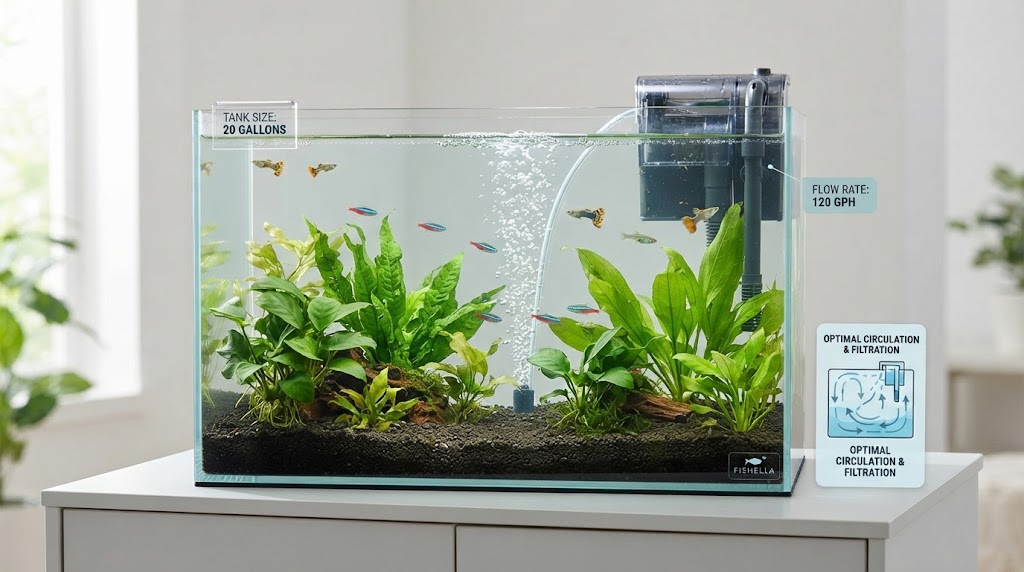
Choosing an aquarium filter starts with your tank size, fish, and water-flow needs. A good starting point is a filter rated for about 4 times your aquarium’s water volume per hour (4x turnover). For example, a 10-gallon tank needs roughly 40 GPH as a starting point.
You should also choose the right filter type. Sponge filters work well for bettas and small aquariums, hang-on-back (HOB) filters suit many beginner tanks, and internal filters are useful when space is limited.
The best aquarium filter is not always the one with the highest GPH. Consider your fish’s bio-load, filtration capacity, water movement, and maintenance needs before buying.
What Does an Aquarium Filter Do?

An aquarium filter helps maintain clean and healthy water for your fish. It removes waste, traps floating particles, and provides a place for beneficial bacteria to grow.
Most aquarium filters support one or more of these three filtration methods:
- Mechanical filtration
- Biological filtration
- Chemical filtration
Mechanical filtration traps solid waste such as uneaten food and fish waste. Biological filtration supports beneficial bacteria that help process toxic ammonia and nitrite. Chemical filtration uses media such as activated carbon to remove certain dissolved substances.
The Merck Veterinary Manual’s guide to aquatic life support systems also identifies biological, mechanical, and chemical filtration as the three basic types of filtration.
A good aquarium filter does not replace regular water changes. You still need to test your water and perform routine aquarium maintenance.
If you are new to the hobby, start with our guide to setting up a freshwater aquarium.
How to Choose an Aquarium Filter
When choosing an aquarium filter, look at more than the filter’s tank-size rating.
Consider these factors:
- Aquarium size
- Filter flow rate
- Fish bio-load
- Fish species
- Water flow strength
- Filter type
- Media capacity
- Maintenance requirements
- Noise level
- Operating cost
A filter that works well for one aquarium may not be the best choice for another tank of the same size.
Start With Your Aquarium Size
The first step is to check your aquarium’s water volume.
Filter manufacturers usually list a recommended aquarium size on the package. For example, a filter may be advertised for aquariums up to 10, 20, or 30 gallons.
This rating gives you a useful starting point. However, you should not choose a filter based only on the number of gallons.
Two 20-gallon tanks can have very different filtration needs. One may contain a few small fish, while another may contain larger fish that produce much more waste.
Your tank size helps you narrow down your options. Your fish and bio-load help you choose between them.
Check the Aquarium Filter’s GPH
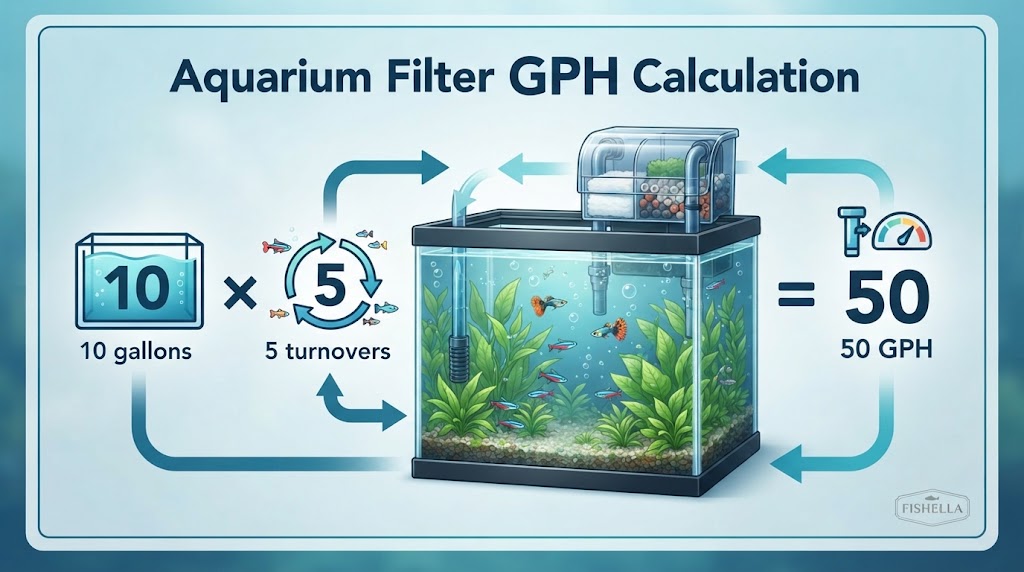
When learning how to choose an aquarium filter, GPH is one of the most important specifications to understand. GPH means gallons per hour. It tells you approximately how much water a filter can move through the system in one hour.
For example, a filter rated at 100 GPH is designed to move about 100 gallons of water per hour under the manufacturer’s testing conditions. A common starting point is to aim for several turnovers of the aquarium’s water volume per hour.
You can use this simple calculation:
Tank size × desired turnover = starting GPH
For example:
10 gallons × 5 = 50 GPH
This gives you a starting target of about 50 GPH for a 10-gallon aquarium.
However, the number printed on a filter does not always represent its actual flow inside your aquarium. Filter media, water level, tubing, and other factors can affect real-world performance. That is why GPH should be treated as a starting point rather than an exact requirement.
Aqueon’s aquarium filtration guide also recommends considering tank size together with bio-load and the type of fish you keep.
Aquarium Filter Size Guide
Choosing the right aquarium filter starts with your tank’s water volume. A common starting point is to select a filter with a flow rate of around 4–6 times your aquarium’s volume per hour.
For example, a 10-gallon aquarium may need a filter rated around 40–60 GPH. GPH means gallons per hour and measures how much water the filter can move.
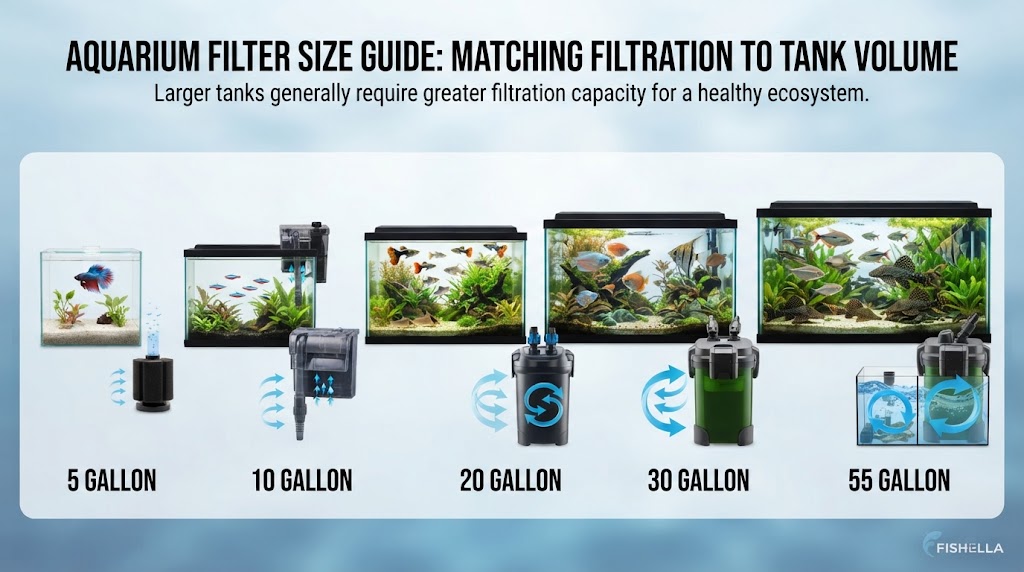
Use this table to estimate the starting flow rate for common freshwater aquariums:
| Aquarium Size | Starting GPH Range | Common Filter Options |
|---|---|---|
| 5 gallons | 20–30 GPH | Sponge or gentle internal filter |
| 10 gallons | 40–60 GPH | HOB, sponge, or internal filter |
| 20 gallons | 80–120 GPH | HOB or larger sponge filter |
| 30 gallons | 120–180 GPH | HOB or canister filter |
| 40 gallons | 160–240 GPH | Large HOB or canister filter |
| 55 gallons | 220–330 GPH | Large HOB or canister filter |
Remember: These figures are starting estimates, not universal requirements. Your ideal filter also depends on fish species, stocking levels, feeding habits, filter media capacity, and actual water flow.
A heavily stocked aquarium may need greater biological filtration capacity than a lightly stocked tank. However, fish that prefer calm water, such as bettas, may need a filter with adjustable flow or a suitable flow baffle.
If you keep a betta in a small aquarium, check our guide to the best filter for a 5-gallon Betta tank for suitable filtration options.
Always consider filtration capacity and water movement separately. A filter with higher GPH is not automatically the best choice for every aquarium.
Consider Your Fish’s Bio-Load
Bio-load refers to the amount of waste produced by the fish and other living organisms in your aquarium.
Fish size, number, feeding habits, and species all affect bio-load. A lightly stocked 20-gallon aquarium may have a lower bio-load than a heavily stocked 20-gallon aquarium. This matters because your filter needs to process the waste produced by your aquarium.
Consider these questions before buying a filter:
- How many fish are in the tank?
- How large will the fish become?
- How often do you feed them?
- Do the fish produce a lot of waste?
- Are you keeping bottom-dwelling fish?
- Do you have live plants?
- Is the aquarium heavily stocked?
If your aquarium has a high bio-load, look for a filter with good mechanical and biological filtration capacity.
Consider Your Fish Species
Different fish have different water-flow preferences. Some fish enjoy stronger water movement. Others prefer calmer areas with gentle flow. This is especially important when choosing a filter for betta fish.
Bettas have long fins and are not strong swimmers compared with many active community fish. A filter that creates excessive current can make it difficult for a betta to swim comfortably.
If you keep a betta, look for a filter with adjustable or gentle flow. A sponge filter or properly adjusted internal or HOB filter can work well when the water movement is appropriate.
You can learn more about their overall setup in our Betta Fish Care guide.
Goldfish are different. They produce a significant amount of waste and generally need strong filtration and good biological capacity.
The important lesson is simple:
Do not choose an aquarium filter based on GPH alone. Choose one that matches your fish’s needs.
Can an Aquarium Filter Be Too Strong?

Yes. An aquarium filter can create too much water movement for certain fish.
A powerful filter is not automatically a better filter.
Signs that your filter may be creating excessive flow include:
- Fish constantly swimming against the current
- Fish struggling to move around the tank
- Betta fins being pushed strongly by the current
- Fish hiding from the filter outlet
- Plants constantly bending in the current
- Substrate being pushed around
- Fish staying in one low-flow area
If you notice these signs, you may not need a completely new filter. You can sometimes reduce the flow, redirect the outlet, add a sponge, or use a filter baffle. For sensitive fish, creating a calm area in the aquarium can also help. Understanding how to choose an aquarium filter also means comparing the different filter designs available for freshwater aquariums.
Choose the Right Type of Aquarium Filter
Aquarium Filter Types Compared
| Filter Type | Best For | Pros | Cons |
|---|---|---|---|
| Sponge Filter | Betta, shrimp, fry, and small tanks | Gentle flow, affordable, easy to clean | Needs a separate air pump |
| Hang-On-Back (HOB) Filter | Beginner and community aquariums | Easy installation, good circulation, accessible media | Can create strong flow and some noise |
| Internal Filter | Small tanks and aquariums with limited outside space | Compact, easy to install, stays inside the tank | Takes up tank space and may have limited media capacity |
| Canister Filter | Medium and large aquariums | Large media capacity, flexible filtration, good for heavier bio-loads | Higher initial cost and more involved maintenance |
Which type should you choose?
- Choose a sponge filter if your fish need gentle water movement.
- Choose a HOB filter if you want a simple option for a beginner community tank.
- Choose an internal filter if you have limited space behind your aquarium.
- Choose a canister filter if your aquarium needs greater media capacity.

Aquarium filters come in several designs. Each type has advantages and disadvantages.
Sponge Filters
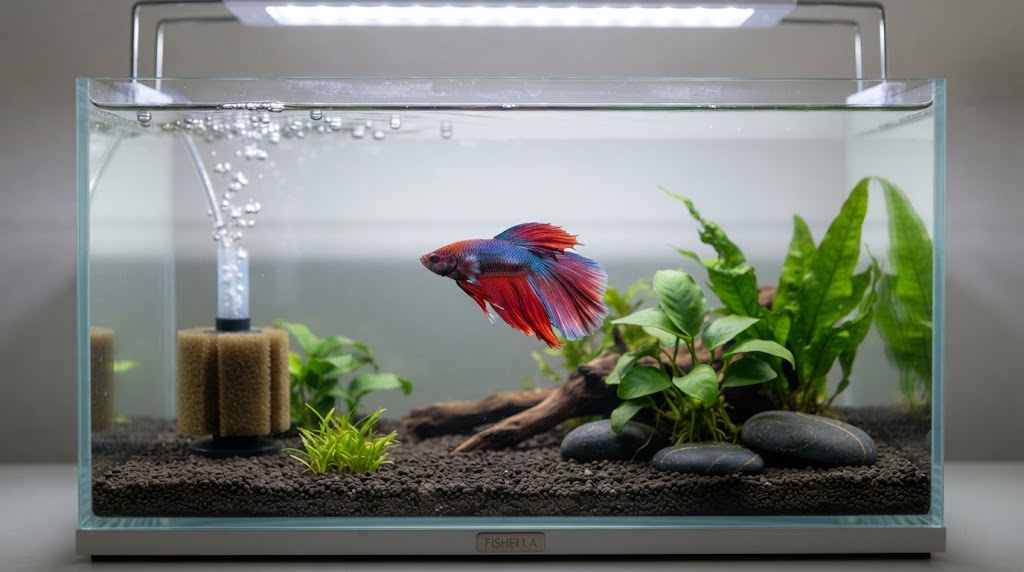
Sponge filters are simple and provide mechanical and biological filtration.
They are popular for:
- Small aquariums
- Betta tanks
- Shrimp tanks
- Breeding tanks
- Fry tanks
They create gentle water movement and are easy to maintain.
The main drawback is that they usually need an air pump to operate.
Hang-On-Back Filters
Hang-on-back, or HOB, filters hang on the back of an aquarium. They are popular with beginners because they are easy to install and maintain.
A HOB filter can provide mechanical, biological, and chemical filtration depending on the media used. They are a good option for many small and medium freshwater aquariums.
Aqueon’s comparison of HOB and canister filters also notes that HOB filters are popular with beginners because of their simple operation and maintenance. If you’re comparing filtration options for your aquarium, read our guide to the best hang-on-back aquarium filters to find a suitable filter for your tank size, budget, and maintenance needs.
Internal Filters
Internal filters sit inside the aquarium and attach to the glass or another surface.
They can work well when you have limited space behind the tank.
They are often useful for smaller aquariums, but the available media space may be more limited than with some larger external filters.
Canister Filters
Canister filters sit outside the aquarium and use hoses to move water through the filter. They usually offer more media capacity than many smaller filter designs.
Canister filters can be useful for larger aquariums or setups that need substantial filtration. However, they can take more time to clean and maintain.
According to Aqueon’s filtration guide, canister filters generally hold more media than HOB filters and are commonly used for medium to larger aquariums.
Which Aquarium Filter Is Best for Beginners?
For many beginners, a simple HOB, sponge, or internal filter is easier to manage than a complex system. The best choice depends on your aquarium and fish.
A beginner should look for a filter that:
- Matches the aquarium size
- Provides enough filtration capacity
- Has suitable water flow
- Is easy to clean
- Has affordable replacement media
- Does not create excessive current
- Is easy to find replacement parts for
A simple filter that you maintain properly is often better than a complicated filter that you find difficult to service.
7. Look at Filter Media Capacity

Filter media is another important factor when choosing an aquarium filter.
Mechanical media catches solid particles. Biological media provides surface area for beneficial bacteria. Chemical media, such as activated carbon, can help remove certain dissolved substances.
Do not choose a filter only because it comes with several types of media. Look at how much media the filter can hold and how easy it is to access. A filter with useful biological media space can provide valuable support for the aquarium’s biological filtration system. Explore the best aquarium filter media for effective biological, mechanical, and chemical filtration.
The Merck Veterinary Manual explains biological filtration as a system that provides surface area for nitrifying bacteria to process nitrogenous waste.
8. Think About Filter Maintenance
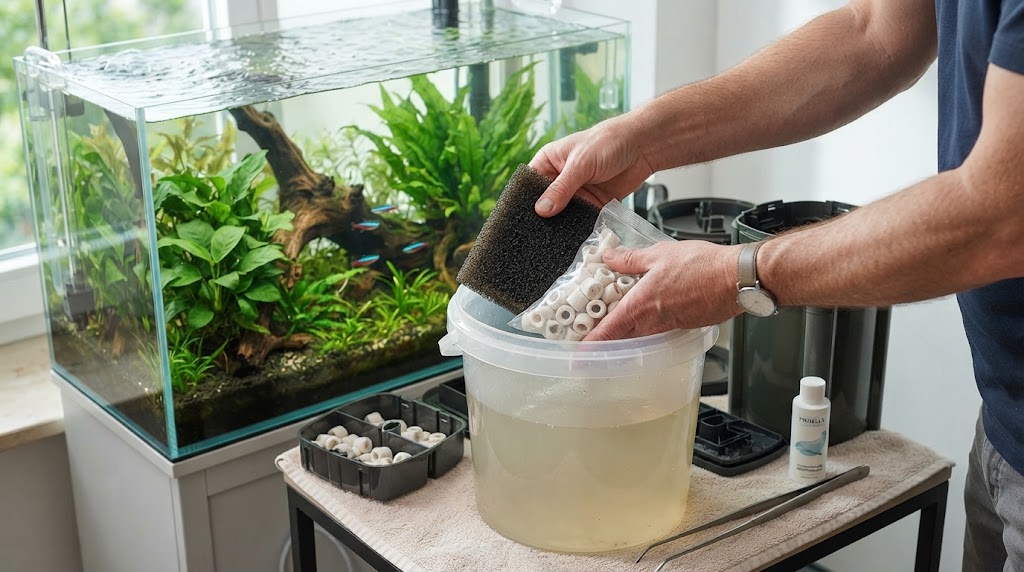
Your aquarium filter will need regular maintenance.
Before buying one, ask yourself:
- Can I easily remove the filter media?
- Can I clean the intake?
- Can I find replacement media?
- Will replacement cartridges become expensive?
- Can I clean the filter without making a mess?
A filter that is difficult to maintain can become frustrating over time.
You should also avoid replacing all biological filter media at once unless the manufacturer specifically requires it. Removing established biological media can reduce the beneficial bacteria available in your aquarium.
Regular aquarium maintenance is still necessary even when you have a good filter. See our guide on how to clean a fish tank for a complete cleaning routine.
Aqueon also explains that filter maintenance does not replace partial water changes in its aquarium filtration basics guide.
9. Consider the Noise Level
Filter noise may not seem important when you first buy an aquarium. After several days, however, a noisy filter can become annoying, especially if your aquarium is in a bedroom or home office.
Look for a filter designed for quiet operation if noise is important to you. Also check the water level. Some filters become noisier when the water level drops too far below the outlet.
10. Consider the Cost of Replacement Media
The purchase price is not the only cost of an aquarium filter. You should also consider ongoing costs.
Some filters use proprietary cartridges that need frequent replacement. Other filters allow you to use reusable or separately purchased media.
Before buying a filter, check:
- Replacement cartridge prices
- Biological media options
- Mechanical media costs
- Availability of replacement parts
- Electricity use
- Expected maintenance frequency
A slightly more expensive filter may cost less over time if its media is easy to maintain and replace.
What Size Filter Do You Need for a 10-Gallon Tank?
For a 10-gallon aquarium, start by looking at filters that provide roughly 40–60 GPH or more, depending on the fish and bio-load.
You should also consider water flow. A betta tank may need gentler water movement, while an active community aquarium may handle more circulation.
Looking for a specific option? Read our Tetra Whisper 10-Gallon Filter review to learn more about its features and performance.
What Size Filter Do You Need for a 20-Gallon Tank?
For a 20-gallon aquarium, a starting flow range of around 80–120 GPH can be useful. However, the ideal choice depends on stocking level and fish species.
A heavily stocked aquarium may benefit from greater filtration capacity. A lightly stocked tank with delicate fish may need a gentler flow.
Do not assume that the highest GPH filter is automatically the best option.
What Size Filter Do You Need for a 30-Gallon Tank?
- For a 30-gallon aquarium, a starting range of about 120–180 GPH can help narrow your choices.
- At this size, HOB and canister filters are common options.
- Consider how much biological and mechanical media the filter provides, not just its GPH rating.
- If you are comparing an internal filter with a 135 GPH rating, you can read our Tetra Whisper 135 GPH Internal Power Filter Review.
Should You Buy a Filter Rated for a Larger Tank?
- A filter rated for a larger aquarium can sometimes be useful.
- For example, you may want additional filtration capacity if your aquarium has a heavy bio-load.
- However, you still need to control the water flow.
- A filter designed for a larger tank may move more water than some fish can comfortably handle.
- If the filter has adjustable flow, you may be able to reduce the current while still benefiting from its larger media capacity.
- The goal is not to buy the strongest filter possible.
The goal is to provide effective filtration with suitable water movement.
Common Aquarium Filter Buying Mistakes
Avoid these common mistakes when choosing a fish tank filter.
Choosing Only by Tank Size
Tank size is important, but it is not the only factor.
Consider bio-load and fish species too.
Buying the Highest GPH
More flow is not always better. Some fish need calm water.
Ignoring Biological Filtration
A filter should provide a suitable environment for beneficial bacteria.
Ignoring Replacement Media Costs
Cheap filters can become expensive if replacement cartridges cost a lot.
Choosing a Filter That Is Difficult to Clean
You will need to maintain your filter regularly.
Replacing All Filter Media at Once
Replacing established biological media can remove beneficial bacteria.
Assuming a Filter Replaces Water Changes
A filter helps maintain water quality, but it does not eliminate the need for regular water changes. If you are dealing with poor water quality, our guide on why your fish may be dying can help you identify common problems.
How Often Should You Clean an Aquarium Filter?
The exact cleaning schedule depends on the filter and aquarium. Inspect the filter regularly and clean mechanical media when it becomes clogged or water flow noticeably decreases.
Avoid washing biological media aggressively with untreated tap water because chlorine or chloramine can harm beneficial bacteria. When cleaning filter media, follow the manufacturer’s instructions and protect the biological filtration system.
If your aquarium is newly established, be especially careful not to disrupt the biological cycle. Our guide on how to cycle a fish tank explains why beneficial bacteria are important.
You can also read Aqueon’s guide to the nitrogen cycle for more information about how beneficial bacteria process ammonia and nitrite.
Does an Aquarium Filter Need to Run 24/7?
In most established aquariums, the filter should run continuously.
The filter provides water circulation and supports biological filtration. Turning it off for long periods can reduce oxygen and interrupt the environment needed by beneficial bacteria.
If you need to turn off your filter for cleaning or maintenance, keep the shutdown period as short as practical and follow the manufacturer’s instructions.
Does a Filter Replace Water Changes?
No.
A filter removes or processes certain types of waste, but it does not make water changes unnecessary. Regular water changes help remove dissolved waste and replenish important minerals.
Your maintenance routine should include:
- Testing aquarium water
- Performing appropriate water changes
- Cleaning the tank
- Maintaining the filter
- Checking water temperature
- Monitoring fish behavior
A clean-looking aquarium can still have water-quality problems. For more filtration basics, see Aqueon’s aquarium filtration guide.
Frequently Asked Questions
What is the best aquarium filter for beginners?
A simple HOB, sponge, or internal filter can be a good choice for beginners. The best option depends on your tank size, fish species, bio-load, flow needs, and maintenance preferences.
How many GPH should an aquarium filter have?
A common starting point is several times the aquarium’s volume per hour. For example, a 10-gallon aquarium might start around 40–60 GPH. However, fish species and bio-load can change the ideal flow.
Can an aquarium filter be too strong?
Yes. Excessive flow can stress fish that prefer calm water. Bettas and other slow swimmers may need gentler flow.
Is a bigger aquarium filter better?
Not always. A larger filter may provide more media capacity, but excessive water flow can be unsuitable for some fish. Choose filtration capacity and flow separately.
What type of aquarium filter is best?
There is no single best filter for every aquarium. Sponge, HOB, internal, and canister filters can all work well when matched to the tank and fish.
Is a sponge filter good for a betta?
A sponge filter can be a good choice for a betta because it usually produces gentle water movement. You should still choose an appropriately sized sponge filter and air pump.
Should an aquarium filter run all the time?
Generally, yes. Continuous filtration helps maintain water circulation and supports biological filtration.
Does an aquarium filter remove ammonia?
Biological filtration helps beneficial bacteria process ammonia through the nitrogen cycle. A filter does not simply make ammonia disappear on its own.
How do I know if my aquarium filter is too weak?
Poor circulation, rapidly clogged media, reduced water flow, and water-quality problems can indicate that your filtration setup needs attention. Check your stocking level and water parameters before automatically buying a stronger filter.
How do I know if my aquarium filter is too strong?
Fish may struggle against the current, hide from the outlet, or stay in low-flow areas. Reducing or redirecting the flow can often help.
Final Thoughts
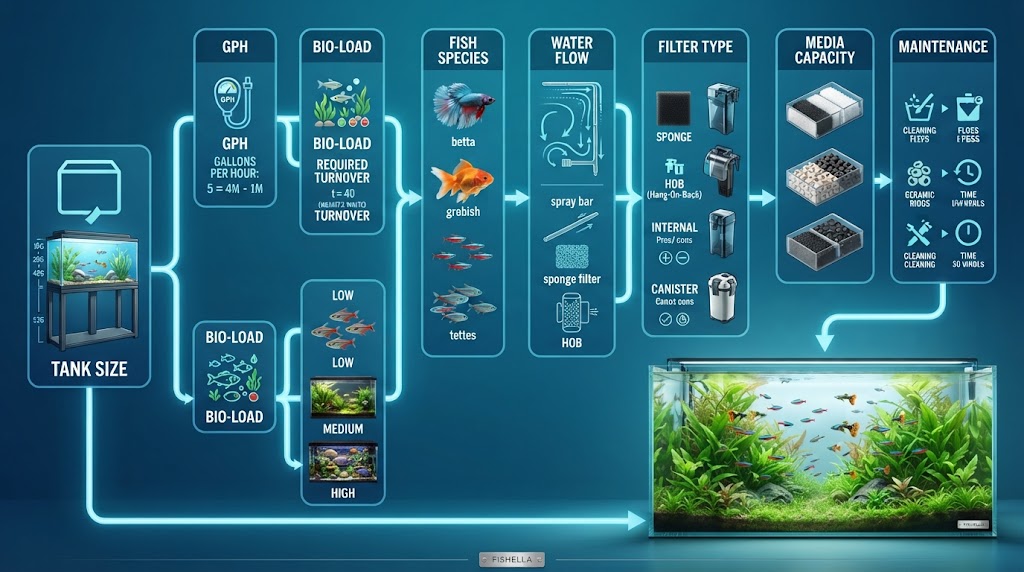
Choosing the right aquarium filter does not have to be complicated. Start with your tank size, then consider GPH, bio-load, fish species, water flow, filter type, media capacity, and maintenance. Do not choose a filter simply because it has the highest GPH rating. Your fish need effective filtration and comfortable water movement.
For most beginners, a simple filter that is easy to maintain is a smart choice. Match the filter to your aquarium rather than trying to find one filter that works for every tank.
With the right filtration system and regular water changes, you can create cleaner, more stable water for your fish. The easiest way to understand how to choose an aquarium filter is to consider the complete setup rather than focusing on one specification.
Choose the right heater to maintain a stable temperature by reading our guide to the best heater for a 5-gallon Betta tank.
Pingback: Best Heater for 5 Gallon Betta Tank (2026 Top 5 Picks)
Pingback: Best Filter for 5 Gallon Betta Tank: 3 Top Picks (2026)
Pingback: Can Goldfish Live in a Bowl? What Experts Advise
Pingback: How to Place Aquarium Heater Correctly (Best Position)
Pingback: Setting Up a Freshwater Aquarium: Easy Beginner’s Guide 2026