Affiliate disclosure: Fishella may earn a commission from qualifying purchases made through the affiliate links in this article, at no additional cost to you.
Looking for the best aquarium air pump for large tank setups? For a 55- to 100-gallon aquarium, the Tetra Whisper 100 is the best-value pick if you need to run one or two air-driven devices. The Fluval Q2 is the better choice for tanks up to about 160 gallons and for people who care about low noise. The Active Aqua 8-outlet pump is the right choice if you run many airstones or sponge filters from one pump. Check each pump’s rated tank size, outlet count, and airflow against your equipment before you buy.
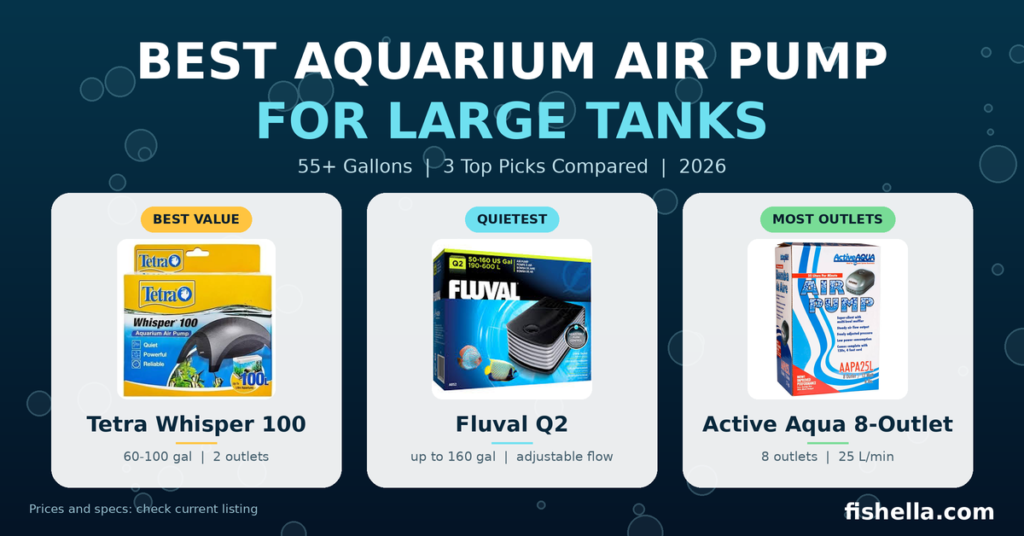
Large tanks are harder on air pumps than small ones. Deeper water pushes back against the air, and a pump that works well on a 10-gallon tank can fall short on a 75-gallon one. This guide compares three pumps built for bigger setups and explains how to size one correctly.
If your tank holds 10 gallons or less, our guide to the best aquarium air pump for small tank setups is a better fit. It covers compact and battery-powered options that are not suited to large tanks.
Quick Comparison: Best Aquarium Air Pump for Large Tank
| Pump | Best for | Rated tank size | Key details | Main limitation |
|---|---|---|---|---|
| Tetra Whisper 100 | Best value for 60-100 gallon tanks | 60 to 100 gallons | 2 outlets, 3.3 L/min listed airflow, about 4.8 W | Some buyers report noise |
| Fluval Q2 | Quiet operation, up to 160 gallons | 50 to 160 gallons (retailer listings) | Adjustable flow knob, UL listed on some listings, about 4 W | Outlet count differs between listings |
| Active Aqua 8-Outlet (AAPA25L) | Many airstones or sponge filters | Multi-tank or fishroom use | 8 outlets, 25 L/min, 12 W, adjustable pressure dial | Sold mainly through hydroponic suppliers; priciest |
Prices and stock change often. Check the current listing for specifications, warranty, and what is included in the box.
How We Chose Best Aquarium Air Pump for Large Tank
We did not physically test these pumps. Our picks are based on manufacturer specifications, retailer listings, and the pattern of buyer feedback on those listings. We say so because a pump that looks right on paper can still be noisy or weak in your home. We looked at:
- Rated tank size: The pump had to be built for 50+ gallon tanks, not stretched from a small-tank model.
- Airflow and outlets: Published output, and whether the pump can feed more than one device.
- Noise and vibration: Documented noise-reduction design, plus recurring complaints from buyers.
- Safety and support: Safety listings and warranty length where stated.
- Fit for the job: Whether the pump suits a single large tank or a multi-tank setup.
Specifications differ between model versions, regions, and sellers. Treat every figure here as a starting point and confirm it on the listing you buy from.
1. Tetra Whisper 100: Best Value for 60-100 Gallon Tanks
Best for: One large tank running a sponge filter, an airstone, or two small air-driven devices.
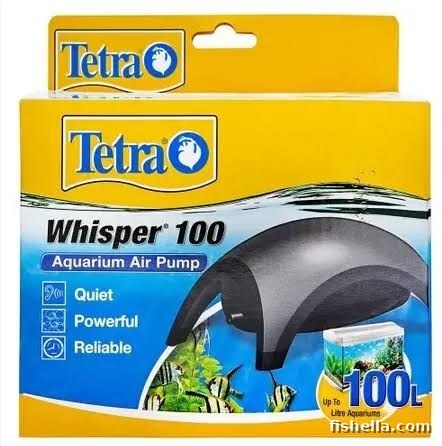
The Tetra Whisper 100 is the largest pump in Tetra’s Whisper range and is rated for aquariums up to 100 gallons. According to retailer listings, it has two outlets, draws about 4.8 watts, and delivers a listed 3.3 liters per minute. Tetra’s official Whisper product page describes a dome-shaped housing, a suspended motor, and sound-dampening chambers designed to reduce noise. One US pet retailer listed it at about $44 when we checked.
What buyers report: Feedback is mixed. Some buyers call it quiet and good value for its size. Others describe it as noisy, and at least one buyer on a retailer page said it was louder than older Whisper pumps they had owned. In our experience reading listings like this, noise complaints often come down to the surface the pump sits on, so see the placement tips below.
Pros
- Two outlets let you run two devices without a splitter.
- Rated for tanks up to 100 gallons.
- Widely available and usually the cheapest pump in this comparison.
- Quiet-design features are documented by the manufacturer.
Cons
- Some buyers report more noise than they expected.
- 3.3 L/min is shared between both outlets, so it will not run many airstones.
- Some versions are sold as non-UL listed. Check the listing for the exact version.
Verdict: Choose this if you have one large tank and a modest air demand. Place it on a stable surface and above the waterline, or add a check valve.
2. Fluval Q2: Best for Quiet Operation and Very Large Tanks
Best for: Large community or planted tanks where noise matters, up to about 160 gallons.
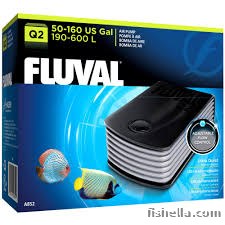
The Fluval Q2 sits at the top of Fluval’s Q series and is listed by retailers for tanks up to 160 gallons. Fluval describes a swing-arm and diaphragm design with double-walled construction, a noise-suppressing baffle chamber, and rubber feet. Retailer listings show about 4 watts, a 6-foot power cord, and a 2-year warranty. It also has an adjustable flow control knob, which is useful when you need to tune bubbles for a calmer fish or a delicate sponge filter. See the Fluval Q2 listing at LiveAquaria for the manufacturer’s description.
What to double-check: Retailer listings disagree on the Q2’s outlet count. Some show one outlet and others show two. Confirm this on the exact listing before you buy, because it decides whether you need a splitter.
Pros
- Rated for tanks up to 160 gallons, the highest rating of the three.
- Adjustable airflow helps you avoid excess current.
- Noise-suppression design and rubber feet.
- Two-year warranty on the listings we checked.
Cons
- Outlet count varies between listings.
- Costs more than the Tetra Whisper 100.
- Larger footprint than small-tank pumps.
Verdict: Choose this for a very large tank, or for a living room where noise would bother you. It is the pick I would lean toward when quiet operation matters more than price.
3. Active Aqua 8-Outlet Air Pump (AAPA25L): Best for Many Airstones or Sponge Filters
Best for: Hobbyists running several sponge filters, multiple tanks, or a breeding rack from one pump.
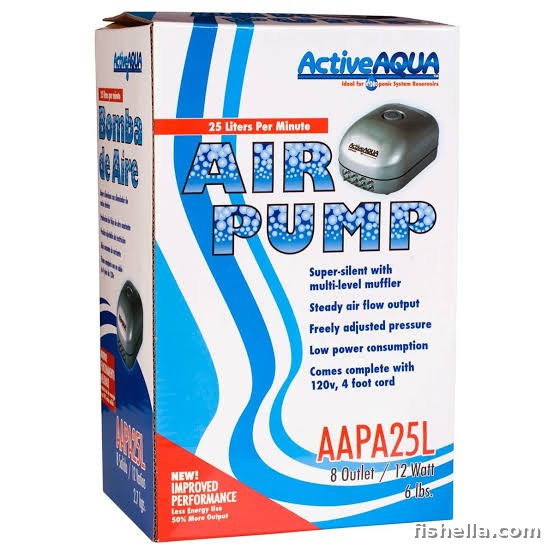
The Active Aqua 8-outlet pump is listed at 25 liters per minute (about 400 gallons per hour), 12 watts, and an ETL listing, with a multi-level muffler and an adjustable pressure dial. Its list price was around $75 at the suppliers we checked. It is sold mainly through hydroponic suppliers, but the same specifications apply to running airstones in aquariums.
This pump is more than a single tank needs. Its value is volume: eight outlets give you room to feed several devices from one pump, which also means one pump to maintain. The warranty is one year on the listings we saw, shorter than the other two.
Pros
- Much higher output than the other two pumps.
- Eight outlets and an adjustable pressure dial.
- Suited to fishrooms, breeding racks, and multi-tank setups.
- ETL listed on the listings we checked.
Cons
- Overkill for a single 55- to 75-gallon tank.
- Higher price and a one-year warranty.
- Not marketed specifically for aquariums by every seller.
Verdict: Choose this only if you need many outlets. For a single large tank, the Tetra Whisper 100 or Fluval Q2 is a better fit.
How to Choose an Air Pump for a Large Aquarium
1. Start With What the Pump Has to Run
A tank-size rating is a rough guide. What matters is what you connect: one sponge filter needs far less air than four airstones. Add up the airflow your devices need and choose a pump that covers it with room to spare.
2. Allow for Water Depth
The deeper the tank, the harder the pump has to push. Published airflow is measured in open air, so real output in a deep tank is lower. For tanks taller than about 24 inches, pick a pump rated above your tank’s size rather than at it.
3. Think About Noise Before You Buy
No air pump is silent. Look for rubber feet and a suspended motor, then read recent reviews for buzzing. Set the pump on a firm surface, away from hollow furniture that amplifies vibration.
4. Use a Check Valve
If the pump sits below the waterline and power drops, water can siphon back through the airline and into the pump. A check valve prevents this. Aquarium Co-Op’s guide to using a check valve shows how to fit one in the right direction.
5. Plan for Backup Filtration
An air pump adds surface movement and can run a sponge filter, but it does not replace a main filter on a large tank. Pair it with a proper filter. Our guide to the best hang on back aquarium filter compares options for mid-size and larger tanks.
Do You Actually Need an Air Pump on a Large Tank?
Not always. If your filter already breaks the water surface well and your tank is not heavily stocked, you may not need one. An air pump helps most when you run a sponge filter, when the tank is heavily stocked, during hot weather when warm water holds less oxygen, or when you want a backup source of surface movement.
If you see fish gasping at the surface, cloudy water, or sudden behavior changes, test your water first. Our API Master Test Kit vs. Test Strips comparison can help you choose a test method. If the water looks hazy, see why your aquarium water is cloudy before assuming you need more aeration. A new tank also needs time to build bacteria, which our guide to the best beneficial bacteria for aquarium setups explains.
Setup and Placement Tips
- Place the pump on a stable, dry surface, ideally above the waterline.
- Connect airline tubing and install a check valve if the pump sits below the water level.
- Attach the airstone or sponge filter and position it securely in the tank.
- Turn the pump on and adjust the airflow so the current does not stress your fish.
- Set a drip loop in the power cord, and keep plugs and outlets dry.
- Check the tubing and connections for leaks or loose fittings every month.
Frequently Asked Questions
What size air pump do I need for a 55-gallon tank?
A pump rated for 60 gallons or more, such as the Tetra Whisper 100 or Fluval Q2, is a reasonable starting point. Match the pump’s airflow to the devices you plan to run, not only to the tank size.
Is the Tetra Whisper 100 loud?
It has noise-reduction features, but buyer feedback is mixed. Some call it quiet, while others report noise. Placing it on a stable, padded surface helps.
Can one air pump run several tanks?
Yes, if it has enough outlets and airflow. A multi-outlet model like the Active Aqua 8-outlet pump is built for this. Splitting a single outlet divides the airflow rather than adding to it.
Do I need an air pump if I already have a filter?
Not necessarily. If your filter provides good surface movement and your stocking is moderate, you may not need one. A pump becomes useful with sponge filters or heavy stocking.
Does water depth affect air pump performance?
Yes. Deeper water adds resistance, so the pump delivers less air than its open-air rating. Choose a pump rated above your tank size for deep tanks.
How often should I replace the diaphragm?
Air pump diaphragms wear over time. Replace one when airflow drops or the pump gets louder. Check your pump’s manual for replacement parts.
Final Verdict: Which Large-Tank Air Pump Should You Buy?
For a single 60- to 100-gallon tank, the Tetra Whisper 100 offers the best balance of price and capacity. If noise matters most, or your tank is very large, the Fluval Q2 is the safer choice. If you run many sponge filters or several tanks, the Active Aqua 8-outlet pump gives you the outlets you need.
Whichever pump you pick, confirm the exact model’s specifications, install a check valve, and watch your fish for a few days after setup.