
This article contains affiliate links. As an Amazon Associate, Fishella earns from qualifying purchases.
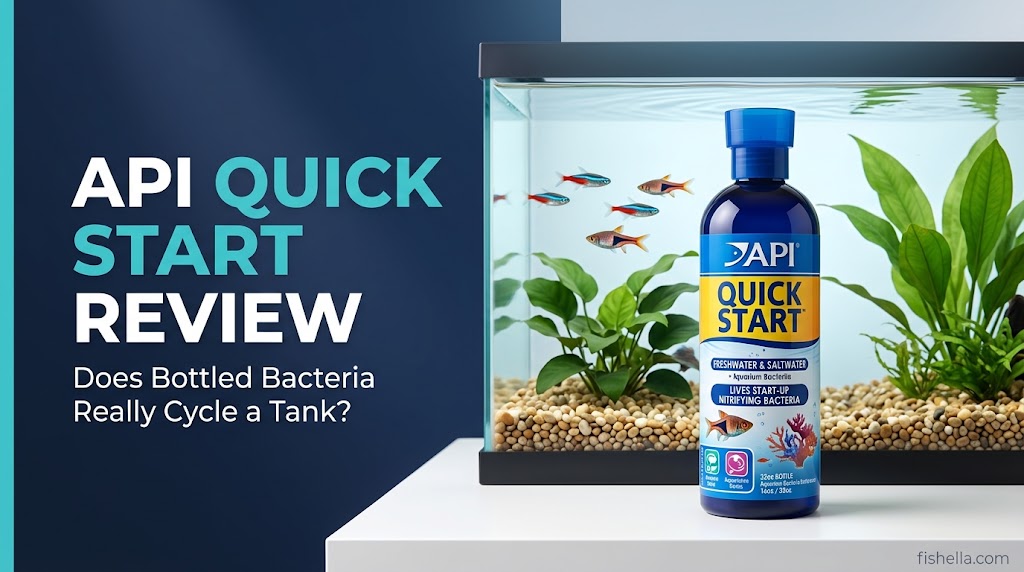
API Quick Start is a bottle of live nitrifying bacteria that helps a new tank build its biological filter. It is easy to use and low cost, and it can be a helpful part of cycling a tank. It is not magic. You still need to test your water, add fish slowly, and keep up with water changes.
This API Quick Start review covers what the product is, the dose, when to use it, what it cannot do, and who should buy it. We did not test it. We used API’s own product page, retailer descriptions, and general aquarium-care guidance.
If you are choosing gear for a new tank, see our best aquarium starter kit guide first.
API Quick Start Reviews at a Glance
| Detail | What the maker says |
| What it is | Live nitrifying bacteria for freshwater and saltwater tanks |
| Claim | Allows instant addition of fish by starting the natural aquarium cycle |
| How it works | Bacteria convert toxic ammonia to nitrite, then to nitrate |
| Dose | 10 mL per 10 U.S. gallons of aquarium water (double for saltwater) |
| Sizes | 1 oz, 4 oz, 8 oz, 16 oz, 32 oz |
| Storage | No refrigeration required, per retailer descriptions |
Details come from API’s product page and retailer pages such as LiveAquaria. You can see the current bottles on Amazon through this link to API MARINE QUICK START Saltwater And Reef Aquarium Nitrifying Bacillus 16-Ounce Bottle. Prices change often, so check the listing.
What Is API Quick Start?
New tanks do not have enough beneficial bacteria yet. Fish waste makes ammonia, which is toxic. Bacteria turn ammonia into nitrite, and then into nitrate, which is much less harmful. This process is called the nitrogen cycle.
API says Quick Start contains patented, live nitrifying bacteria that start this cycle right away, and that it helps prevent “new tank syndrome.” Retailer pages say you can use it when starting a new tank, adding fish, changing water or filter media, after medicating, or whenever ammonia or nitrite show up.
Want to understand the cycling process step by step? Read our guide on how to cycle a fish tank fast to learn how to establish beneficial bacteria while monitoring water parameters safely.
How to Use API Quick Start
- Shake the bottle well before use.
- Treat your tap water with a conditioner first. A UK retailer notes that a conditioner should be used before Quick Start.
- Use the dosing cap. Add 10 mL for every 10 U.S. gallons. For a 5 gallon tank, that is about 5 mL.
- Add fish as the label allows, but start with a few and test the water often.
- Dose again after water changes, filter media changes, new fish, or medication, as the label suggests.
For help choosing a conditioner, see our best aquarium water conditioner guide. If you are deciding between two popular options, our Seachem Prime vs. API Stress Coat comparison may help.
What We Like
- Simple to use. Shake, measure, pour.
- Clear dosing. 10 mL per 10 gallons is easy to scale for small tanks.
- No refrigeration. Retailers say it does not need to be refrigerated.
- Freshwater and saltwater. The same product works for both, with a doubled saltwater dose.
- Useful in routine care. Many keepers use it after filter changes.
Limits and Cautions
It Does Not Replace Testing
Even if a product says you can add fish right away, your tank still needs checks. A UK retailer notes that Quick Start works best when pH, temperature, and filtration are suitable. Test ammonia and nitrite often in the first weeks. Our API Master Test Kit vs. test strips comparison explains which test to use.
Results Vary
Bottled bacteria are a tool, not a promise. Hobbyists report different results, and we did not find an independent study to cite for this product. Treat the “instant” claim as a manufacturer claim, and plan to watch the numbers.
Do Not Overstock a New Tank
A small group of fish in a new tank can overwhelm the filter. Add fish a few at a time, and feed lightly.
Chlorine and Chloramine Still Matter
Treat your tap water with a conditioner before you add Quick Start. Chlorine and chloramine can harm bacteria and fish.
Who Should Buy API Quick Start?
- Buy it if you are setting up a new freshwater tank, want to support the cycle, and will test the water.
- Buy it if you often change filter media or medicate fish and want to help restore bacteria.
- Skip it if you expect it to replace testing, water changes, or a proper filter.
API Quick Start vs. Other Bacteria Products

There are other bottled bacteria products on the market, such as Seachem Stability, Tetra SafeStart Plus, and Fritz Zyme 7. We did not compare data between them, and we would not claim one is better without independent testing. Check each label for dose, storage, and use instructions, and choose one that fits your routine.
If you want to compare sizes, API sells bottles from 1 oz to 32 oz. A small tank owner may be happy with a 4 oz bottle, while someone with several tanks may prefer a 16 oz bottle.
Before adding fish, test your aquarium water carefully. Our guide to the API Master Test Kit vs. test strips compares two ways to monitor important water parameters during cycling.
Frequently Asked Questions
How much API Quick Start do I use for a 5 gallon tank?
API says to use 10 mL per 10 gallons, so a 5 gallon tank needs about 5 mL.
Can I add fish right after using API Quick Start?
API says you can. We suggest adding only a few fish and testing often.
Do I need to refrigerate the bottle?
Retailer descriptions say no refrigeration is required. Check your bottle for storage notes.
Can I use it with a water conditioner?
Yes. Retailers advise using a conditioner to remove chlorine and chloramine, and dosing it first.
Does it work for saltwater tanks?
API says it can be used in saltwater tanks and tells you to double the dose.
Final Verdict
API Quick Start is an easy, affordable way to add live nitrifying bacteria to a new or recently serviced tank. It is a helpful tool for a cycle, not a shortcut around good habits. Use it with a water conditioner, test regularly, and add fish slowly. If you do that, it is a sensible addition to your new tank routine.
Pingback: How to Cycle a Fish Tank Fast: Beginner’s Guide