
As an Amazon Associate, Fishella earns from qualifying purchases.
The best sponge filter for betta fish should provide gentle water movement, reliable biological filtration, and enough surface area for beneficial bacteria. For most 5-gallon betta tanks, the Aquarium Co-Op Nano Sponge Filter is a strong option. The Small model is better suited to 10-gallon tanks, while the Medium works for larger aquariums.
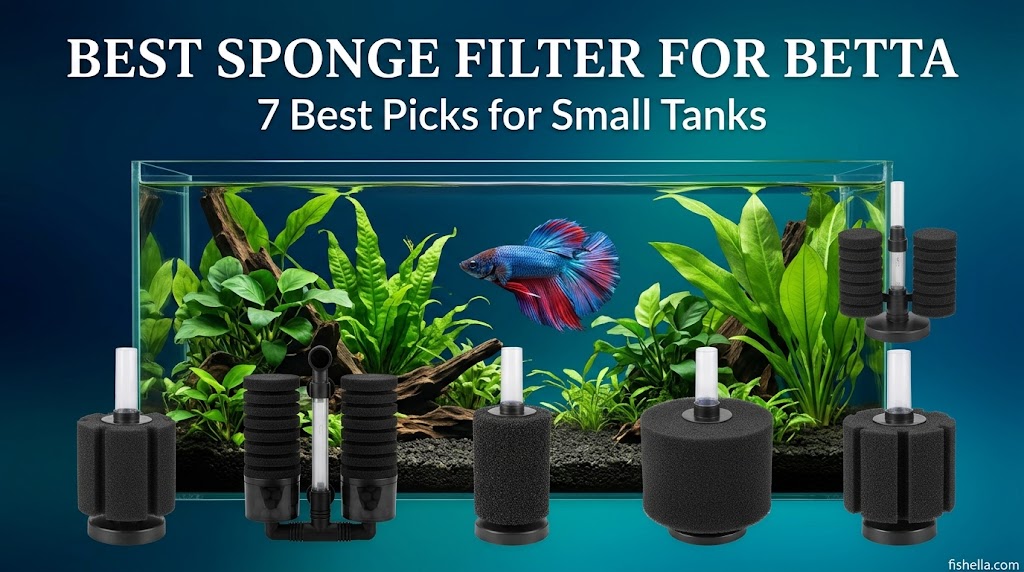
Sponge filters are popular with betta owners because they create gentle water movement. They also provide a surface where beneficial bacteria can grow. However, you still need an air pump, proper airflow control, and regular maintenance.
In this guide, we’ll compare seven sponge filters for betta tanks. You’ll learn which models suit different aquarium sizes, what features to consider, and how to install one correctly.
Quick Comparison: Best Sponge Filters for Betta Tanks
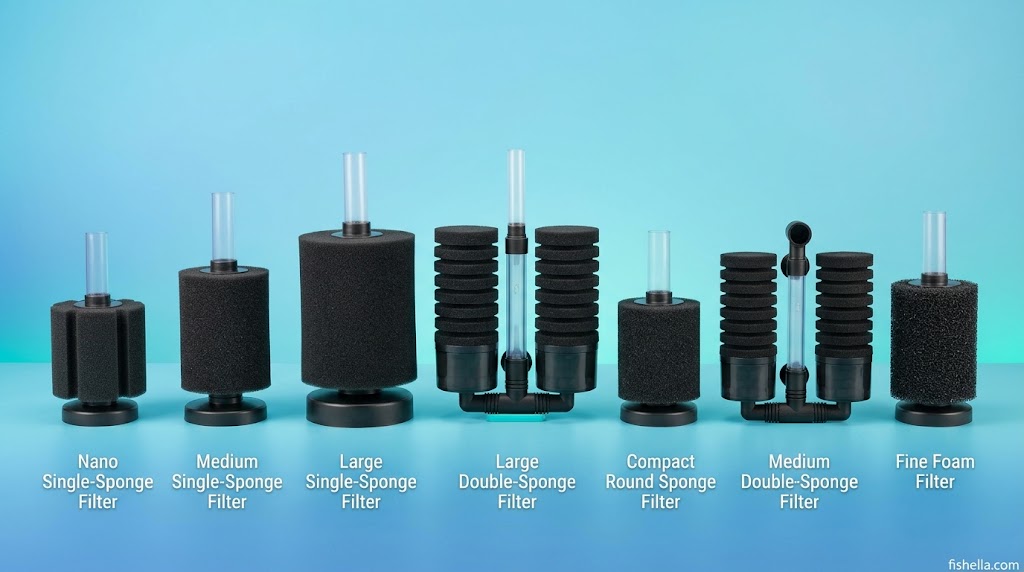
| Sponge filter | Best for | Recommended tank size | Air pump |
|---|---|---|---|
| Aquarium Co-Op Nano | Best overall | 5 gallons and up | Separate |
| Aquarium Co-Op Small | 10-gallon tanks | 10 gallons and up | Separate |
| Aquarium Co-Op Medium | Larger betta tanks | 20 gallons and up | Separate |
| Hygger Double Sponge | Extra biological media | Depends on model | Separate |
| Pawfly Nano Bio Sponge | Budget buyers | Depends on selected version | Separate |
| Aquaneat Round Sponge | Compact setups | Check exact model rating | Separate |
| Hikari Bacto-Surge Mini | Small aquariums | Up to 10 gallons | Check package contents |
Important: Tank-size ratings are manufacturer or listing guidelines, not guarantees of filtration performance. Always check the exact model, dimensions, and package contents before purchasing.
7 Best Sponge Filters for Betta Fish (2026 Reviews)
1. Aquarium Co-Op Nano Sponge Filter – Best Overall for 5-Gallon Betta Tanks
Best for: Standard 5-gallon betta aquariums.
The Aquarium Co-Op Nano Sponge Filter is a compact option for small aquariums. It uses an air-driven lift tube to pull water through the sponge.
The manufacturer recommends this model for tanks of 5 gallons and up. You can choose coarse or fine sponge material.
Key features:
- Compact single-sponge design.
- Available in coarse and fine versions.
- Easy Flow kit for water circulation.
- Requires an external air pump.
- Designed for aquariums starting at 5 gallons.
Pros
- Small footprint for compact aquariums.
- Coarse foam can allow longer intervals between cleaning.
- Simple design with no motor inside the aquarium.
- Suitable for gentle filtration when airflow is adjusted.
Cons
- Air pump is sold separately.
- Fine foam may need more frequent cleaning.
- Excessive airflow can create unwanted water movement.
Our verdict: This is my preferred starting point for a standard 5-gallon betta tank. Pair it with a small air pump and an adjustable valve. Reduce the airflow if your betta struggles against the bubbles.
Check price: View Aquarium Co-Op Nano Sponge Filter
2. Aquarium Co-Op Small Sponge Filter – Best for 10-Gallon Betta Tanks
Best for: Betta aquariums around 10 gallons.
The Aquarium Co-Op Small Sponge Filter provides more sponge capacity than the Nano model. It is a practical choice for a larger betta aquarium.
The manufacturer’s sizing guide recommends the Small model for tanks of 10 gallons and up.
Key features:
- Single-sponge design.
- Coarse and fine foam options.
- Larger sponge than the Nano model.
- Requires an external air pump.
- Designed for larger aquariums than the Nano.
Pros
- More sponge surface area than the Nano.
- Simple installation and maintenance.
- Suitable for 10-gallon aquariums.
- Easy to adjust using an air control valve.
Cons
- Takes up more aquarium space.
- Air pump is an additional purchase.
- Fine foam may clog faster than coarse foam.
Our verdict: Choose this model if your betta lives in a 10-gallon aquarium. It provides more filtration capacity without needing a complicated filter system.
Check price: View Aquarium Co-Op Small Sponge Filter
3. Aquarium Co-Op Medium Sponge Filter – Best for 20-Gallon Betta Tanks
Best for: Larger aquariums with a betta and compatible tank mates.
The Aquarium Co-Op Medium Sponge Filter offers more sponge capacity for larger aquariums. It can be useful when a tank has a higher biological load.
The manufacturer’s sizing guide recommends this model for aquariums of 20 gallons and up.
Key features:
- Larger single-sponge design.
- Coarse or fine foam options.
- Air-driven filtration.
- Requires a separate air pump.
- Designed for larger freshwater aquariums.
Pros
- More surface area for beneficial bacteria.
- Suitable for larger aquariums.
- Straightforward maintenance.
- No electrical motor inside the aquarium.
Cons
- Takes up more space.
- Needs suitable airflow.
- May create excessive movement if the pump is too strong.
Our verdict: This is a better choice for a 20-gallon aquarium than a small nano filter. Make sure the bubble stream does not create an uncomfortable current for your betta.
Check price: View Aquarium Co-Op Medium Sponge Filter
4. Hygger Double Sponge Filter – Best Double Sponge Design
Best for: Betta keepers who want two sponge sections and additional biological media.
A double sponge filter uses two sponge sections instead of one. This gives bacteria more surfaces to colonize.
Many Hygger models also include a ceramic media chamber. However, the included accessories and recommended tank sizes can vary by model.
Key features:
- Two sponge sections.
- Ceramic media chamber on applicable models.
- Air-driven operation.
- Suction cups for positioning.
- Replacement sponge availability varies.
Pros
- Two sponge sections provide additional surface area.
- Ceramic media adds another biological filtration surface.
- Useful for larger or more heavily stocked aquariums.
- Some packages include spare sponges.
Cons
- Takes up more space than a nano filter.
- Requires an external air pump.
- Some models can be difficult to hide.
- Strong airflow can create excessive bubbles.
Our verdict: Consider a smaller Hygger double sponge model if your aquarium needs additional biological filtration. Check its exact dimensions and tank-size recommendation before buying. It may be unnecessarily large for a simple 5-gallon betta setup.
Check price: View Hygger Double Sponge Filters
5. Pawfly Nano Bio Sponge Filter – Best Budget Option
Best for: Budget-conscious aquarium owners.
Pawfly offers several sponge filter sizes and configurations. Its Nano Bio Sponge Filter range includes different options for small and larger aquariums.
This is important because the smallest nano version is not the same product size as its larger versions.
Key features:
- Multiple sizes and configurations.
- Air-driven operation.
- Bio-foam filtration.
- Some packages include airline tubing and valves.
- Replacement sponge options may be available.
Pros
- Affordable options.
- Several sizes to choose from.
- Useful for multiple aquarium setups.
- Simple air-driven design.
Cons
- Package contents vary.
- Air pump is generally sold separately.
- Different versions have different dimensions.
- Check replacement sponge compatibility.
Our verdict: Pawfly is worth considering if you want an affordable sponge filter. Select the correct 5–10-gallon or larger version rather than assuming every Nano listing is suitable for the same aquarium size.
Check price: View Pawfly Nano Bio Sponge Filter
6. Aquaneat Round Sponge Filter – Best Compact Design
Best for: Aquariums where filter space is limited.
Aquaneat offers compact round sponge filter designs. Their small shape can make placement easier in some aquarium layouts.
However, check the exact model and dimensions before buying. Different listings may include different accessories.
Key features:
- Compact round sponge design.
- Air-driven operation.
- Some packages include airline tubing and valves.
- Small footprint.
- Requires a compatible air pump.
Pros
- Compact design.
- Easy to position in aquarium corners.
- Affordable option.
- Simple maintenance.
Cons
- Small sponge surface area compared with larger filters.
- Air pump may not be included.
- Product specifications vary by listing.
- May not provide enough filtration capacity for a larger aquarium.
Our verdict: This is worth considering when space is limited. For a 5-gallon betta tank, verify the exact model’s rating and sponge dimensions. Do not choose a filter only because its listing advertises a low price.
Check price: View Aquaneat Sponge Filters
7. Hikari Bacto-Surge Mini – Best from an Established Fish-Care Brand
Best for: Betta keepers who prefer a compact sponge filter from an established aquarium brand.
The Hikari Bacto-Surge Mini is designed for small freshwater aquariums. Its fine foam provides a surface for beneficial bacteria to grow.
Hikari lists the Mini for aquariums up to 10 gallons.
Key features:
- Fine foam construction.
- Mechanical and biological filtration.
- Compact design.
- Rated for aquariums up to 10 gallons.
- Air-driven operation.
Pros
- Suitable for small aquariums.
- Compact dimensions.
- Fine foam provides biological surface area.
- Established aquarium brand.
Cons
- Fine foam may require regular cleaning.
- Air pump requirements should be checked.
- May need more frequent maintenance in dirty aquariums.
- Not intended for large tanks.
Our verdict: The Hikari Bacto-Surge Mini is worth considering for a small betta aquarium. Its compact size makes it an alternative to larger sponge filters.
Check price: View Hikari Bacto-Surge Sponge Filters
What Is the Best Sponge Filter for Different Betta Tank Sizes?
Choosing the right sponge filter starts with your aquarium’s actual water volume. A filter designed for a large tank is not automatically better for a small betta aquarium.
Best Sponge Filter for a 5-Gallon Betta Tank
The Aquarium Co-Op Nano is my preferred choice for a standard 5-gallon aquarium.
It has a compact design and is rated for tanks starting at 5 gallons. You can also consider a correctly sized Pawfly or Aquaneat model.
Use an adjustable air valve to control the bubbles.
Best Sponge Filter for a 10-Gallon Betta Tank
The Aquarium Co-Op Small is a suitable starting point for a 10-gallon tank.
You can also consider the Hikari Bacto-Surge Mini or a properly sized Hygger double sponge filter.
Choose based on sponge capacity, available space, and airflow control.
Best Sponge Filter for a 20-Gallon Betta Tank
The Aquarium Co-Op Medium is a practical choice for a 20-gallon aquarium.
A suitable Hygger double sponge model is another option if you need more biological media.
Make sure your betta has calm areas away from the bubble stream.
Best Nano Sponge Filter for a Small Betta Aquarium
For a standard 5-gallon betta tank, the Aquarium Co-Op Nano is a strong choice.
Avoid choosing a filter simply because its listing says it works for very small tanks. Your aquarium must also provide enough swimming space and suitable living conditions for your betta.
How to Choose the Best Sponge Filter for a Betta Tank
Not every sponge filter works equally well in every aquarium. Consider these features before purchasing.
1. Match the Filter to Your Tank Size
Check the manufacturer’s recommended tank size before ordering.
For example:
- Nano: 5 gallons and up.
- Small: 10 gallons and up.
- Medium: 20 gallons and up.
These are Aquarium Co-Op’s general sizing recommendations. Other manufacturers use different sizing systems.
You can check the Aquarium Co-Op sponge filter sizing guide before choosing a model.
2. Single Sponge vs. Double Sponge Filters
A single sponge filter has one foam section. It is usually compact and easy to maintain.
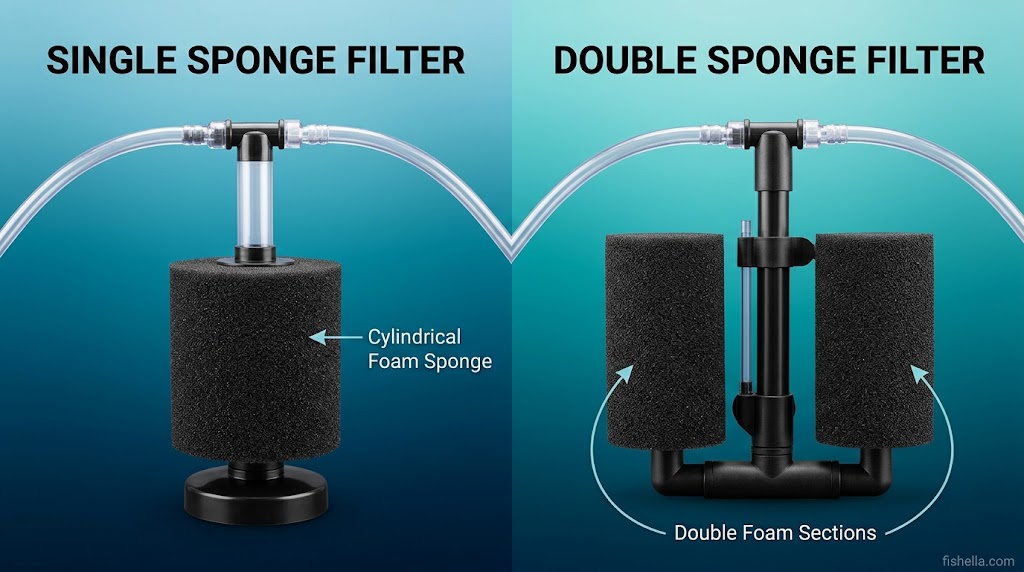
A double sponge filter has two foam sections. It provides more surface area but takes up additional space.
For most small betta aquariums, a single sponge filter is a practical choice. Larger tanks with higher biological loads may benefit from a double design.
3. Check Sponge Size and Material
Sponge size affects how much surface area is available for beneficial bacteria.
Coarse foam allows water to pass through more easily and may clog less quickly.
Fine foam can trap smaller particles, but it may need more frequent cleaning.
Choose a sponge that balances mechanical and biological filtration.
4. Check Air Pump Compatibility
Most sponge filters need a separate air pump.
Before purchasing, check whether the package includes:
- Air pump.
- Airline tubing.
- Check valve.
- Air control valve.
- Sponge and lift tube.
Many sponge filters include only the filter itself.
5. Look for Adjustable Airflow
This is especially important for betta fish.
A powerful air pump can create excessive water movement. Your betta should be able to swim and rest without fighting the current.
Choose an air pump with adjustable output or install an air control valve.
For more help, read our guide on how to slow down aquarium filter flow.
6. Consider Cleaning and Replacement Parts
Choose a sponge filter that is easy to remove and clean.
Check whether replacement sponges are available. You should not need to replace the entire filter when its sponge wears out.
Are Sponge Filters Good for Betta Fish?
Yes. Sponge filters are a good filtration option for many betta aquariums.
They offer three important benefits:
Gentle water movement: Air-driven sponge filters can produce a gentle current when properly adjusted. This helps bettas swim and rest comfortably.
Biological filtration: The sponge provides a surface for beneficial bacteria. These bacteria help process ammonia and nitrite in an established aquarium.
Simple maintenance: Sponge filters have few moving parts. You can remove the sponge and rinse it carefully when it becomes dirty.
However, sponge filters also have limitations.
They do not remove all dissolved waste. They cannot replace regular water changes, and they may not provide enough mechanical filtration for heavily stocked aquariums. Need a different filter style? Compare our guide to the best hang-on-back aquarium filters.
The Merck Veterinary Manual guide to aquatic life-support filtration explains the roles of mechanical and biological filtration.
Do Betta Sponge Filters Need an Air Pump?
Yes. A traditional sponge filter needs an air pump to operate.
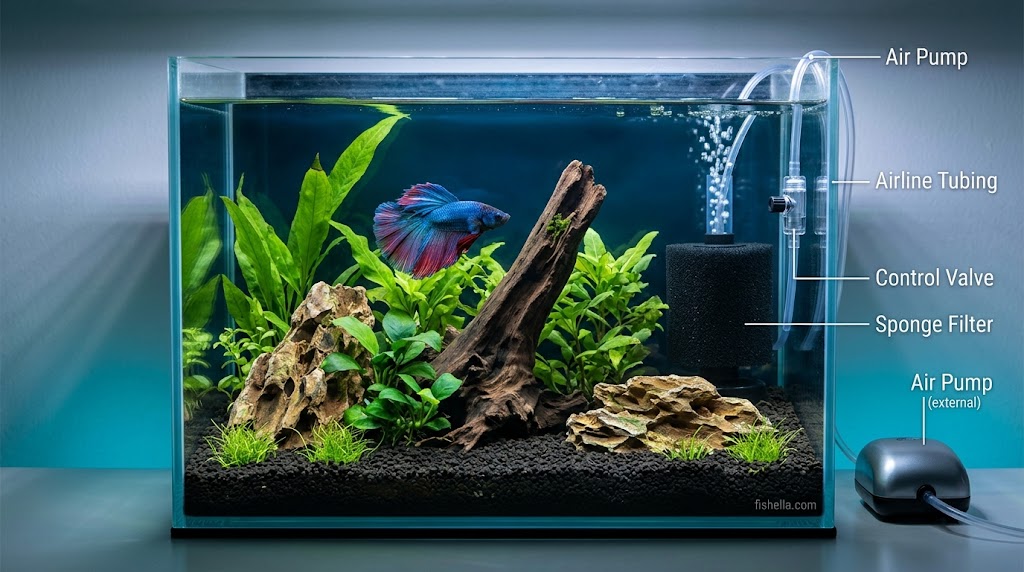
The pump sends air through airline tubing into the filter’s lift tube. Rising bubbles pull water through the sponge.
You will generally need:
- Air pump: Supplies air to the filter.
- Airline tubing: Connects the pump to the filter.
- Check valve: Helps prevent water from flowing backward into the pump.
- Air control valve: Allows you to reduce airflow.
- Sponge filter: Traps debris and provides biological filtration.
An air stone is optional. Some sponge filters already have a bubble diffuser, while others use a simple lift tube.
Do not assume an air pump is included. Check the product package before purchasing.
How to Install a Sponge Filter in a Betta Aquarium
Installing a sponge filter is simple. Follow these steps.
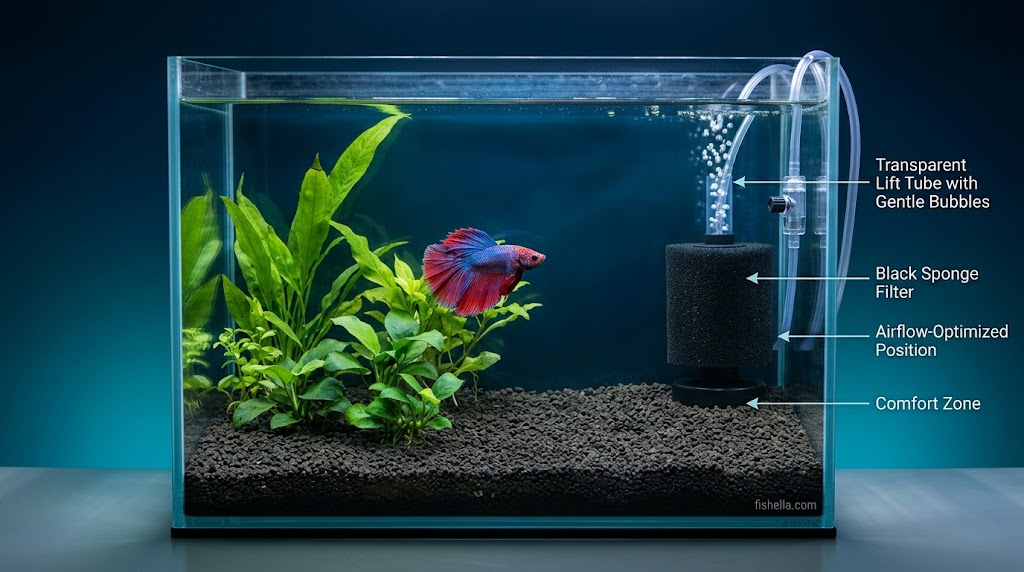
Step 1: Prepare the sponge
Rinse the new sponge in dechlorinated water to remove loose dust or manufacturing residue.
Step 2: Assemble the filter
Connect the sponge, lift tube, and other included parts according to the manufacturer’s instructions.
Step 3: Connect airline tubing
Attach the airline tubing to the filter’s air inlet.
Step 4: Install a check valve
Place a check valve in the airline if needed. Follow its directional marking.
Step 5: Position the filter
Place the sponge filter near the back or corner of your aquarium. Make sure it stands securely.
Step 6: Start the air pump
Turn on the pump and check that air is moving through the filter.
Step 7: Adjust the airflow
Reduce the airflow until the water movement is gentle.
Watch your betta swim and rest. If the fish struggles against the current, reduce the airflow further.
Important: A new sponge filter does not contain an established colony of beneficial bacteria. Allow the aquarium to cycle and test ammonia and nitrite regularly before considering the filter biologically mature.
Common Sponge Filter Mistakes to Avoid
Even a good sponge filter can perform poorly when installed or maintained incorrectly.
1. Using excessive airflow
Too much airflow can create unnecessary water movement. Adjust the valve to keep the current gentle.
2. Choosing the wrong size
A tiny sponge may not provide enough biological filtration. A very large model may occupy too much space.
3. Cleaning the sponge with untreated tap water
Chlorine can harm beneficial bacteria. Squeeze the sponge gently in removed aquarium water during maintenance.
4. Replacing all filter media at once
Avoid replacing all established biological media together. This can reduce the beneficial bacteria available in your aquarium.
5. Skipping water changes
A sponge filter does not remove every type of waste. Continue regular partial water changes.
6. Assuming a new sponge filter is already cycled
A new sponge needs time to develop beneficial bacteria. Test your aquarium water during the cycling process.
Final Verdict: Which Sponge Filter Should You Buy?
The best sponge filter depends on your aquarium size, available space, and filtration needs.
Here are my recommendations:
| Buying category | Recommended product |
|---|---|
| Best overall for 5 gallons | Aquarium Co-Op Nano |
| Best for 10 gallons | Aquarium Co-Op Small |
| Best for 20 gallons | Aquarium Co-Op Medium |
| Best double sponge option | Hygger Double Sponge |
| Best budget option | Pawfly Nano Bio Sponge |
| Best compact alternative | Aquaneat Round |
| Best established brand option | Hikari Bacto-Surge Mini |
My overall recommendation: Start with the Aquarium Co-Op Nano for a standard 5-gallon betta aquarium. Choose the Small for 10 gallons and the Medium for 20 gallons.
Whichever model you choose, use a suitable air pump and control the airflow. A properly sized sponge filter can provide useful biological filtration without creating excessive water movement.
For more help building a healthy aquarium, visit our complete betta fish care guide.
Frequently Asked Questions
1. Are sponge filters better for bettas?
Sponge filters are a good choice for many betta aquariums because they can provide biological filtration with gentle water movement. However, the right filter depends on aquarium size and stocking.
2. What size sponge filter does a betta need?
Choose a filter based on your aquarium’s water volume. Aquarium Co-Op recommends its Nano for 5 gallons and up, Small for 10 gallons and up, and Medium for 20 gallons and up.
3. Can I use a sponge filter in a 5-gallon betta tank?
Yes. A compact model such as the Aquarium Co-Op Nano is designed for tanks starting at 5 gallons. Adjust the airflow to avoid excessive current. Not sure which filter to choose? Compare the best filter options for a 5-gallon betta tank.
4. Does a sponge filter need an air pump?
Yes. A traditional sponge filter uses an external air pump to move water through its sponge.
Need an air pump for your sponge filter? Check out our guide to the best aquarium air pumps for small tanks.
5. Can a sponge filter create too much current?
Yes. Excessive airflow can create strong bubbles and water movement. Use an adjustable air valve to reduce the flow.
6. How often should I clean a betta sponge filter?
Clean it when water flow decreases or the sponge becomes clogged. Cleaning frequency depends on feeding, stocking, and sponge type. Rinse it gently in removed aquarium water.
7. Can a sponge filter fully cycle a betta aquarium?
A sponge filter can support the beneficial bacteria needed for biological filtration. However, installing a new sponge does not instantly cycle an aquarium. Test ammonia and nitrite until the aquarium is established.
8. Are double sponge filters better than single sponge filters?
Not always. Double sponge filters provide more surface area but take up more space. A single sponge filter is often sufficient for a typical small betta aquarium.
Pingback: Best Filter for 5 Gallon Betta Tank: 3 Top Picks (2026)