Affiliate Disclosure: As an Amazon Associate, Fishella earns from qualifying purchases. If you buy through links on this page, we may earn a commission at no extra cost to you.
The best filter for guppies keeps aquarium water clean without creating a strong current. Sponge filters work especially well for baby guppies and breeding tanks. Hang-on-back filters suit many beginner aquariums, while canister filters are useful for larger setups. Your best choice depends on tank size, fish population, and maintenance needs. Start with our complete guppy fish care guide for more setup advice.
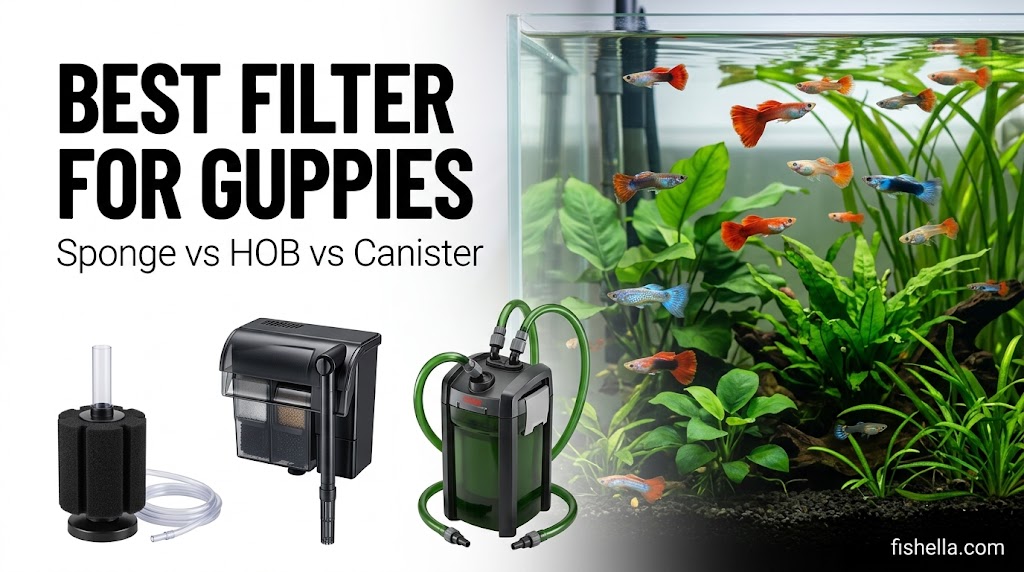
Choosing the best filter for guppies depends on your tank size, fish population, and water flow. Sponge filters work well for guppy fry, while hang-on-back filters suit many beginner aquariums. Larger tanks may benefit from a canister filter with adjustable flow. If you’re raising newborn guppies, read our complete guide to baby guppy care to learn about fry feeding, safe tank setup, water changes, and healthy growth.
Why Do Guppies Need a Filter?
A filter helps keep your guppies healthy by supporting beneficial bacteria and removing suspended debris. These bacteria convert toxic ammonia into nitrite and then less-toxic nitrate.
Filtration has three main functions:
- Biological filtration: Provides surfaces where beneficial bacteria process ammonia and nitrite.
- Mechanical filtration: Traps uneaten food, fish waste, and other particles.
- Chemical filtration: Uses media such as activated carbon to remove certain dissolved substances when needed.
Biological filtration is essential in most established aquariums. However, a filter does not replace regular water changes or water testing. Maintaining good water quality is essential for healthy guppies. Learn more about fish health and water quality.
Before adding guppies, learn how to cycle an aquarium. A properly cycled filter helps control ammonia and nitrite.
Best Filter Types for Guppies Compared
The right filter depends on your aquarium size, stocking level, and whether you keep baby guppies.
| Filter Type | Main Advantages | Potential Drawbacks | Best Use |
|---|---|---|---|
| Sponge filter | Gentle flow, fry-friendly, affordable | Requires an air pump and airline tubing | Breeding tanks and small aquariums |
| Hang-on-back (HOB) filter | Easy maintenance and flexible media options | Intake and outflow may need adjustment | Many beginner and community tanks |
| Canister filter | Large media capacity and flexible setup | Higher cost and more involved maintenance | Larger or heavily stocked aquariums |
| Internal power filter | Compact and easy to install | Uses space inside the tank | Small aquariums with suitable flow |
1. Sponge Filter: Best for Baby Guppies
A sponge filter is one of the safest choices for guppy fry. An air pump pushes water through the sponge, which traps debris and supports beneficial bacteria.
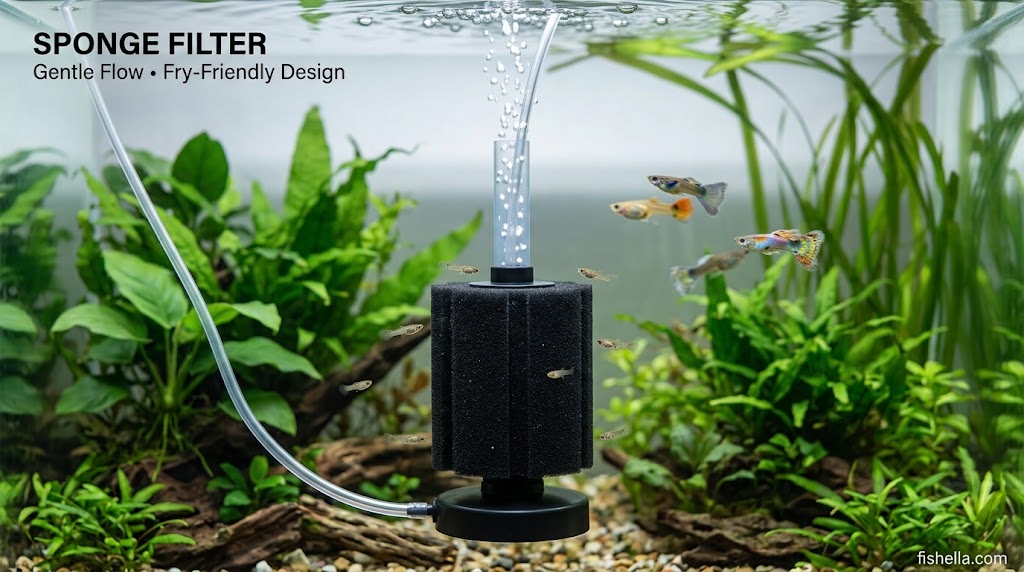
The gentle flow helps small fish swim comfortably. The sponge also provides a surface for biofilm, which young fry may nibble on.
Advantages:
- Gentle water movement
- Low cost and simple design
- Reduced risk of fry entering an intake
- Easy cleaning when handled correctly
Disadvantages:
- Requires an air pump
- May not capture fine debris as effectively as some other filters
- Can look bulky in a small aquarium
Choose a sponge filter rated for your aquarium’s size and stocking level. For a breeding tank, this is often the most practical option.
2. Hang-on-Back Filter: Best for Many Beginner Tanks
A hang-on-back filter, often called a HOB filter, hangs on the rear edge of an aquarium. It pulls water through filter media and returns the cleaned water to the tank.
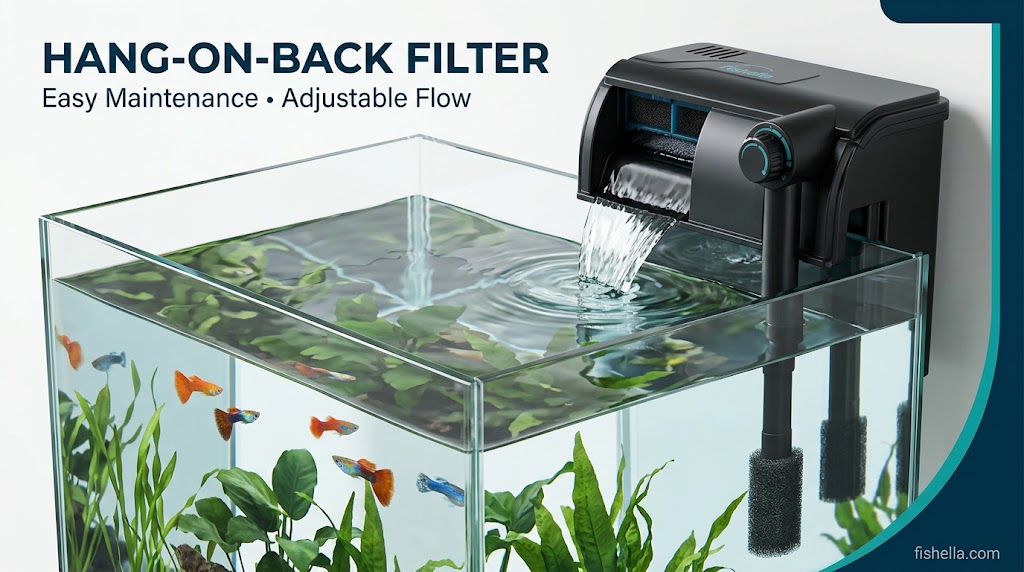
Many models provide mechanical and biological filtration in one compact unit. Some also let you adjust the flow rate.
Advantages:
- Easy to install and maintain
- Offers room for different filter media
- Keeps most equipment outside the aquarium
- Works well for many community tanks
Disadvantages:
- Strong outflow may stress guppies
- Intake openings can endanger fry
- Water evaporation may affect operation if the water level gets too low
Choose a model with adjustable flow when possible. Add a suitable sponge pre-filter to protect baby guppies from the intake.
3. Canister Filter: Best for Larger Aquariums
A canister filter sits outside the aquarium and circulates water through a sealed container of filter media. Its larger media capacity can support effective mechanical and biological filtration.
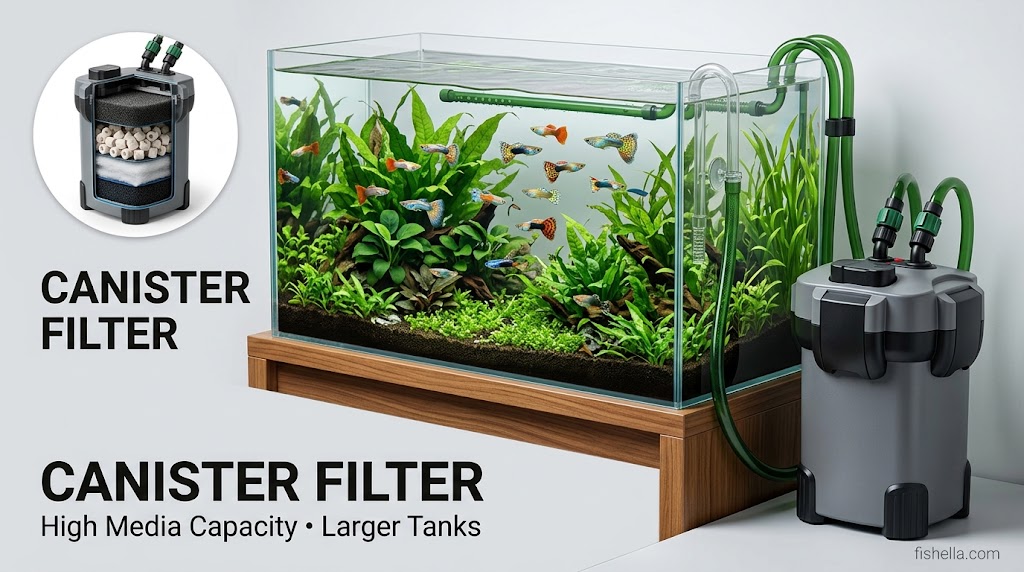
Canister filters can work well for larger guppy communities. However, they may be unnecessary for a small, lightly stocked tank.
Advantages:
- High media capacity
- Flexible media arrangements
- Suitable for larger aquariums
- Keeps most equipment outside the tank
Disadvantages:
- Usually costs more
- Takes longer to clean
- Strong intake or return flow may need adjustment
- Requires careful setup to prevent leaks
If you choose a canister filter, check its recommended aquarium size and actual flow under normal operating conditions.
4. Internal Power Filter: Best for Compact Setups
An internal power filter sits inside the aquarium and uses a motor to move water through its media. It can be convenient when you want a simple, self-contained unit.
Look for a model with suitable biological media and a gentle, adjustable outlet. Protect the intake if your aquarium contains fry.
This filter type is worth considering when an external filter is impractical. However, remember that it takes up swimming space inside the tank.
How to Choose the Right Filter Flow Rate
Filter flow rate is usually measured in gallons per hour (GPH). It tells you how much water a filter can circulate under specified conditions.
A rough starting point is to consider a filter rated around four times the aquarium’s volume per hour. However, this is only a guideline. Stocking level, media resistance, tank shape, and the filter’s actual performance all affect the right choice.
| Aquarium Size | Example Starting Flow Rate |
|---|---|
| 5 gallons | 20 GPH |
| 10 gallons | 40 GPH |
| 20 gallons | 80 GPH |
| 29 gallons | 116 GPH |
These figures are estimates, not strict requirements. A more heavily stocked tank may need greater filtration capacity, while a strong outlet may require flow adjustment.
Signs Your Filter Flow Is Too Strong
Watch how your guppies behave after installing a filter.
- Fish struggle to swim against the current.
- Guppies avoid areas near the filter outlet.
- Fry are pushed around the tank.
- Long-finned fish have difficulty moving comfortably.
If you notice these signs, reduce the flow when possible. You can also redirect the outlet toward the aquarium glass or use an appropriate flow diffuser.
Do not reduce circulation so much that water movement and filtration become inadequate.
How to Protect Baby Guppies From Filter Intakes
Guppy fry are small enough to enter some filter intakes. This risk is especially important in breeding tanks and aquariums with newborn fish.
Use these precautions:
- Choose a sponge filter for a dedicated fry tank.
- Fit a compatible sponge pre-filter over a HOB or canister intake.
- Check the sponge regularly for trapped debris.
- Clean the pre-filter when needed to maintain water flow.
- Make sure the filter continues to circulate water properly.
A sponge pre-filter reduces intake risks, but it does not eliminate every hazard. Inspect it regularly as your fry grow.
For more advice, read our guide to baby guppy care.
Which Filter Media Should You Use?
The filter media you choose affects how well your filter traps debris and supports beneficial bacteria.
Mechanical Media
Sponges, filter pads, and floss catch suspended particles. They help keep aquarium water clear and prevent debris from accumulating inside the filter.
Biological Media
Sponges, ceramic rings, and other porous materials provide surfaces for beneficial bacteria. These bacteria are essential for processing ammonia and nitrite.
Biological filtration relies on beneficial bacteria to process fish waste. For additional background, explore aquarium water quality and biological filtration.
Chemical Media
Activated carbon and certain specialized resins can remove specific dissolved substances. They are useful in some situations but are not always necessary for routine filtration.
For most guppy aquariums, prioritize effective biological filtration and suitable mechanical filtration. Follow the manufacturer’s instructions when arranging the media.
How to Maintain a Guppy Filter
Regular maintenance keeps a filter working properly without unnecessarily disturbing its beneficial bacteria.
Follow these steps:
- Check the filter’s flow regularly.
- Remove trapped debris when the media becomes dirty.
- Rinse reusable biological media gently in removed aquarium water when needed.
- Avoid washing biological media in untreated tap water.
- Never replace all established biological media at once unless necessary.
- Follow the manufacturer’s instructions for cartridges, impellers, and other components.
Some disposable cartridges combine mechanical and biological filtration. Replacing them too frequently may remove useful bacteria. When the design allows, preserve established biological media while replacing only what is necessary.
Filter maintenance should be part of your regular guppy tank maintenance routine.
Common Guppy Filter Mistakes
Avoid these mistakes when setting up your aquarium:
- Choosing an undersized filter: Heavy stocking creates more waste and increases filtration demands.
- Ignoring strong flow: Guppies need areas where they can swim without fighting the current.
- Cleaning all media at once: This can remove a large portion of the beneficial bacteria.
- Rinsing media in untreated tap water: Chlorine or chloramine can harm beneficial bacteria.
- Leaving the intake unprotected: Small fry may be pulled into unsuitable intakes.
- Skipping water tests: Clear water can still contain dangerous ammonia or nitrite.
A suitable filter, regular water changes, and water testing work together to maintain a healthy aquarium.
Frequently Asked Questions
What is the best filter for guppies?
A sponge filter is an excellent choice for breeding tanks and aquariums with fry. A hang-on-back filter is suitable for many beginner setups when its flow is controlled. Larger aquariums may benefit from a canister filter.
Is a sponge filter enough for guppies?
Yes, a properly sized sponge filter can be enough for a small or moderately stocked guppy tank. Its effectiveness depends on the fish population, feeding habits, maintenance, and biological capacity.
Can guppies live without a filter?
Guppies may survive in some carefully managed, lightly stocked aquariums without mechanical filtration. However, this requires close monitoring and is less forgiving for beginners. A suitable filter is strongly recommended.
What flow rate is best for guppies?
There is no single ideal flow rate for every aquarium. Around four times the tank volume per hour is a useful starting estimate, but stocking, filter performance, and current strength also matter.
Do guppy fry need a special filter?
A sponge filter is a practical choice for fry because it provides gentle flow and reduces intake risks. If you use another filter type, add a suitable sponge pre-filter and inspect it regularly.
How often should I clean my guppy filter?
Clean the media when debris buildup reduces flow or when the manufacturer recommends maintenance. The timing depends on stocking, feeding, and filter design. Avoid unnecessarily deep-cleaning all biological media at once.
The best filter for guppies is one that keeps water clean, supports beneficial bacteria, and provides a safe flow for adult guppies and fry.
Final Verdict: Which Filter Should You Choose?
For most guppy keepers, a sponge filter is the best starting choice for fry and breeding tanks. A hang-on-back filter is a versatile option for many beginner aquariums, while a canister filter makes more sense for larger setups.
Prioritize reliable biological filtration, manageable maintenance, and a gentle current. Protect filter intakes when keeping fry, and test your water regularly.
A good filter supports a healthy aquarium, but it works best alongside proper stocking, feeding, and routine water changes.