This article contains affiliate links. As an Amazon Associate, Fishella earns from qualifying purchases.
Compare the best betta hammock and leaf perch options, including Zoo Med Betta Bed and Floating Betta Log. Learn safe placement and care tips. The best betta hammock and leaf perch for most aquariums is a smooth, securely attached leaf that lets your fish rest near the water surface. The Zoo Med Betta Bed is a simple option, while a floating betta log offers additional shelter. Live plants provide a natural alternative.
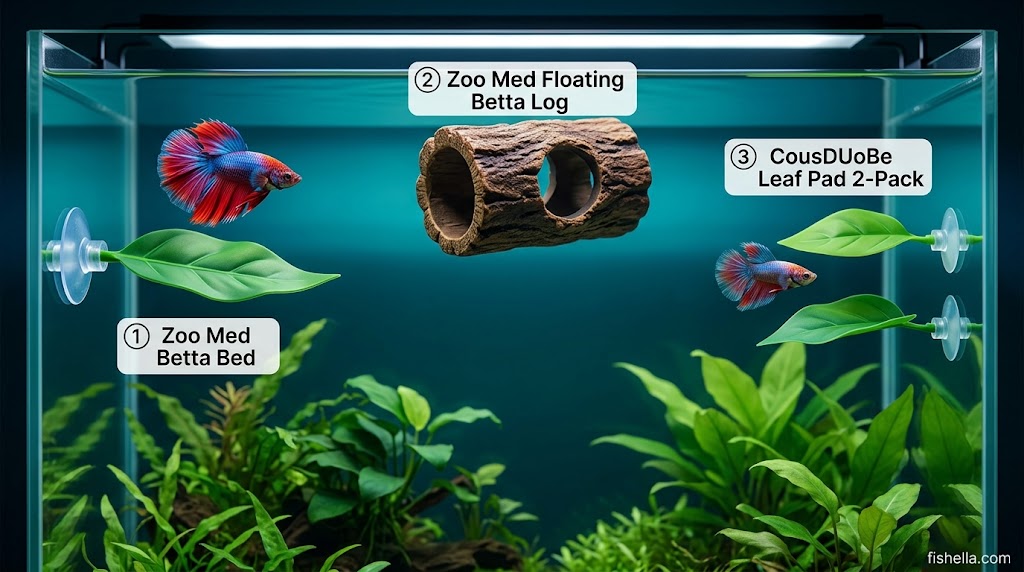
Betta fish often rest on leaves and other surfaces near the water. A hammock can provide a convenient resting place, but it is optional. Your betta still needs a suitable tank, warm water, gentle filtration, and clean water.
In this guide, we compare three resting-spot options, explain their potential drawbacks, and show you how to position one safely.
For a natural alternative, explore our guide to the best live plants for betta tanks.
Best Betta Hammock and Leaf Perch: Quick Picks
| Product | Type | Best for | Main consideration |
|---|---|---|---|
| Zoo Med Betta Bed Leaf Hammock | Suction-cup leaf | A simple, elevated resting spot | Check the leaf coating and attachment regularly |
| Zoo Med Floating Betta Log | Floating log | Bettas that enjoy shelter | Check the opening size and available swimming space |
| CousDUoBe Betta Leaf Pad, 2 Pack | Two-leaf set | Offering multiple resting positions | Verify the materials and suction-cup quality |
Prices, availability, and product designs can change. Check the current Amazon listing for specifications, customer feedback, and the exact version being sold.
How We Chose These Betta Resting Spots
We did not physically test these products. Our comparisons use available retailer descriptions, published product information, and reported buyer experiences.
We considered five practical factors:
- Safety: Smooth surfaces, secure construction, and no exposed sharp parts.
- Surface access: Whether the resting spot can sit near the surface without blocking access to air.
- Installation: Whether the product uses a suction cup or floats freely.
- Durability: Whether available reviews mention peeling, loosening, or other wear.
- Tank suitability: Whether the design offers enough room for your betta to swim comfortably.
These are research-based recommendations, not results from hands-on testing. We cannot independently confirm the durability of every product.
1. Zoo Med Betta Bed Leaf Hammock: Best Simple Pick
The Zoo Med Betta Bed Leaf Hammock attaches to the aquarium glass with a suction cup. Its leaf creates a small resting platform near the water surface.
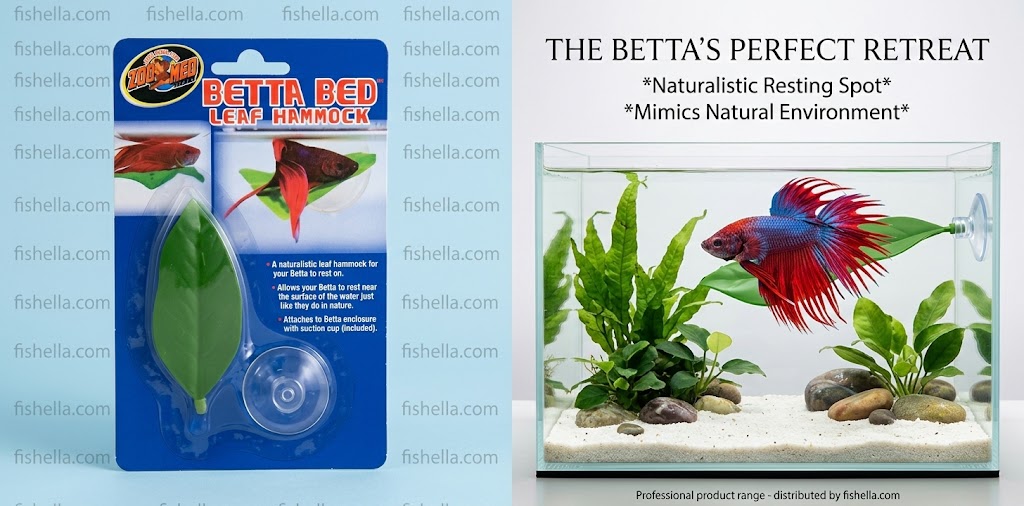
A Pet Valu product listing describes it as a resting place for bettas, including larger varieties. An Australian retailer listing gives approximate leaf dimensions of 6.3 × 4.5 cm. Confirm the dimensions of the version you purchase.
Customer feedback on That Pet Place includes reports of bettas using the hammock regularly. One buyer also reported that the green coating peeled after about two months.
That report does not establish how common the problem is. However, it makes regular inspection important.
Pros
- Simple suction-cup installation.
- Provides a resting spot near the surface.
- Takes up little aquarium space.
- Does not require a separate stand.
Cons
- Some bettas may ignore it.
- The leaf coating may wear over time.
- The suction cup may loosen and require repositioning.
Best for: Bettas in aquariums with a smooth glass wall and enough room for unrestricted swimming.
Safety tip: Inspect the leaf before installation and during routine maintenance. Remove it if the coating peels, the surface becomes rough, or any part breaks.
2. Zoo Med Floating Betta Log: Best for Bettas That Like Cover
The Zoo Med Floating Betta Log offers a different approach. Instead of attaching a leaf to the glass, you provide a floating structure that can offer shelter and a resting area.
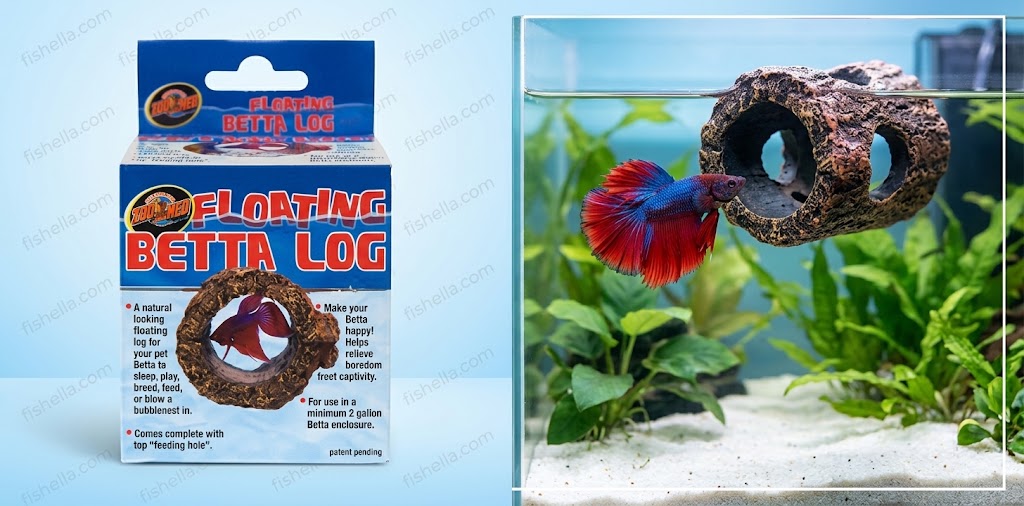
Available product descriptions mention a feeding opening on top. Check the current listing to confirm the design and dimensions of the version you buy.
Some bettas may prefer a sheltered area over an exposed leaf. A floating log can also provide a shaded space, depending on its position and design.
However, the log should never trap your fish or prevent it from reaching the surface.
Pros
- Can provide shelter as well as a resting area.
- Offers an alternative to a suction-cup leaf.
- May suit bettas that prefer covered spaces.
Cons
- May drift around the aquarium.
- Requires enough space for comfortable swimming.
- The opening must suit your betta’s size.
- Actual durability depends on the product version.
Best for: Bettas that enjoy shelter in aquariums with enough open swimming space.
Safety tip: Check for rough edges, cracks, and openings that could trap your fish. Make sure the log does not obstruct the filter or prevent easy access to the surface.
3. CousDUoBe Betta Leaf Pad, 2 Pack: Best for Two Resting Spots
The CousDUoBe Betta Leaf Pad, 2 Pack is an option if you want to offer your betta more than one resting position.
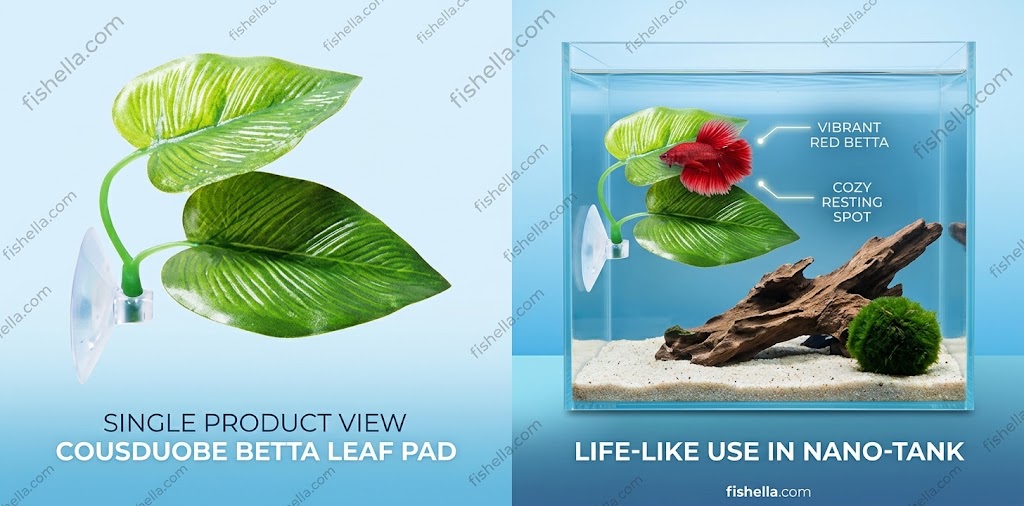
A published roundup describes a set with two leaves of different sizes. However, we could not independently verify the current materials, dimensions, or durability.
Before purchasing, check the listing photos, measurements, suction-cup design, and recent customer reviews.
Two leaves can give your betta a choice, but adding more accessories is not always better. Leave enough open water for normal swimming.
Pros
- Offers more than one resting position.
- May suit keepers who want to experiment with placement.
- Provides an alternative to a single-leaf design.
Cons
- Product details are limited.
- Materials and durability need verification.
- Two leaves may take up unnecessary space in a small tank.
Best for: Keepers who want to try different resting positions and can maintain enough swimming space.
Safety tip: Install one leaf first. Add the second only if your betta still has plenty of room to move freely.
Natural Alternative: Live Plant Leaves
Live plants can provide natural resting surfaces and shelter. Broad, sturdy leaves may work particularly well for bettas that prefer resting on vegetation.
Suitable plant choices depend on your aquarium’s lighting, water conditions, and maintenance routine. Plants also provide cover, although they do not replace filtration or routine water changes.
Start with our guide to the best live plants for betta tanks to find options for your aquarium.
If you choose live plants, check their care requirements before adding them. Some need more light or maintenance than others. Our guide to the best aquarium light for a planted tank can help you choose suitable lighting.
Are Betta Hammocks Safe?
A betta hammock can be a useful accessory when it is made from suitable materials and installed correctly. However, a poorly made or damaged product can create unnecessary risks.
Check these safety points before and after installation.
1. Look for Smooth Edges
Inspect the leaf or log for sharp edges, rough seams, cracks, and loose pieces. Rough surfaces can snag delicate fins.
If a product has damaged or peeling material, remove it rather than trying to keep using it.
2. Avoid Exposed Metal or Sharp Parts
Choose a design without exposed sharp wire or loose metal components. Inspect any attachment points before putting the accessory in your aquarium.
Do not assume that every version of a product uses the same construction.
3. Keep the Resting Spot Near the Surface
Place a leaf just below the water surface so your betta can rest and easily reach the air.
Bettas have a labyrinth organ that allows them to take in atmospheric air. The resting spot should never obstruct their access to the surface.
Avoid placing the leaf so high that your fish cannot rest on it comfortably.
4. Check the Attachment Regularly
A suction cup can loosen over time. Press it firmly against clean glass and check that it stays in place.
If the hammock falls repeatedly, clean the attachment and glass with plain water. Reposition or replace the accessory if it will not stay secure.
5. Leave Enough Swimming Space
A resting accessory should not crowd the aquarium. Your betta needs room to swim around decorations, plants, and equipment.
If you are still choosing an aquarium, read our best betta fish tank guide. It compares tank options and helps you consider your fish’s space requirements.
How to Place a Betta Hammock Correctly
Follow these steps to install a suction-cup leaf hammock.
- Clean the glass. Wipe the installation area with plain water. Do not use soap or household cleaners inside the aquarium.
- Inspect the hammock. Check for rough edges, peeling material, and loose components.
- Position the leaf. Place it just below the surface, where your betta can rest and reach air easily.
- Secure the suction cup. Follow the manufacturer’s instructions and press it firmly against the glass.
- Choose a calm location. Keep the hammock away from strong filter outflow if the current makes resting difficult.
- Leave open swimming space. Ensure your betta can move freely around the leaf.
- Observe your fish. Watch how your betta uses the new accessory over the next few days. Move it if necessary.
If your betta ignores the hammock, do not force it to use the accessory. Try another position or consider a suitable live plant.
Where Should You Put a Betta Hammock?
The best position depends on your tank layout and your betta’s behavior.
| Location | Recommendation |
|---|---|
| Near the water surface | Usually the most practical position |
| Beside a calm area of the tank | Helpful if the filter current is strong elsewhere |
| Near live plants | Can provide a more natural resting area |
| Directly in strong filter outflow | Avoid if the current pushes your fish away |
| In a crowded corner | Avoid if it restricts movement |
Check the hammock after water changes and whenever you clean the aquarium. Make sure it remains secure and does not interfere with other equipment.
What Your Betta Needs Beyond a Hammock
A hammock is optional. Proper tank conditions matter much more to your betta’s health.
Maintain a Suitable Tank
Choose an appropriately sized aquarium with enough swimming space. A hammock does not make a small aquarium suitable for long-term care.
Our best aquarium starter kit guide can help you compare equipment bundles. You can also explore our best 5-gallon betta fish tank kit guide for options in that size category.
Keep the Water Warm and Stable
Bettas need consistently warm water. A heater designed for your aquarium can help maintain a stable temperature.
Compare suitable options in our guide to the best heater for a 5-gallon betta tank. Use a reliable digital aquarium thermometer to monitor the actual water temperature.
Provide Gentle Filtration
A filter helps support biological filtration and water quality. Choose a model that does not create a current your betta struggles to swim against.
See our recommendations for the best filter for a 5-gallon betta tank.
Monitor Water Quality
Clear water does not always mean safe water. Test the aquarium regularly for ammonia, nitrite, and nitrate.
If you are deciding how to test your aquarium, read our API Master Test Kit vs. test strips comparison.
For treated tap water, compare suitable products in our guide to the best aquarium water conditioners.
Frequently Asked Questions
Do betta fish need a hammock?
No. A hammock is an optional accessory, not a basic requirement. Some bettas use artificial leaves, while others prefer plant leaves or other suitable resting surfaces.
Why does my betta ignore its hammock?
Your betta may prefer another resting position, or the hammock may be poorly placed. Try moving it to a calmer spot near the surface. You can also offer a suitable live plant.
How high should a betta hammock sit?
Position it just below the water surface. Your betta should be able to rest comfortably and reach the surface without difficulty.
Can a betta hammock damage a betta’s fins?
Yes, a damaged or rough accessory can snag delicate fins. Inspect the surface and remove the hammock if it develops sharp edges, cracks, or peeling material.
Can I use a betta hammock in a 3-gallon tank?
A hammock may physically fit in a 3-gallon aquarium, but that does not make the tank an ideal long-term home. Prioritize adequate swimming space, stable water conditions, heating, and filtration. Read our best 3-gallon fish tank for betta guide for a comparison of small-tank options and their limitations.
How long does a betta hammock last?
Its lifespan depends on the materials, construction, and maintenance. One buyer reported peeling on a Zoo Med Betta Bed after about two months, but this single report does not establish the typical lifespan. Inspect your accessory regularly and replace it when it deteriorates.
Can I use a live leaf instead of a plastic hammock?
You can use suitable live aquarium plants as natural resting spots. Choose aquarium-safe species with leaves that can support your betta, and confirm that the plants suit your tank conditions.
Final Verdict: Which Betta Hammock Should You Choose?
The Zoo Med Betta Bed Leaf Hammock is a straightforward option if you want a simple resting spot attached to the aquarium glass. The Zoo Med Floating Betta Log may suit a betta that enjoys shelter. The CousDUoBe two-leaf set offers more than one resting position, but check its materials and construction carefully.
Before buying, prioritize smooth surfaces, secure installation, and easy access to the water surface. Remove any accessory that becomes damaged or restricts movement.
Most importantly, remember that a hammock is an extra, not a substitute for proper aquarium care. A suitable tank, stable warm water, gentle filtration, and regular water testing will do far more for your betta’s well-being.