
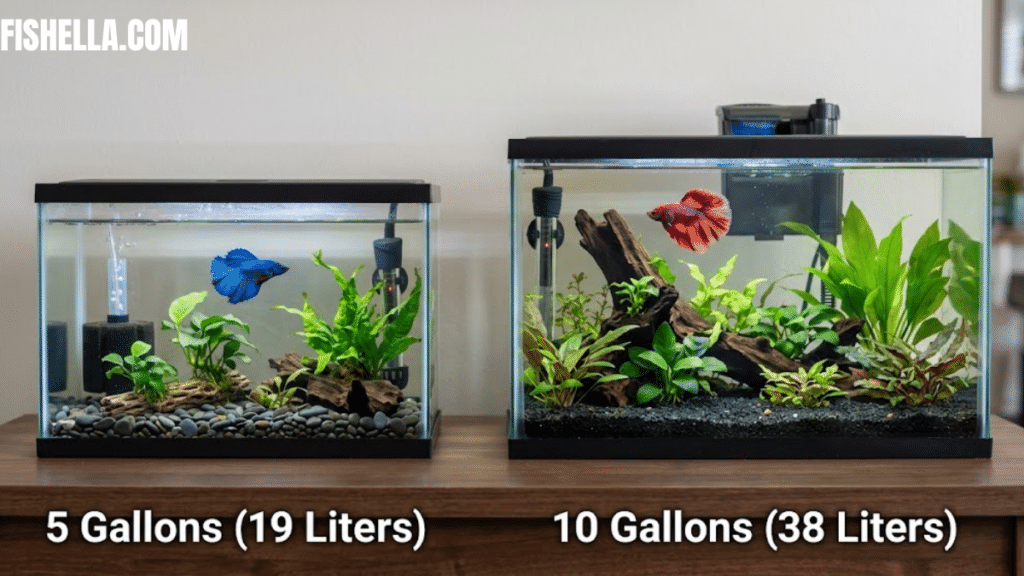
Choosing the right tank is one of the first decisions you make when bringing home a betta fish. Many beginners wonder whether a 5 gallon or 10 gallon tank is better.
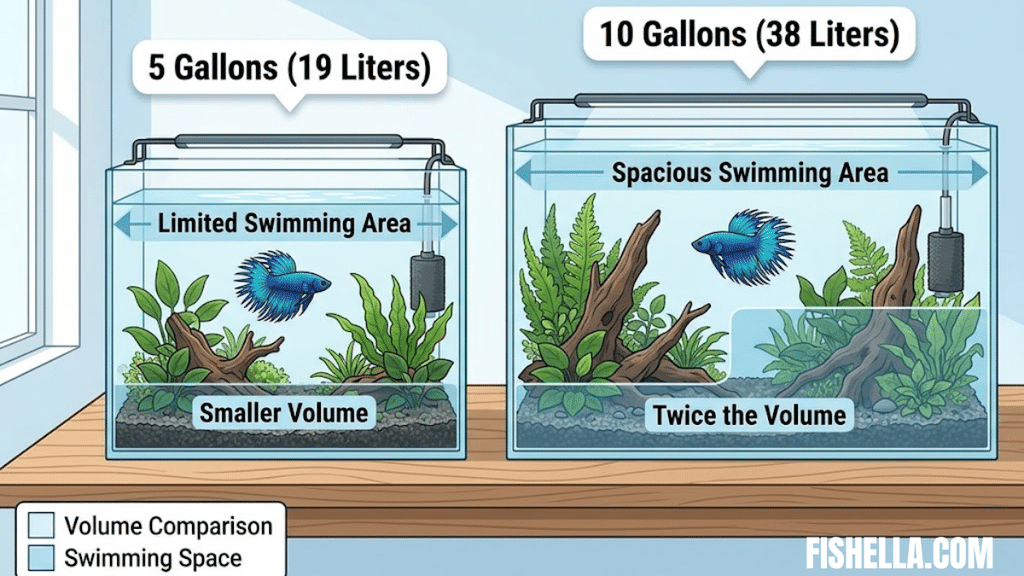
Both sizes can work for a single betta when the aquarium is properly heated, filtered, cycled, and maintained. However, a 10 gallon tank gives your betta more swimming space and gives you a larger volume of water to work with.
In this guide, we will compare a 5 gallon vs 10 gallon tank for betta fish and explain the main differences in setup, water quality, maintenance, space, and tank mates.
Why Tank Size Matters for Betta Fish
Bettas are small fish, but that does not mean they should live in tiny containers. They need clean, warm, stable water and enough space to swim, explore, rest, and move around decorations.
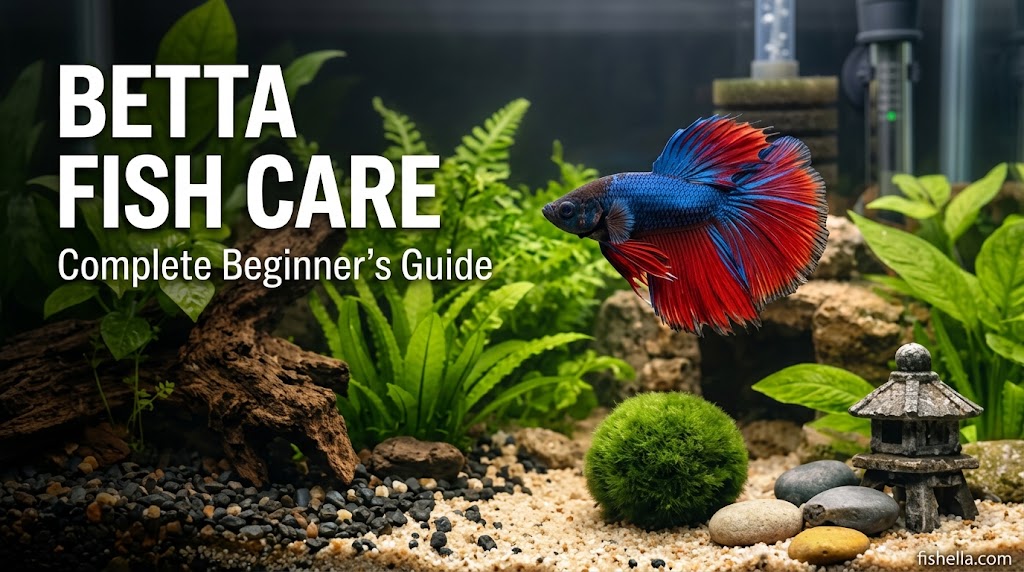
Bettas also come from shallow, slow-moving freshwater environments with vegetation and cover. A good aquarium should give them open swimming space as well as safe places to rest and hide. This comparison is part of our bigger guide on the best tank size for betta fish.
Tank size also affects water stability. A larger volume of water generally changes more slowly when there is a small amount of waste, uneaten food, or a temperature change. This does not replace good maintenance, but it can make the aquarium more forgiving for beginners.
Is There a Betta Fish Gallon Rule?
There is no single universal “betta fish gallon rule” that every fish-care organization follows.
Current care sources give different minimum recommendations, but 5 gallons is a commonly recommended starting point for a single betta. Some sources recommend 5–10 gallons as an ideal range, while others list smaller minimum habitats.
For a beginner, the important thing is not just the number of gallons. The aquarium should be fully cycled, heated, filtered with gentle flow, and maintained with regular water testing and water changes.
If you have room and budget for a 10 gallon tank, the extra water volume and swimming space can make the setup easier to manage. If you are considering a smaller aquarium, read our guide on whether a 2.5 gallon tank is good for a betta fish.
5 Gallon Betta Tank: Pros and Cons
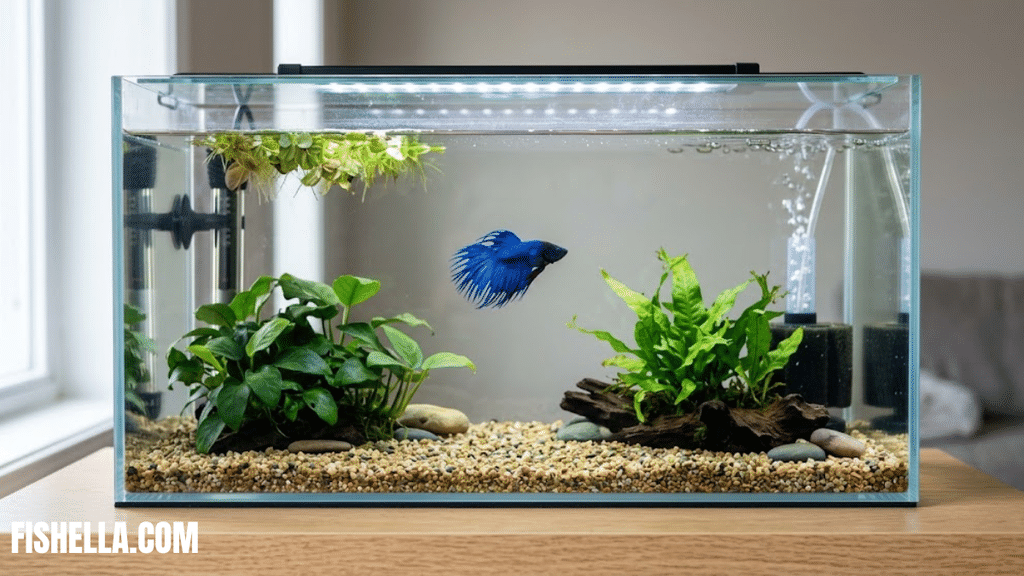
A 5 gallon betta tank is a popular choice for keeping one betta. It gives the fish much more usable space than a bowl or very small container while still being fairly easy to fit into a home.
Setup Basics
A 5 gallon aquarium should have a secure lid, heater, thermometer, gentle filter, water conditioner, and decorations with smooth edges.
Choose a filter with adjustable or gentle flow. Bettas can struggle against strong currents, especially those with long fins. A sponge filter or another low-flow option can work well.
The heater should be appropriate for the room temperature and aquarium size. Always use a thermometer because the heater setting does not always match the actual water temperature.
Water Stability
Five gallons provides a reasonable amount of water for one betta, but problems can still develop quickly if the aquarium is overfed or poorly maintained.
The tank should be cycled before adding the fish. Beneficial bacteria help process ammonia and nitrite through the nitrogen cycle. Ammonia and nitrite should be kept at 0 mg/L in an established aquarium.
A 5 gallon tank is therefore not a “set it and forget it” aquarium. Regular testing and maintenance are still important.
Maintenance
A single betta has a relatively small bioload, but fish waste, uneaten food, and decaying plant material still affect water quality.
Test the water regularly, watch your fish, and perform partial water changes based on your tank’s condition and test results. There is no single water-change percentage that is perfect for every aquarium.
Limitations
The main limitation of a 5 gallon tank is space.
You have less room for large decorations, dense plants, or possible tank mates. It can also be less forgiving than a larger aquarium if something goes wrong with water quality.
Still, a properly maintained 5 gallon aquarium can be a good home for a single betta.
10 Gallon Betta Tank: Pros and Cons

A 10 gallon tank gives your betta more room while also giving you more flexibility when designing the aquarium.
More Swimming Space
The extra space allows your betta to explore different areas of the tank. You can create open swimming areas while adding plants, caves, driftwood, or other safe decorations.
A 10 gallon tank can also provide more usable floor space if you choose a longer, rectangular aquarium.
Better Water Stability
One of the biggest advantages of a 10 gallon tank is water volume.
A small amount of waste has less impact when it is diluted in a larger volume of water. Temperature and water chemistry can also be more stable, although regular maintenance is still necessary.
Larger tanks are generally easier to keep stable because changes happen more gradually.
More Enrichment Options
A 10 gallon aquarium gives you more space for live plants, hiding places, resting areas, and open swimming space.
This lets you create a more interesting environment without filling the entire tank with decorations.
Make sure plants and decorations do not have sharp edges that could damage delicate betta fins.
More Flexibility
A 10 gallon aquarium can give you more options if you are considering carefully selected tank mates.
However, bigger does not mean every betta will accept tank mates. Male bettas can be territorial, and individual personality matters. Never keep two male bettas together.
Cost and Space
The biggest disadvantages are usually cost and physical space.
A 10 gallon tank needs more water, more substrate, and potentially more decorations. It may also require a larger stand or more room in your home.
For many beginners, however, the extra space is worth considering because it gives more room for a stable and attractive setup.
5 Gallon vs 10 Gallon Betta Tank: Side-by-Side Comparison
| Feature | 5 Gallon Tank | 10 Gallon Tank |
|---|---|---|
| Space for one betta | Good | Excellent |
| Water stability | Good with proper care | Generally more forgiving |
| Swimming space | Moderate | More generous |
| Decoration options | Good | More flexible |
| Plant options | Good | More room |
| Maintenance | Manageable | Can be easier to keep stable |
| Tank mate flexibility | Limited | More possibilities, but compatibility still matters |
| Space required | Less | More |
| Initial cost | Usually lower | Usually higher |
| Beginner friendly | Yes | Yes |
The biggest difference is not that one size makes a betta healthy and the other does not. Both can work when properly maintained. The 10 gallon simply gives you more room and a larger water volume to manage.
Water Quality and Filtration Differences
Water quality is one of the most important parts of betta fish care.
Fish release ammonia into the water, and beneficial bacteria help convert ammonia into nitrite and then nitrate. Ammonia and nitrite are toxic to fish, so a healthy biological filter is essential.
A 10 gallon tank has an advantage because it contains twice the water volume of a 5 gallon tank. This can make some changes in water chemistry less sudden.
However, a 5 gallon tank can still have excellent water quality when it is properly cycled and maintained. For a broader guide to aquarium care, see our complete Betta Fish Care guide, including temperature, feeding, filtration, and water changes.
For either aquarium:
- Keep ammonia at 0 mg/L.
- Keep nitrite at 0 mg/L.
- Monitor nitrate regularly.
- Test pH and temperature.
- Use conditioned tap water.
- Avoid overfeeding.
- Keep the filter running.
- Use gentle water flow.
Merck Veterinary Manual recommends regular monitoring of important aquarium parameters such as temperature, pH, ammonia, nitrite, and nitrate.
For more information about aquarium water quality and the nitrogen cycle, see the Merck Veterinary Manual’s aquarium fish guidance.
Does Tank Size Affect Betta Happiness?
It is better to focus on observable health and natural behavior than trying to measure “happiness” directly.
A healthy betta should normally show interest in its surroundings, eat well, swim normally, and use different areas of the aquarium.
A larger tank gives the fish more space for movement and gives you more room to create hiding and resting areas. But tank size alone does not guarantee good health.
Water quality, temperature, filtration, diet, tank design, and stress levels all matter.
A poorly maintained 10 gallon aquarium can be worse for a betta than a well-maintained 5 gallon aquarium.
Tank Mates and Community Options
A 5 gallon tank is usually best kept as a single-betta setup.
A 10 gallon tank gives you more space to consider compatible tank mates, but this should be approached carefully.
Bettas have individual personalities. Some may tolerate peaceful tank mates, while others may chase or attack them. Avoid putting a betta with aggressive or fin-nipping fish.
Never place two male bettas together. Their territorial behavior can lead to serious injury or death.
If you want a community aquarium, research each species’ adult size, behavior, water requirements, and space needs before adding anything.
Which Tank Size Should You Choose?
If you are deciding between a 5 gallon and 10 gallon tank, consider your available space, budget, and care routine.
Choose a 5 gallon tank if:
- You want to keep one betta.
- You have limited space.
- You want a smaller aquarium.
- You are comfortable testing and maintaining the water.
- You want a simple betta-only setup.
Choose a 10 gallon tank if:
- You have enough room for a larger aquarium.
- You want more swimming space.
- You want more room for plants and decorations.
- You want greater water volume and stability.
- You may eventually explore a carefully planned community setup.
For many beginners, a 5 gallon tank is a practical starting point, while a 10 gallon tank provides more room and flexibility.
Tips for Setting Up Either Tank Size

Whether you choose 5 gallons or 10 gallons, focus on the basics. If your betta or other aquarium fish suddenly becomes sick or starts dying, our guide on why fish may be dying can help you check common problems such as water quality and tank conditions.
1. Cycle the Aquarium
Do not rush the nitrogen cycle. Beneficial bacteria need time to establish in the filter and aquarium.
Fishless cycling is a useful approach because it allows the biological filter to develop before the fish is added.
2. Use a Heater and Thermometer
Bettas are tropical fish and need warm, stable water. A commonly recommended range is around 76–81°F, although exact recommendations vary slightly between care sources.
Use a thermometer to check the actual temperature.
3. Use Gentle Filtration
The filter should provide biological filtration without creating a strong current.
If your betta is constantly fighting the current or struggling to swim, reduce the flow if possible.
4. Add Safe Plants and Hiding Places
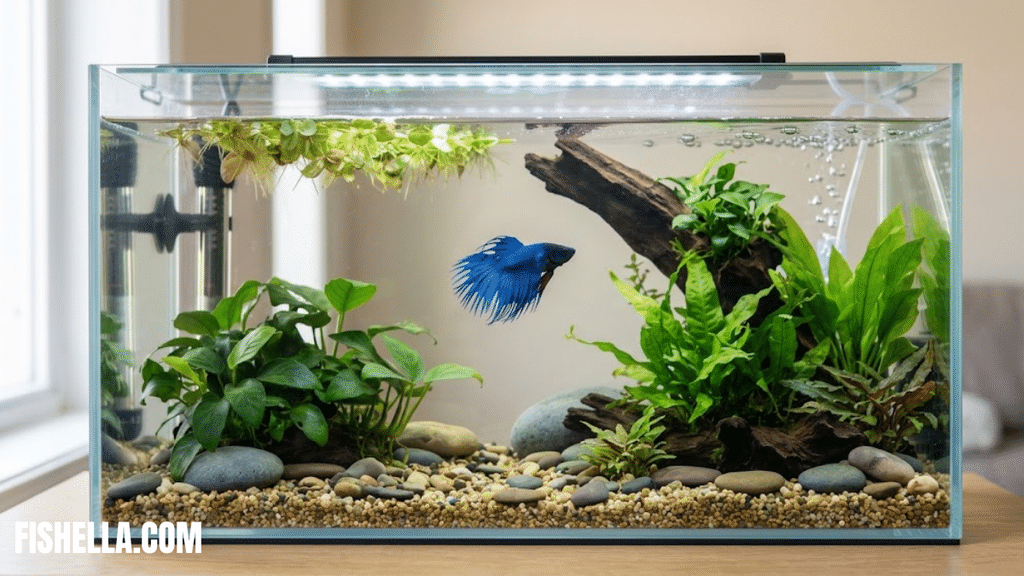
Plants and decorations can provide cover and resting areas.
Choose smooth decorations without sharp edges. Leave enough open space for your betta to swim freely.
5. Test the Water
Regular water testing helps you find problems before they become serious.
Pay particular attention to ammonia and nitrite, especially during the first several weeks after setting up a new aquarium. New tank syndrome can occur when the biological filter has not fully developed.
6. Perform Regular Maintenance
Do not wait until the water looks dirty before checking it.
Remove uneaten food, monitor the filter, clean algae when needed, and perform appropriate partial water changes.
Conclusion
When comparing a 5 gallon vs 10 gallon tank for betta fish, both can be suitable for a single betta when properly set up and maintained.
A 5 gallon tank offers a practical amount of space for one betta and is easier to fit into many homes. A 10 gallon tank gives your fish more room to explore and gives you more water volume, planting space, and flexibility.
A bigger tank does not automatically mean a healthier or longer-lived betta. Good water quality, stable temperature, proper filtration, a cycled aquarium, safe decorations, and consistent care are what matter most.
If you have enough room and budget, a 10 gallon tank can be an excellent choice. If you prefer a smaller setup, a well-maintained 5 gallon betta tank can also provide a good home for one betta.
Frequently Asked Questions
What is the minimum tank size for a betta?
Recommendations vary between sources, but 5 gallons is a commonly recommended starting size for a single betta. Some veterinary and aquarium-care sources list smaller minimums, while recommending larger tanks for better space and water stability.
Can betta fish live happily in a 5 gallon tank?
Yes. A properly heated, filtered, cycled, and maintained 5 gallon tank can provide a suitable home for one betta. Give your fish clean water, gentle filtration, safe decorations, and enough open swimming space.
Do bettas need a heater and filter?
A heater is important for keeping betta water warm and stable, especially when room temperature is below the desired range. A gentle filter helps remove waste and supports beneficial bacteria, but avoid strong water flow.
How often should I do water changes?
There is no single schedule that works for every betta aquarium. Water changes depend on tank size, stocking, filtration, feeding, plants, and water-test results. Regular testing can help you decide when maintenance is needed.
Can I add tank mates in a 10 gallon tank?
Possibly, but a 10 gallon tank does not guarantee compatibility. Betta personality varies, and some fish may be chased or attacked. Research each potential tank mate and provide enough space and hiding areas before adding another fish. Never keep two male bettas together.
Is a 10 gallon tank better than a 5 gallon tank for a betta?
A 10 gallon tank provides more swimming space and water volume, which can make the aquarium more flexible and forgiving. However, a well-maintained 5 gallon tank can also be suitable for one betta. The quality of care matters more than simply choosing the larger number.
What temperature should a betta tank be?
A common target is around 76–81°F. Use a reliable aquarium thermometer to check the actual water temperature and keep it stable rather than relying only on the heater setting.
Does a bigger tank make bettas live longer?
Tank size by itself does not guarantee a longer lifespan. A suitable aquarium combined with stable water quality, proper temperature, nutrition, filtration, and regular maintenance can support good health and normal lifespan.
Pingback: Best Tank Size for Betta Fish: A Beginner's Guide (2026)
Pingback: Betta Fish Tank Mates: 11 Fish That Can Live with a Betta
Pingback: Fish Care Guide: Everything You Need for Healthy Fish