
Affiliate Disclosure: This article contains affiliate links. As an Amazon Associate, Fishella earns from qualifying purchases. We may earn a commission when you buy through these links, at no additional cost to you.
Choosing the Best Saltwater Aquarium Heater is essential for maintaining a stable temperature in your marine aquarium. Saltwater fish, corals, and other reef inhabitants can become stressed when water temperature fluctuates. A reliable heater helps maintain consistent conditions, while proper wattage, corrosion-resistant materials, and accurate temperature control keep your aquarium environment stable.
Choosing the right heater involves more than matching wattage to tank size. You should also consider corrosion resistance, thermostat accuracy, overheating protection, and whether the heater includes an independent temperature controller.
In this guide, you’ll learn how to choose a saltwater aquarium heater, compare two titanium options, understand their pros and cons, and avoid common heating mistakes.
Do Saltwater Aquariums Need a Heater?
Most indoor saltwater aquariums need a heater to maintain a stable temperature, especially when room temperatures fluctuate.
Marine fish and reef organisms are sensitive to sudden environmental changes. A cold room, air-conditioning system, or seasonal temperature drop can lower aquarium temperature and create unnecessary stress.
A suitable heater helps you:
- Maintain a consistent water temperature.
- Reduce temperature fluctuations during colder weather.
- Support the temperature requirements of marine fish and corals.
- Keep aquarium conditions more predictable.
However, not every saltwater aquarium needs additional heating throughout the year. If your room consistently maintains the appropriate aquarium temperature, you may not need a heater running continuously.
Important: A heater maintains temperature; it does not correct poor water quality, unsuitable salinity, or other aquarium problems.
What Temperature Should a Saltwater Aquarium Be?
Many tropical marine aquariums are maintained around 75–80°F (24–27°C). However, the correct temperature depends on the fish, corals, invertebrates, and other organisms you keep.
For a typical tropical reef aquarium, many aquarists choose a target around 77–78°F (25–26°C).
The most important factor is consistency. Avoid making sudden temperature adjustments unless you are correcting an unsafe condition.
Before setting your heater, check the temperature requirements of every species in your aquarium. Some marine animals have different environmental needs.
How to Choose the Best Saltwater Aquarium Heater
A good marine aquarium heater should offer reliable temperature control, appropriate wattage, and materials that can withstand saltwater conditions.
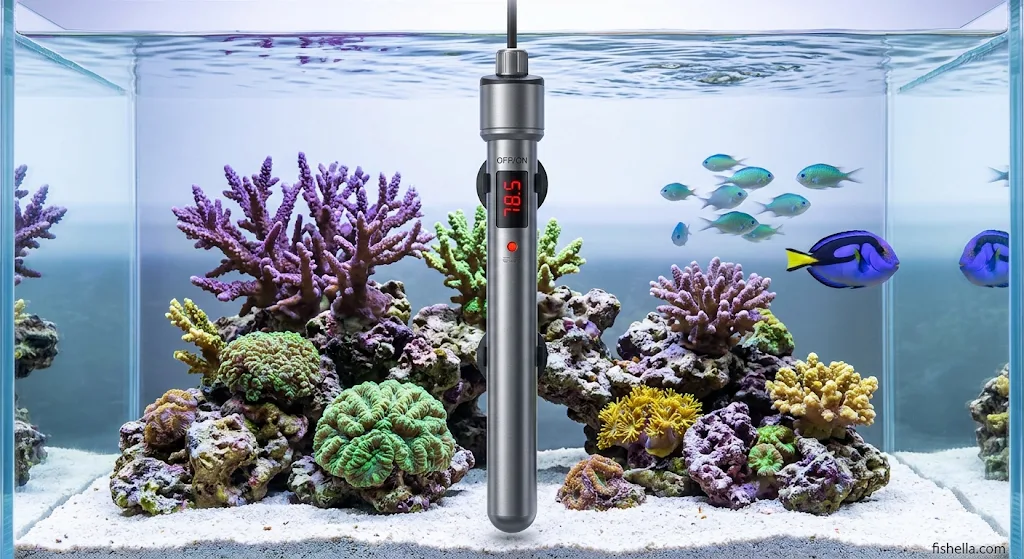
Consider these features before buying.
1. Choose a Saltwater-Compatible Heater
Saltwater can corrode materials that are not designed for marine environments. Therefore, check the manufacturer’s specifications before purchasing a heater.
Titanium heating elements are a popular choice for marine aquariums because titanium offers strong corrosion resistance and does not use a fragile glass heating tube.
However, don’t assume every titanium heater is automatically suitable for saltwater. Confirm that the manufacturer specifically approves the model for marine use.
2. Select the Correct Wattage
Heater wattage depends on aquarium volume, room temperature, and the difference between room and target water temperature.
A common starting estimate is around 3–5 watts per gallon, but this is not a universal rule. A tank in a cold room may need more heating capacity than one in a warm room.
Use the manufacturer’s recommended aquarium-size range as your starting point.
| Aquarium size | Approximate starting wattage |
|---|---|
| 10 gallons | 50W |
| 20 gallons | 75–100W |
| 30 gallons | 100–150W |
| 40 gallons | 150–200W |
| 55 gallons | 200–250W |
| 75 gallons | 250–300W |
These are planning estimates, not guaranteed heater requirements. Actual needs depend on room temperature, insulation, tank dimensions, and equipment.
For larger aquariums, two appropriately sized heaters placed in different areas can distribute heat more evenly and provide some backup if one unit fails. Both heaters still need suitable temperature control.
3. Choose an Accurate Temperature Controller
A thermostat switches the heater on and off to maintain its set temperature. A separate temperature controller can provide another layer of control.
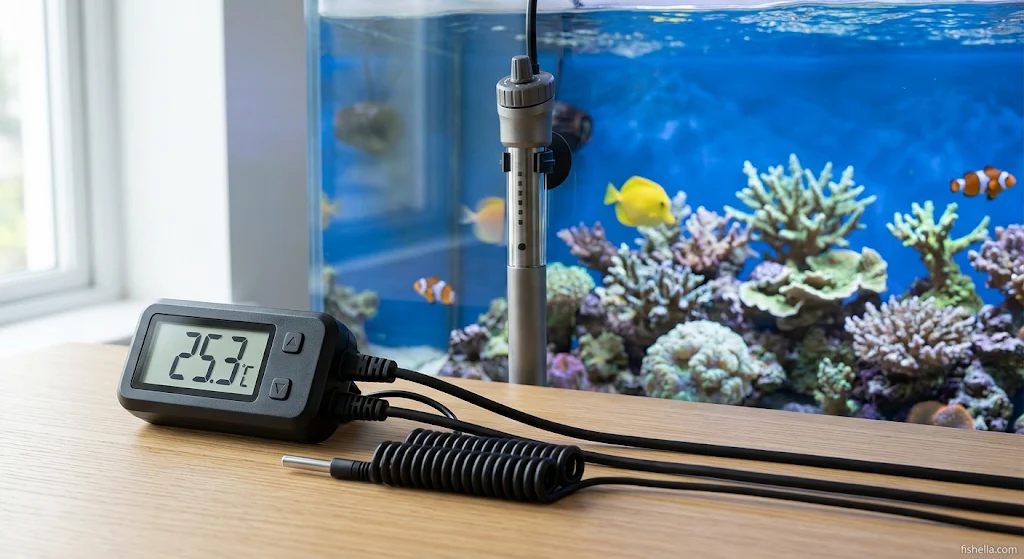
Look for:
- A clear temperature display.
- Adjustable temperature settings.
- A reliable temperature sensor.
- Overheating protection.
- An alarm or shutdown feature, if available.
A heater’s displayed temperature is not a substitute for an independent aquarium thermometer. Check the actual water temperature regularly.
4. Titanium Aquarium Heater vs. Glass Aquarium Heater
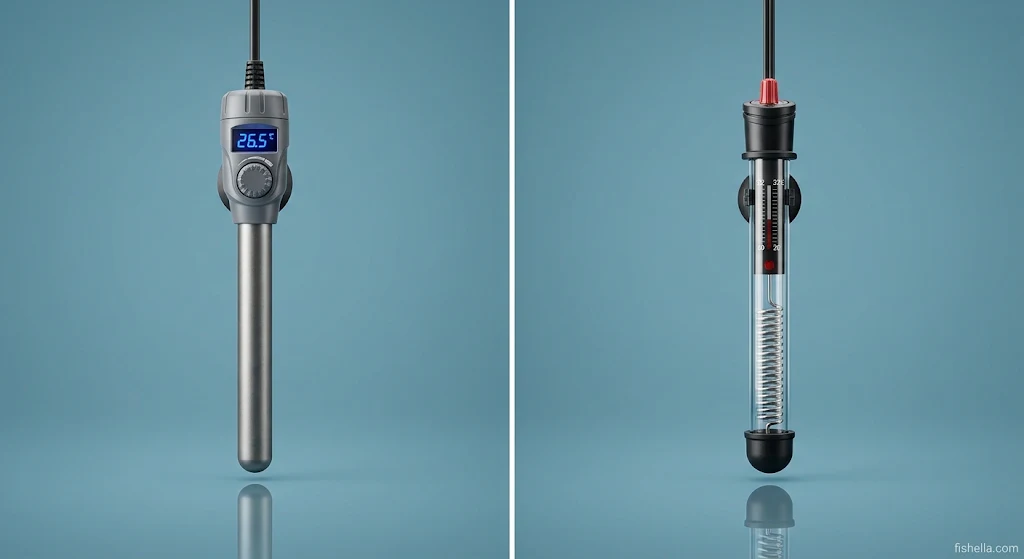
Both materials can be used in aquarium heaters, but they have different characteristics.
| Feature | Titanium heater | Glass heater |
|---|---|---|
| Corrosion resistance | High when marine-rated | Depends on construction |
| Breakage risk | No glass heating tube | Glass can crack |
| Saltwater use | Many models are designed for it | Only use models approved for marine tanks |
| Temperature control | Often paired with external controllers | Usually built-in thermostat |
| Cost | Often higher | Often lower |
Which is better for saltwater?
A marine-rated titanium heater is a strong option if you want a corrosion-resistant heating element and an external controller. A glass heater can also work if its manufacturer approves it for saltwater and it has suitable safety features.
Best Saltwater Aquarium Heaters: Product Comparison
If you’re comparing heaters for a marine aquarium, the following two titanium options are worth considering because their manufacturers explicitly describe them as suitable for saltwater use.
This is a specification-based comparison, not a laboratory test or personal performance ranking.
| Product | Main feature | Best suited for |
|---|---|---|
| hygger HG802 Titanium Aquarium Heater | External digital controller and titanium tube | Marine aquariums needing adjustable wattage |
| hygger HG085 Titanium Aquarium Heater | Titanium tube with temperature probe and digital controller | Aquarists wanting an external temperature display |
1. hygger HG802 Titanium Aquarium Heater
Best for: Saltwater aquariums needing an external digital controller
The hygger HG802 is a titanium aquarium heater designed for freshwater and saltwater use. It uses a titanium heating tube and an external digital temperature controller.
The manufacturer lists several wattage options, including 50W, 100W, 200W, and 500W. Its published aquarium-size recommendations vary by wattage.
Key features:
- Titanium heating tube.
- External digital temperature controller.
- Temperature display.
- Adjustable temperature settings.
- Designed for freshwater and saltwater aquariums.
- Multiple wattage options.
Pros
- Titanium construction reduces the risk of glass breakage.
- Manufacturer explicitly lists saltwater compatibility.
- External controller makes temperature adjustments easier.
- Multiple wattages accommodate different aquarium sizes.
Cons
- Requires proper installation of the controller and heater.
- The heating tube and temperature sensor must be installed according to the manual.
- It is not suitable for every aquarium material or setup; check the manufacturer’s restrictions.
- You still need a separate thermometer to verify water temperature.
Who should consider it?
This model is worth considering if you want a titanium heater with an external controller and a wattage option that matches your marine aquarium.
Check the hygger HG802 specifications
Amazon affiliate placement: Add your exact HG802 model and wattage affiliate link here after confirming the listing matches the manufacturer’s specifications.
2. hygger HG085 Titanium Aquarium Heater
Best for: Aquarists who prefer a separate temperature probe
The hygger HG085 is another titanium heater designed for freshwater and saltwater aquariums. It includes an external digital controller and temperature probe.
The manufacturer lists wattage options from 50W to 500W, depending on the model. Its recommended aquarium sizes differ between wattage versions, so select the correct one for your tank.
Key features:
- Titanium heating tube.
- External digital temperature controller.
- Separate temperature probe.
- Adjustable temperature settings.
- Temperature calibration function.
- Manufacturer-listed saltwater compatibility.
Pros
- Titanium construction is suitable for marine use according to the manufacturer.
- External probe measures water temperature away from the heating element.
- Digital controller makes temperature adjustments convenient.
- Multiple wattage options are available.
Cons
- The probe needs correct positioning and installation.
- Temperature accuracy should be checked against a separate thermometer.
- The heater requires more installation components than a basic preset model.
- The selected wattage must match your aquarium and room conditions.
Who should consider it?
Consider the HG085 if you prefer an external temperature probe and want to monitor and adjust the heater without relying on a simple preset control.
Check the hygger HG085 specifications
Amazon affiliate placement: Add your exact HG085 model and wattage affiliate link here after confirming the listing matches the manufacturer’s specifications.
What Are the Pros and Cons of Titanium Saltwater Aquarium Heaters?
Titanium heaters offer several advantages for marine aquarium owners, but they are not perfect for every setup.
Advantages
- Corrosion resistance: Marine-rated titanium heating elements are designed to handle saltwater conditions.
- Shatter resistance: They avoid the fragile glass heating tube found in traditional glass heaters.
- External controls: Many models include a separate controller for temperature adjustments.
- Wattage choices: Different models are available for small and large aquariums.
Disadvantages
- Higher initial cost: Some titanium models cost more than basic glass heaters.
- Installation requirements: External controllers and probes need correct positioning.
- Not automatically fail-proof: A thermostat or controller can still malfunction.
- Compatibility matters: Always check the exact model’s marine rating and installation restrictions.
How to Install a Saltwater Aquarium Heater Safely
Correct installation helps distribute heat evenly and reduces avoidable equipment problems.
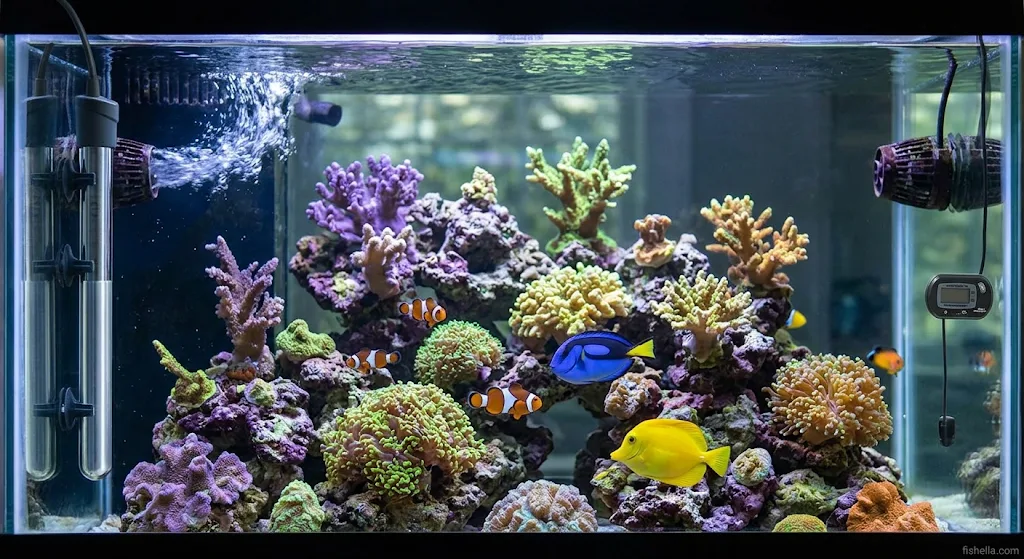
Follow these steps:
- Read the manufacturer’s instructions before installation.
- Choose a location with good water circulation.
- Keep the heater submerged to the depth specified by its manufacturer.
- Position the temperature probe correctly if your model uses one.
- Keep the heater away from direct contact with sand, rocks, and decorations.
- Use a separate thermometer on the opposite side of the aquarium.
- Check the water temperature before making further adjustments.
For more detailed placement instructions, read our guide on how to place an aquarium heater correctly.
Electrical safety: Keep electrical connections dry, use a drip loop, and connect aquarium equipment to an appropriately protected electrical circuit. Never handle a powered heater in the water.
Why Does a Saltwater Aquarium Heater Stop Working?
A heater may stop heating or fail to maintain the correct temperature for several reasons.
Incorrect Wattage
A heater with insufficient wattage may struggle to maintain the target temperature, especially in a cold room.
Solution: Check the heater’s recommended aquarium size and compare it with your actual tank conditions.
Faulty Thermostat
A damaged thermostat may switch the heater off too early or allow the water to become too warm.
Solution: Compare the heater’s reading with an independent thermometer. Replace faulty equipment rather than relying on an unreliable thermostat.
Poor Water Circulation
Water near the heater may become warmer than water elsewhere in the aquarium.
Solution: Position the heater near an area of suitable water movement and check the temperature at the opposite end of the tank.
Saltwater Corrosion or Equipment Damage
A heater that is not designed for marine use may deteriorate over time.
Solution: Choose equipment with explicit saltwater compatibility and inspect it regularly for damage.
Power Interruption
A power outage can stop heating and cause the aquarium temperature to fall.
Solution: Consider a backup power plan appropriate for your aquarium and monitor temperature during extended outages.
How to Maintain a Saltwater Aquarium Heater
Regular inspection helps you identify problems before they affect your aquarium.
- Check the aquarium temperature daily.
- Inspect the heater and cable for visible damage.
- Check the controller and probe for correct operation.
- Clean salt deposits according to the manufacturer’s instructions.
- Unplug the heater before maintenance.
- Allow it to cool as directed before removing it from the water.
- Replace damaged or unreliable equipment.
When performing a water change, switch off the heater before lowering the water level. Follow the cooling instructions before exposing or removing it. Our guide explains how to do a water change without removing fish.
Frequently Asked Questions
What is the best heater for a saltwater aquarium?
A marine-rated titanium heater with reliable temperature control is a strong choice. The best model depends on aquarium size, room temperature, wattage requirements, and safety features.
Can I use a freshwater aquarium heater in saltwater?
Only if the manufacturer explicitly approves the exact model for saltwater use. Do not assume that every freshwater heater is suitable for a marine aquarium.
Are titanium aquarium heaters better for saltwater?
Titanium heaters are popular because titanium resists corrosion and does not use a fragile glass heating tube. However, the controller, sensor, and overall product design also matter.
What wattage heater do I need for a 30-gallon saltwater aquarium?
A 100W–150W heater is a reasonable starting range for many 30-gallon aquariums. The correct choice depends on room temperature and the amount of heating required.
Should I use two heaters in a saltwater aquarium?
Two appropriately sized heaters can distribute heat more evenly in a larger aquarium and provide some backup if one fails. Use suitable independent temperature control and monitor the aquarium closely.
Can a saltwater aquarium get too hot?
Yes. A faulty heater, warm room, direct sunlight, or equipment malfunction can raise aquarium temperature. Use a reliable thermometer and monitor the aquarium during hot weather.
Do reef tanks need a special heater?
Reef tanks need a heater that is approved for saltwater and suitable for the aquarium’s volume and temperature requirements. A marine-rated titanium model with an external controller is one option.
Final Verdict: Which Saltwater Aquarium Heater Should You Choose?
A suitable saltwater aquarium heater should provide stable heating, marine-compatible construction, and reliable temperature control.
The hygger HG802 is worth considering if you want a titanium heating tube with an external digital controller. The hygger HG085 is another option if you prefer a separate temperature probe and digital adjustment.
Before buying, check the exact model, wattage, aquarium-size recommendation, electrical rating, and saltwater compatibility. Pair your heater with a separate thermometer and inspect the equipment regularly.
A reliable heater is important, but consistent monitoring is what helps you maintain a stable marine aquarium. For readers setting up a smaller freshwater tank, our guide to the Best Heater for a 5-Gallon Betta Tank explains how to choose the right heater and maintain a stable temperature for betta fish.
Pingback: Best Heater for 5 Gallon Betta Tank: 5 Top Picks